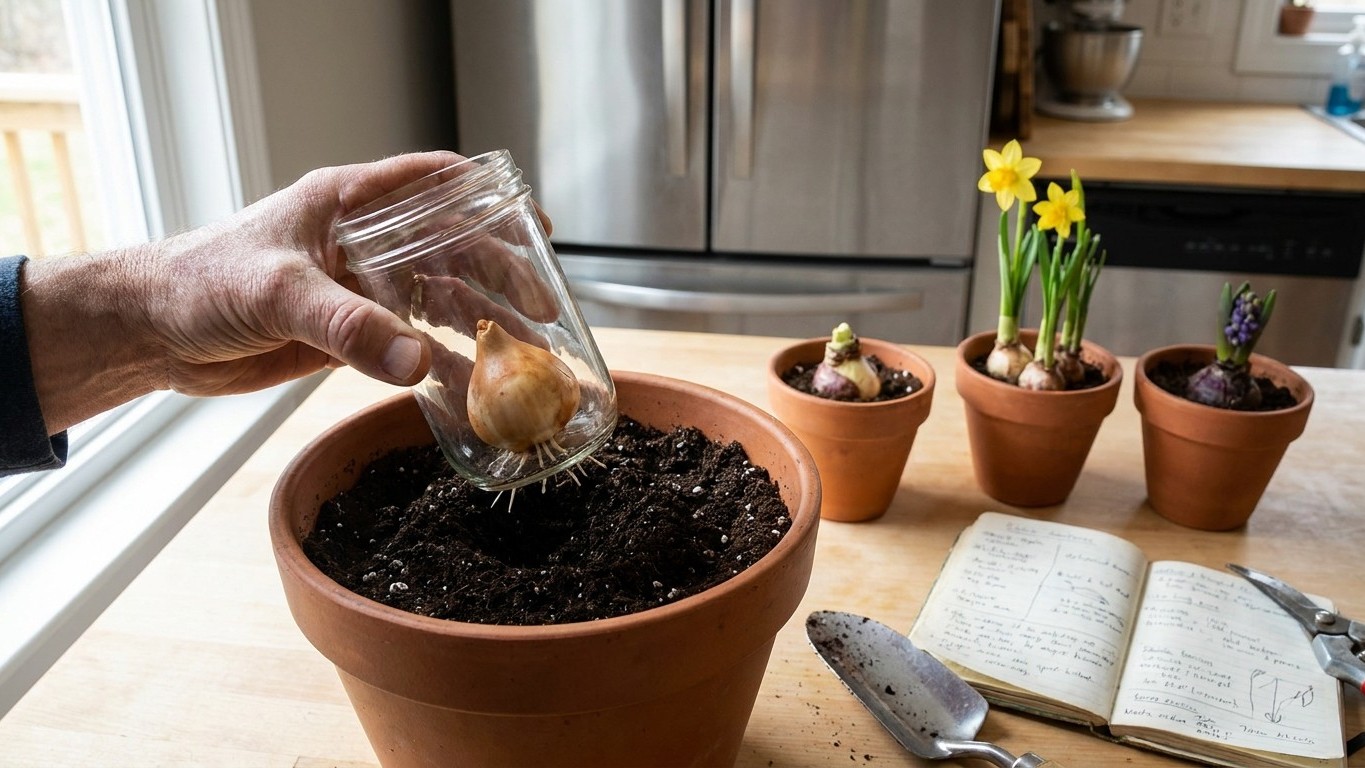

Forcing works in Louisiana because the state’s winters almost never deliver the sustained chill spring bulbs need to bloom on their own schedule. Tulips, hyacinths, and most daffodils require weeks of near-freezing temperatures before they’ll flower, and Louisiana’s mild winters don’t reliably provide that. The fix is straightforward: chill the bulbs yourself, in a refrigerator or unheated space, before potting them up indoors.
Why this matters in Louisiana

The average low during Louisiana’s coldest month, measured at the New Orleans reference station, sits at 46.1°F. That single number explains almost everything about why forcing is necessary here. Spring-flowering bulbs like tulips and most daffodils need roughly twelve to fourteen weeks of temperatures consistently below 45°F to complete the internal chemistry that lets them push up a flower stalk. When the coldest month of the year averages a low of 46.1°F, the ground and the outdoor air simply don’t stay cold enough, long enough, for that process to happen on its own.
This is different from the container-freezing problem that shows up in colder states. In places where winter ground freezes solid a foot or more down, a potted bulb left outside can freeze through entirely, roots and all, even when the same bulb would survive fine planted in a garden bed. That’s a hardiness mismatch between pot and ground. Louisiana isn’t that territory. With most of the state falling in USDA Hardiness Zones 8a through 10a (using the reference city of New Orleans for a dated example), hard, ground-freezing cold is rare and short-lived even in an unusually cold winter. The problem here isn’t that a pot gets too cold. It’s that nothing outdoors gets cold enough, for long enough, to satisfy a bulb’s chilling requirement.
That distinction changes what a gardener needs to do. In a genuinely cold state, forcing might mean protecting a potted bulb from freeze damage. In Louisiana, forcing means manufacturing the cold that winter won’t supply, using a refrigerator, a cooler, or occasionally an unheated interior space that happens to stay reliably below 45°F for months at a stretch. Skip this step and plant a tulip bulb straight into a Louisiana garden bed expecting spring color, and the most common result is a bulb that produces leaves, maybe, and no flower at all. The bulb isn’t dead. It just never received the signal it needed.
Gardeners transplanting habits from farther north often assume the mild climate is an advantage for bulb growing. For spring bulbs specifically, it’s the opposite. The same warmth that makes Louisiana pleasant for citrus and camellias is exactly what defeats a tulip’s chilling requirement, and it’s why forcing indoors, with an artificial cold source, has become the standard workaround rather than a niche technique.
How to do it here
Because ambient winter cold can’t be trusted to do the job, the entire method centers on a controlled cold source rather than anything happening outdoors on its own schedule. Here’s the sequence, in order:
- Buy pre-chilled bulbs, or plan to chill them yourself. Some mail-order suppliers sell bulbs already given their cold treatment. If buying local bulbs at a garden center, assume they have not been chilled and budget the full weeks below.
- Identify twelve to fourteen weeks on the calendar for chilling. Count backward from the date you want blooms indoors. This is the single biggest planning mistake gardeners make: starting the chill too late leaves no time for the bulb to complete it.
- Choose the refrigerator over the garage. An unheated Louisiana garage does not reliably stay below 45°F for twelve to fourteen consecutive weeks; a warm spell of even a few days can interrupt the chilling clock. A refrigerator crisper drawer holds a steady temperature and is the more dependable choice in this climate.
- Keep bulbs away from ripening fruit. Apples, bananas, and other ripening produce release ethylene gas, and ethylene damages or kills the flower bud forming inside a chilling bulb. Store bulbs in a separate drawer, in a paper bag with ventilation holes, never sealed in plastic with fruit.
- Pot the bulbs before or after chilling, not during. Many gardeners chill bulbs already potted in slightly moist soil, which also works in a refrigerator drawer as long as space allows.
- Check for root growth at the end of the chilling period. A small amount of white root showing at the base of the pot, or through drainage holes, signals the bulb is ready to bring into warmth and light.
- Move the pot to a cool, bright spot first, then warmer light. A sudden jump from refrigerator cold to a warm, sunny windowsill can stress the bulb. A few days in indirect light at room temperature eases the transition before full sun.
If you’re chilling potted bulbs and considering leaving them outdoors instead of in a refrigerator, the container-hardiness rule still applies as a general safeguard: a pot should be at least two hardiness zones hardier than the bulb calls for, or moved indoors and mulched during any unusual cold snap. In most of Louisiana this rarely becomes the limiting factor, since the bigger obstacle is getting enough cold in the first place, not protecting against too much of it.
Which bulbs are worth it
Not every bulb pays back the effort of a twelve-to-fourteen-week refrigerator commitment. Bulbs with short chilling requirements, sturdy short stems, and forgiving timing tend to reward Louisiana gardeners who force them. Bulbs with long chilling requirements, tall floppy stems, or a narrow blooming window tend to disappoint, no matter how carefully the steps above are followed.
Because most forced bulbs are treated as single-season purchases here anyway, spending the effort on a bulb that was never going to survive Louisiana’s summer heat and rebloom the next spring costs nothing extra in the long run. You’re not sacrificing a perennial. You’re getting one good bloom cycle from a bulb that would have struggled regardless.
- Paperwhite narcissus, which need no chilling at all and are effectively pre-adapted to this climate
- Hyacinths, which have a moderate chill requirement and short, sturdy stems well suited to indoor pots
- Crocus, small and quick to chill, ideal for a first attempt
- Muscari (grape hyacinth), compact and reliable indoors
- Miniature daffodils such as smaller-cupped varieties, which chill faster than standard trumpet types
- Tulips, which generally need the longest chilling period and produce tall stems that flop without staking in a pot
- Standard large-trumpet daffodils, whose height makes them top-heavy and prone to tipping indoors
- Late-season alliums, whose extended chill requirement makes the timing math difficult to fit into a Louisiana refrigerator schedule
What goes wrong, and when you can still fix it
Leaves come up, but no flower ever forms
This is the classic sign of insufficient chilling. The bulb had enough stored energy to push leaves but never received the full twelve to fourteen weeks below 45°F needed to trigger flower formation. There’s no fix this season. The bulb has used its reserves on foliage instead of bloom, and the only remedy is starting over with a fresh bulb and a longer, uninterrupted chilling period next time.
A flower appears, but on a stem too short to see it properly
This usually means the bulb was moved from cold storage into warmth and bright light too abruptly, or too early relative to its chilling schedule. The flower bud formed but didn’t have the gradual transition needed to elongate the stem normally. This one can’t be corrected once it happens; the bloom will still open, just low and compact. Note the timing for next season and add a few extra days of intermediate, cool, bright conditions before full warmth.
The bulb rots in its pot
Rot points to drainage, not cold. A pot without adequate drainage holes, or soil kept too wet during chilling or forcing, creates the moist, cool conditions rot organisms favor. Once a bulb has gone soft and rotted, it cannot be saved this season. For the next attempt, use a pot with real drainage and check soil moisture rather than keeping it consistently soaked throughout the chilling weeks.