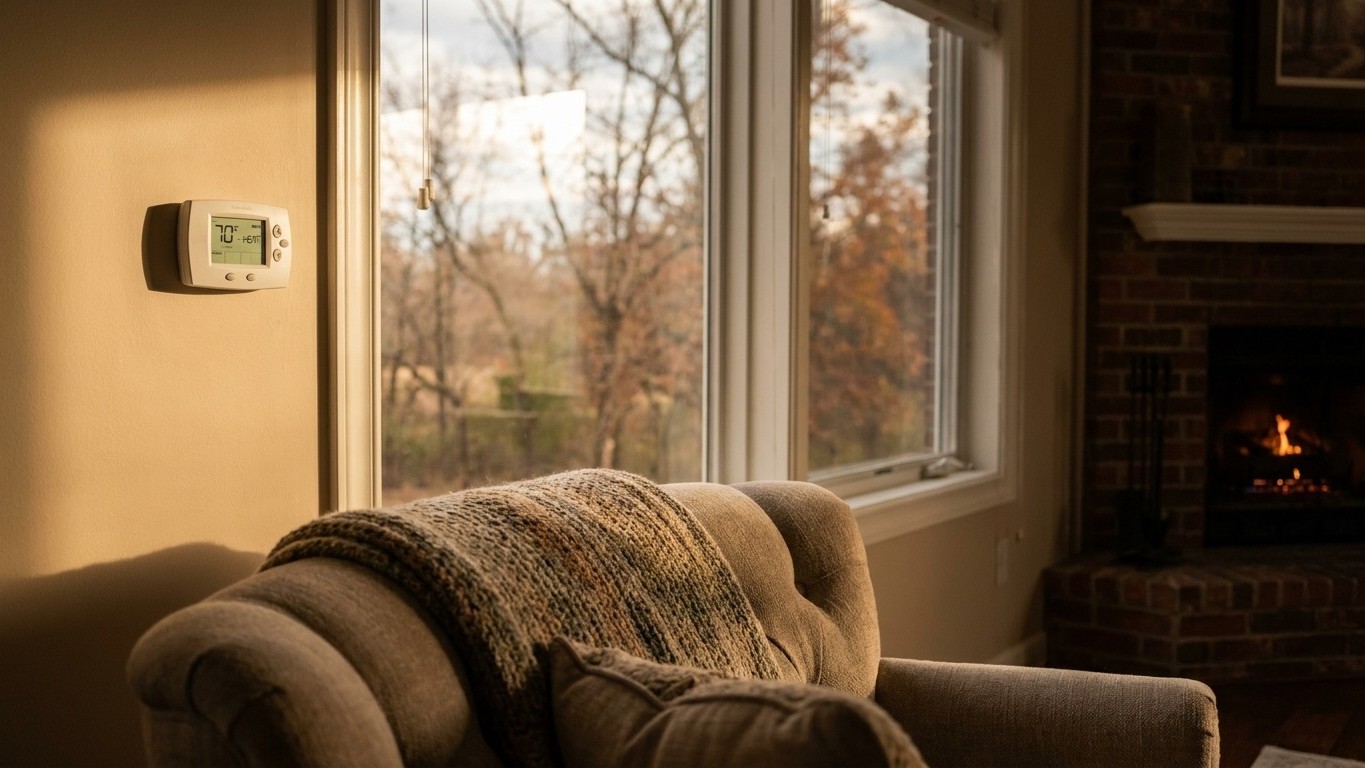

In Louisiana, heating demand doesn’t announce itself with a hard date. It builds slowly, starting in November when the region’s average temperature first dips below the comfort threshold that utilities and climatologists use to track heating need, then fades out again by spring. The real question isn’t a calendar day, it’s a pattern, and that pattern is worth looking at closely.
When the heating season starts in Louisiana

At New Orleans International Airport, the reference station for this part of the state, November is the first month where the average temperature (62.4°F) drops below the 65°F baseline that the National Oceanic and Atmospheric Administration uses to calculate heating degree days. That’s the technical marker of when homes start needing supplemental heat on a regular basis, not just on the occasional cool night. Demand builds through the winter and peaks in January, before easing back and disappearing entirely once April’s average climbs back above 65°F. All told, the heating season here runs about five months.
That’s a normal, built from thirty years of NOAA climate data. It tells you what a typical November looks like, not what this particular November will do. Cold fronts don’t check the calendar, and a hard freeze can show up in late October some years, long before the monthly average says it’s time.
The month-by-month breakdown below shows how the season actually unfolds, using heating degree days, a measure of how much and how long temperatures sit below that 65°F baseline. The table doesn’t include June through September, because none of those months register any heating degree days at this station. Cooling, not heating, runs the show there.
| Month | Heating Degree Days |
|---|---|
| January | 350 |
| February | 226 |
| March | 118 |
| April | 27 |
| May | 1 |
| October | 21 |
| November | 143 |
| December | 290 |
Numbers like these don’t require ranking or superlatives. They’re there to read, month by month, as a picture of how the season builds, holds, and lets go.
How hard the winter works here
New Orleans International Airport logs about 1,176 heating degree days a year, against roughly 3,206 cooling degree days over the same stretch. Heating degree days are essentially a proxy for fuel use: they tally up, day by day, how far below 65°F the average temperature falls. Double the degree days, and a house of the same size and construction burns roughly double the fuel to stay comfortable. A single house here, tracked over a winter, uses that logic to explain why some months barely register on a heating bill and others do.
What the annual figure alone can’t tell you is shape. A place can rack up its degree days over a long, mild stretch or cram them into a short, sharp one, and the yearly total looks identical either way. Louisiana’s monthly table above answers that question directly: the season here is long relative to how mild it runs, spreading modest heating need across five months rather than concentrating it into a brutal six-week stretch. That’s a very different experience for a furnace, and for a homeowner’s patience, than a short, punishing cold snap would be.
None of this compares meaningfully to heating figures from north of the border. Canadian degree-day counts use an 18°C base and a different averaging period, so lining them up against a U.S. figure counted on a 65°F base produces numbers that look comparable and aren’t. The only fair comparison is with another U.S. location measured the same way, or no comparison at all.
What most homes in Louisiana actually heat with
Federal survey data on how Louisiana households actually heat their homes shows a clear tilt toward one kind of system, with fuel choice split more than the equipment numbers might suggest.
| System or fuel | Share of homes |
|---|---|
| Furnace | 57% |
| Central heat pump | 21% |
| Steam or hot-water boiler | none reported |
| Natural gas | 33% |
| Electricity | 62% |
| Fuel oil or kerosene | none reported |
| Propane | not reported |
“None reported” and “not reported” aren’t the same as zero. The first means the survey turned up too few households heating that way to publish a reliable number; the second means an estimate existed but was judged too shaky to release. Neither is a statement that nobody in Louisiana uses boilers or fuel oil, just that the sample couldn’t confirm it with confidence.
The furnace’s dominance here reflects what got installed when these homes were built and what fuel was affordable at the time, not a verdict on what’s best for any single house today. A furnace paired with electric resistance heat, which the fuel numbers suggest is common, does a solid job of pushing warm air quickly through a home and responds fast to a thermostat change. What it struggles with is efficiency compared to a heat pump running the same electric supply, and it depends entirely on ductwork that’s often original to the house and rarely inspected. Skip filter changes on a furnace and you choke airflow, strain the blower motor, and can shorten the unit’s life by years. That’s the one maintenance item that quietly punishes neglect more than any other.
Run it once before you need it
Heating systems tend to fail on the first genuinely cold night of the year, exactly when every HVAC technician in the region is fielding the same emergency call. The fix is to test the system weeks ahead, sometime in October or early November, before the cold actually arrives. Here’s the order that matters, cheapest and fastest steps first:
- Turn the thermostat down, then up past the current room temperature, and listen for the system to kick on within a minute or two.
- Let it run a short cycle and listen for grinding, rattling, or a burning-dust smell. That smell on first firing is normal, it’s just dust burning off elements or a heat exchanger that sat unused for months, and it should clear within minutes.
- Check and replace the air filter if it’s dirty. A clogged filter is the single most common cause of poor airflow and short-cycling.
- Walk the house and clear anything blocking vents, radiators, or a heat pump’s outdoor unit. Furniture, curtains, and stored boxes all cut into airflow.
- Test every carbon monoxide alarm in the home. Combustion appliances that haven’t run in months are exactly the kind that can develop a leak, and a working alarm is the cheapest insurance against it.
- If the system won’t start, cycles constantly, or throws an error code, stop and call a licensed technician rather than troubleshooting further.
Even a system that passes every one of these checks can still be losing heat before it reaches a room. According to the U.S. Department of Energy, “in a typical house, about 20%-30% of the air that moves through the duct system is lost due to leaks, holes, and poorly connected ducts.” That’s not a flaw you can hear or smell during a test run, it shows up as a room that never quite warms up and a system that runs longer than it should to compensate.
What turning it down is actually worth
The Department of Energy puts a number on the payoff for actually using a thermostat setback instead of just having one. Its own words: “You can save as much as 10% a year on heating and cooling by simply turning your thermostat back 7-10°F for 8 hours a day from its normal setting.” That figure covers both heating and cooling combined over a full year, not a single winter month, and it’s not a per-degree formula that scales up or down with a bigger or smaller setback.
In a place where heating draws down over roughly five months, a setback earns its keep across a good stretch of the year, even if the days it works hardest are concentrated in December and January. A programmable or smart thermostat set to pull back automatically overnight or during work hours does the job without anyone having to remember to touch the dial, which matters most in a season where the coldest week can still arrive earlier than the monthly averages suggest.