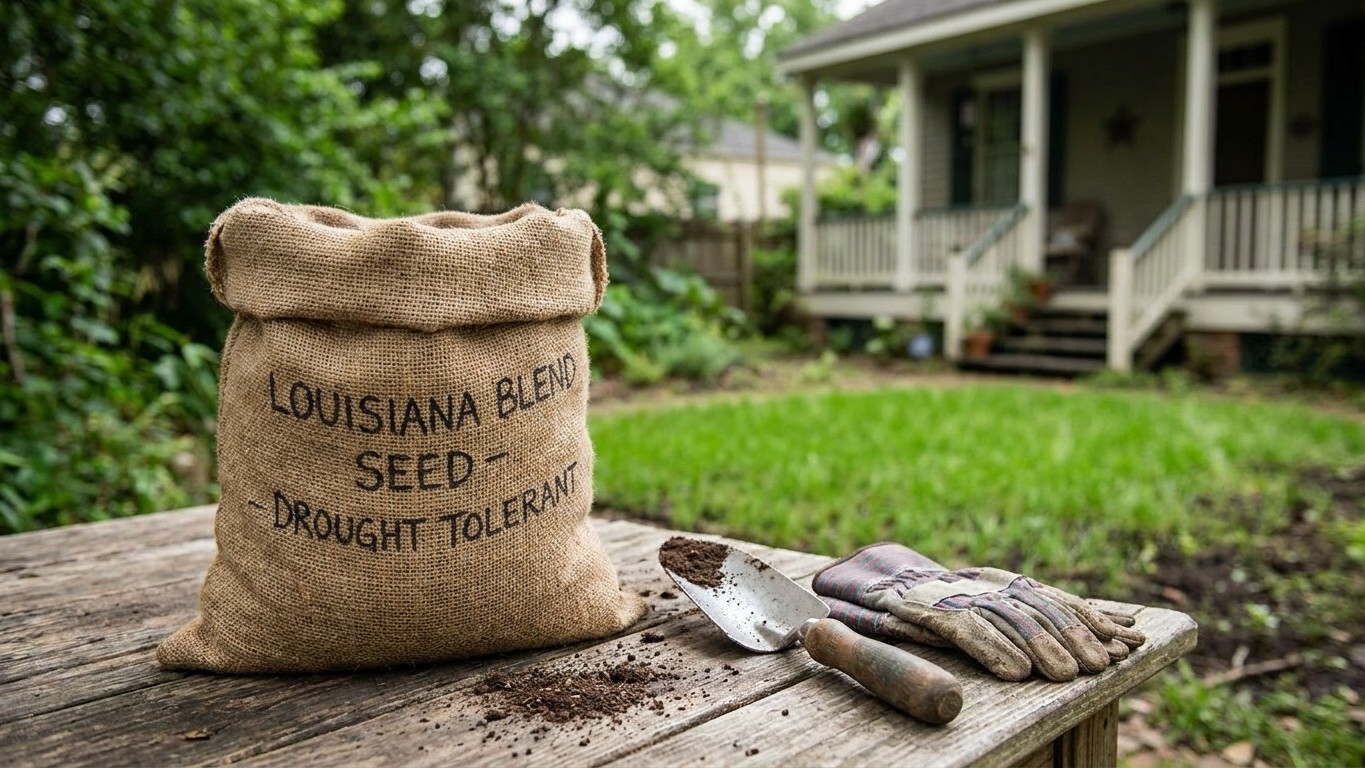

New Orleans summers set the standard here: brutal highs, mild winters, and a growing season that runs almost year-round. That climate alone knocks fescue, ryegrass and bluegrass off the table before you ever read a seed label, leaving seven true contenders for a Louisiana lawn — Bahiagrass, Bermudagrass, Carpetgrass, Centipedegrass, Seashore Paspalum, St. Augustinegrass and Zoysiagrass. Picking the right one from that short list comes down to your shade, your foot traffic and your soil, not the bag with the prettiest photo.
The short answer for Louisiana
Louisiana lawns belong to the warm-season turf zone almost everywhere in the state, based on the reference climate for New Orleans, days at or above 90°F and the mean daily minimum of the coldest month, read against the season tolerances Clemson Cooperative Extension publishes in HGIC 1214. That single fact rules out an entire aisle of grass seed before you even look at a bag. Fescue, ryegrass and bluegrass are cool-season species, and Louisiana’s summer heat kills them outright rather than merely slowing them down. The seven species HGIC 1214 lists for a warm zone are Bahiagrass, Bermudagrass, Carpetgrass, Centipedegrass, Seashore Paspalum, St. Augustinegrass and Zoysiagrass.
What decides which of the seven fits your yard
Which one is best for your yard depends on shade, traffic, soil pH and whether salt spray reaches your property. St. Augustinegrass tolerates more shade than Bermudagrass but wears out faster under kids and dogs. Centipedegrass asks for almost nothing once established but will not take heavy foot traffic or a high-pH soil. Bermudagrass wants full sun and rewards mowing and feeding with the densest, most traffic-tolerant turf on the list, at the cost of needing exactly that mowing and feeding. None of the seven is a universal answer. The work is matching the site, not finding a single best grass. If you’re starting from bare dirt rather than renovating an old lawn, read through the broader steps of Louisiana lawn care before you commit to a species, since grading and soil prep decide how well any of the seven will take.
Working through the year

Ranking the seven species
For a home lawn rather than a pasture or a roadside strip, three species do most of the work in Louisiana: Bermudagrass where you have full sun and heavy use, St. Augustinegrass where you have shade and want a thicker blade, and Centipedegrass where you want the lowest input and can tolerate a slower fill-in. Zoysiagrass sits behind those three because it establishes slowly from seed. Bahiagrass and Carpetgrass suit a utility lawn or a wet, low-traffic corner more than a manicured front yard. Seashore Paspalum is a coastal specialist, not a general-purpose choice.
| Species | Sun/Shade | Seed available | What it costs you |
|---|---|---|---|
| Bahiagrass | Full sun | Yes | Coarse texture, better for a pasture-style lawn than a manicured look |
| Bermudagrass | Full sun | Yes (common types) | Highest mowing and feeding demand of the seven, no shade tolerance |
| Carpetgrass | Full sun to light shade | Yes | Struggles with real foot traffic or dry soil |
| Centipedegrass | Full sun to light shade | Yes | Intolerant of high soil pH and heavy traffic |
| Seashore Paspalum | Full sun | Rarely, usually sprigged | Salt tolerance you likely don’t need away from the coast |
| St. Augustinegrass | Shade tolerant | No, sod, plugs or sprigs only | No true seed option, and thatch builds up fast |
| Zoysiagrass | Full sun to moderate shade | Yes, but slow to establish | Dense turf, slow fill-in, mowing gets harder as it thickens |
Following the Clemson calendars
For the species Clemson publishes a full maintenance calendar for, follow that calendar rather than a generic mowing schedule pulled from a seed bag. HGIC 1216, the Bermudagrass Maintenance Calendar, times spring green-up fertilization, summer mowing frequency and a pre-emergent herbicide window, and calls for more frequent feeding than any of the others. HGIC 1215, the Centipedegrass Maintenance Calendar, sets a far lighter nitrogen program instead, since over-feeding centipede is the single fastest way to kill it. HGIC 1218, the St. Augustinegrass Maintenance Calendar, times mowing height changes across the growing season, and HGIC 1217, the Zoysiagrass Maintenance Calendar, spaces feedings further apart than Bermuda’s because zoysia grows more slowly. St. Augustinegrass is not sold as true seed at all: nurseries propagate it from sod, plugs or sprigs, so if you started this search looking for a bag of St. Augustine seed, budget for sod instead. Seashore Paspalum lawns go in the same way, usually by sprigging. For the fuller month-by-month picture across all of these tasks, the Louisiana Lawn Care Calendar, month by month lines the work up against the season rather than against one species at a time.
What changes across Louisiana
Freeze timing shifts north to south
The figures above are anchored to New Orleans, and Louisiana runs roughly 300 miles from the Gulf to the Arkansas line, so treat that station as a starting point, not a statewide fact. NOAA’s 1991-2020 climate normals put the first fall freeze at New Orleans in a window of December 17 to January 8, and a 32°F freeze shows up in only 86.8 percent of years there, meaning roughly one winter in seven brings no freeze at all along the coast. Shreveport and the rest of north Louisiana sit further from the Gulf’s moderating effect and freeze more reliably and earlier than that window. That matters because it shortens the true growing season for whichever warm-season grass you plant, and it makes dormancy, the grass turning brown rather than dying, a longer and more predictable part of the year up there than it is on the coast.
Soil and salt change the calculus
Soil is the other axis that moves across the state. The alluvial, higher-pH clay soils along the Mississippi River and through the southern parishes suit Bermudagrass and St. Augustinegrass better than they suit Centipedegrass, which wants the more acidic, sandy soils common further north and inland. Along the coast itself, salt spray and occasional saltwater intrusion after storm surge push Seashore Paspalum into contention where none of the other six species would tolerate the salt load. None of this changes the warm-season verdict itself. Every part of Louisiana still sits on the same side of the cool-warm line. What changes parish to parish is how long the growing season runs and which of the seven species tolerates the specific ground you’ve got.
The mistakes this climate punishes
Feeding too late in the year
Feeding a warm-season lawn nitrogen late in the year is the most common mistake in this state, and it does not show up until the following spring. Nitrogen applied too close to the fall freeze window pushes tender new growth right when the plant should be hardening off for dormancy, and that tender growth is what cold injury and large patch disease take out over winter. The damage reads as dead-looking patches in February and March, long after the fertilizer bag is empty and the mistake is forgotten.
Seeding a cool-season lawn for winter color
Seeding a cool-season species such as fescue for a green winter lawn is the second mistake. It germinates fine in cool weather and looks like a win through the winter, then collapses the moment summer heat arrives, leaving bare, weedy ground right where the warm-season grass around it should have been filling in on its own.
Mowing too short in peak heat
Mowing too short during peak summer heat hits St. Augustinegrass and Zoysiagrass hardest, because both carry more of their growth close to the soil than Bermudagrass does. Scalp either one in the hottest part of summer and the exposed soil heats up, the roots stop growing, and thin, brown patches show up within two or three weeks, right where the mower wheel tracked lowest.
- Late-season nitrogen: damage shows in late winter, not at the time of application
- Cool-season seed in a warm zone: looks fine through winter, fails by early summer
- Scalping in summer heat: bare patches within two to three weeks
Brown isn’t necessarily dead
A warm-season lawn goes brown after a freeze because the top growth is dormant, not dead, and it greens back up on its own once the soil warms. That is a different problem from a lawn that stays brown through a summer dry spell after scalping. If you can’t tell which one you’re looking at, scratch the crown near the soil line before assuming the worst.
Checking this against your county
Every figure above is measured at or near New Orleans, and Louisiana’s parishes differ enough in soil, drainage and freeze timing that the LSU AgCenter is the better source for anything specific to your address. The LSU AgCenter runs a parish-by-parish extension network that can confirm which of the seven species suits your soil test, and whether your parish’s frost pattern runs earlier or later than the New Orleans window used here. A five-minute call to your parish office before you buy seed or sod costs less than replacing a lawn that was never suited to the ground it went into.
Common questions
Can I just seed my whole yard with Bermudagrass and be done with it?
You can, but Bermuda goes fully dormant and brown through winter, more so in north Louisiana than on the coast, and it spreads by runners into flower beds and any neighboring lawn of a different species. It’s a strong choice for a sunny, high-traffic yard, not a low-maintenance one.
Does grass seed even work for St. Augustinegrass?
No. True St. Augustinegrass seed isn’t sold, it’s propagated from sod, plugs or sprigs. Plugs and sprigs cost less per square foot than sod but leave bare ground exposed longer, which gives weeds a window to move in before the grass fills the gaps.
How do I know if my grass died in the freeze or just went dormant?
Scratch the stem near the soil line with a fingernail. Green tissue underneath means the plant is alive and dormant. Brown and dry all the way through the stem means that section is dead and will need to fill back in from surrounding runners or be reseeded.
Is it too late in the year to plant grass seed in Louisiana?
Warm-season seed needs warm soil to germinate and enough time to root before growth slows for the year. Seeding right up against the NOAA fall freeze window for the New Orleans area, December 17 to January 8, gives a new lawn too little time to establish before cool weather arrives, so most of the year’s growing season is a better bet than the tail end of it.