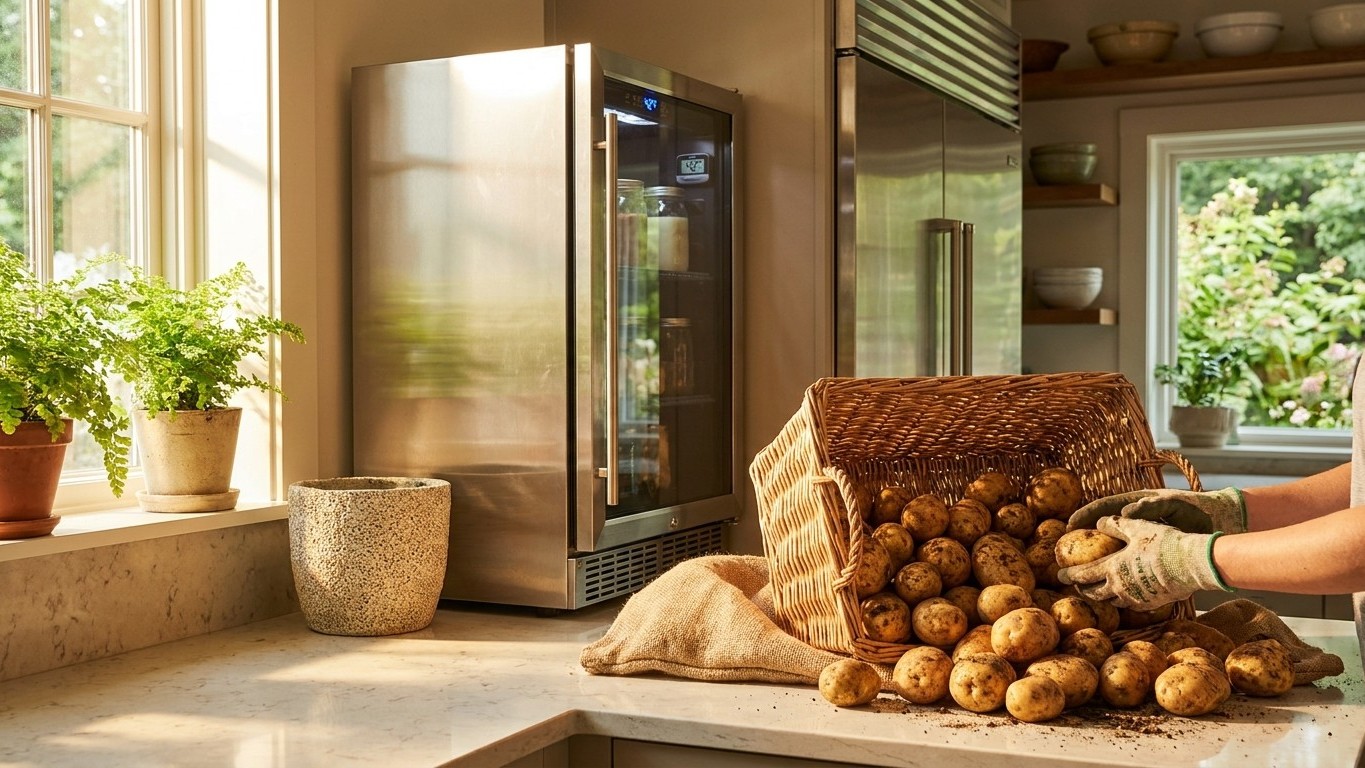

Louisiana potatoes come out of the ground ahead of summer’s heat, not ahead of a fall freeze, and that single fact rewrites the whole storage plan. Curing needs 55-60°F for 2 to 3 weeks (Utah State University Extension), and long-term storage wants 40-45°F in the dark (Utah State University Extension) or 38°F at 95 percent humidity (University of Maine Cooperative Extension). Because this state’s cold season barely touches the 40s, growers here lean on a refrigerator or a cooler, not a cold room, to hit those targets.
The short answer
Two numbers set the terms for potato storage in Louisiana. The first fall freeze, the 32°F kind, lands somewhere between December 17 and January 8 in a typical year, and that’s based on the 30-70 percent probability band in the NOAA NCEI 1991-2020 Climate Normals. But that window is misleading if you read it the way a Midwest grower would. A 32°F freeze shows up in only 86.8 percent of years at the reference station behind that data, which means close to one winter in seven never freezes at all. South Louisiana’s growing calendar isn’t built around dodging frost. It’s built around beating heat.
That’s why potatoes here go into the ground in late winter and come out in late spring, usually well before the first fall frost date has any relevance at all. By the time a Louisiana garden would normally worry about a freeze, the potato crop has been dug, cured, and (with luck) tucked into storage for months already. The fall frost window matters more for how long stored potatoes can coast on outdoor-adjacent cold later in the season than for the timing of the harvest itself.
The second number is the one that actually decides whether an unheated shed, garage, or closet can do the job of storage on its own. The coldest month in this climate has a mean daily minimum of just 46.1°F, based on NOAA NCEI Climate Normals for the New Orleans reference station. That’s the average low on an average night in the coldest stretch of the year, not a record cold snap. It sits above the 40-45°F storage target, and well above the 38°F mark from the University of Maine Cooperative Extension.
So the risk in Louisiana isn’t a freeze ruining the crop in storage. It’s the opposite problem. An unheated space here will rarely, if ever, get cold enough on its own to hold potatoes properly through the winter. Anyone storing a home harvest in this state needs to plan for mechanical cooling, not just a dark corner of the garage.
Curing, and where
Curing is the step between digging and storing, and skipping it is the single fastest way to lose a harvest to soft rot within weeks. The target, according to Utah State University Extension, is 55-60°F with high humidity, held for 2 to 3 weeks. In Louisiana, that target is harder to hit than it sounds, because harvest happens in late spring, right as ambient temperatures are already climbing into the 80s and 90s. A shaded porch or an open garage can easily run 15 to 20 degrees too warm for proper curing at that time of year.
Basements, the traditional curing spot in cooler climates, are uncommon across most of Louisiana because of the state’s high water table. That rules out one of the easiest curing options available to growers farther north. What’s left are interior spaces that can be shaded, ventilated, and monitored with an actual thermometer rather than a guess.
- Dig potatoes on a dry day and let excess soil fall off without washing the tubers, since washing invites rot before curing even starts.
- Move them immediately out of direct sun into the coolest, most shaded space available, since Louisiana’s spring sun can push surface temperatures well past the 60°F ceiling within an hour.
- Choose an interior closet, a shaded garage bay with a box fan running, or an air-conditioned room set toward the higher end of comfortable, since none of these will hit 55-60°F without some help.
- Spread the tubers in a single layer with airflow on all sides, rather than piling them, so humidity stays high without trapping heat against the skins.
- Check a thermometer placed at tuber level, not just the room’s general reading, since a garage floor can run several degrees cooler than the air near the ceiling.
- Hold that environment for the full 2 to 3 weeks before moving tubers to storage, resisting the urge to shortcut the process just because the harvest is done.
Storing through this winter
Once cured, potatoes want dark and 40-45°F, per Utah State University Extension, or as cold as 38°F at 95 percent humidity, per the University of Maine Cooperative Extension. Neither number lines up naturally with what this climate offers. A coldest-month mean minimum of 46.1°F means that even in the depths of a Louisiana winter, the average overnight low in an unheated space sits above the low end of the recommended storage range, not below it. There’s no equivalent here to a root cellar that coasts near freezing for months on its own.
That changes the practical advice considerably. A spare refrigerator set toward its warmest setting, a wine cooler, or a small dedicated chest freezer used as a refrigerator (with a plug-in thermostat controller to keep it out of true freezing range) will get much closer to the 40-45°F target than any unheated closet, garage, or shed in this state ever will on its own. Darkness is easy to arrange anywhere. Cold is the part that requires equipment here, not just a good location.
The upside of this climate is that freezing damage, the kind that turns tubers to mush the moment they thaw, is a minor risk for most of the state during a typical winter. Growers farther north have to worry about an uninsulated storage space dropping below 32°F on the coldest nights. In Louisiana, given a coldest-month mean minimum of 46.1°F, that’s rarely the concern. The tradeoff is that potatoes left in ambient conditions here will drift toward sprouting and shriveling well before spring, simply because the air around them never gets cold enough to slow them down.
Humidity works in growers’ favor if managed loosely, since Louisiana air rarely goes bone dry the way arid-region storage areas do. But high humidity paired with warmth, rather than high humidity paired with cold, is exactly the combination that breeds rot in stored tubers. Keeping the temperature side of that equation under control with a refrigerator or cooler solves most of the problem on its own.
What goes wrong here
- Curing in ambient heat instead of a controlled space. Louisiana’s late-spring harvest window often means 80-plus-degree days right when curing calls for 55-60°F (Utah State University Extension). The remedy is an air-conditioned interior room or a fan-ventilated shaded space, checked with a thermometer at tuber level rather than trusted by feel.
- Storing in an unheated garage or shed and expecting cold-climate results. With a coldest-month mean minimum of 46.1°F, that space simply won’t reach the 40-45°F target most winters. The fix is a spare refrigerator, a cooler with a plug-in thermostat, or another mechanically cooled space set to that range.
- Skipping the cure entirely because the harvest window is short. Rushing straight from field to storage bin, especially in Louisiana’s humid spring air, invites soft rot within days. The full 2 to 3 weeks at 55-60°F (Utah State University Extension) isn’t optional just because the weather turned hot fast.
- Fungal and insect pressure building in warm, humid soil before harvest. Extension guidance calls for appropriate fungicide and appropriate insecticides applied during the growing season, since Louisiana’s warmth and moisture favor both fungal disease and insect activity more than a drier, cooler climate would.
- Digging during a wet spell. Louisiana’s spring rains can leave garden soil saturated right around harvest time, and digging wet tubers out of wet ground bruises skins and seals in moisture that curing then has to fight against. Waiting for a dry stretch, even a short one, makes a measurable difference in how well the crop cures and stores afterward.
Common questions
Can potatoes be stored outdoors in Louisiana over the winter?
Not reliably. With a coldest-month mean minimum of 46.1°F, outdoor or unheated storage rarely reaches the 40-45°F range recommended by Utah State University Extension, so tubers tend to sprout and soften well before spring.
Does Louisiana’s mild winter mean freezing isn’t a storage risk?
Largely correct for most of the state. The first fall freeze at 32°F lands between December 17 and January 8 in a typical year, and occurs in only 86.8 percent of years at the reference station behind that figure, so a hard freeze is far from guaranteed. The bigger challenge is the opposite one: storage spaces staying too warm rather than too cold.
What temperature should a home refrigerator be set to for potato storage?
Utah State University Extension recommends 40-45°F for general storage, while the University of Maine Cooperative Extension notes 38°F at 95 percent humidity as an option. A spare refrigerator set toward its warmest range, checked with a separate thermometer, can approximate either target more reliably than an unheated space in this climate.
Why does curing matter so much if potatoes are going straight into a refrigerator?
Curing at 55-60°F for 2 to 3 weeks (Utah State University Extension) hardens the skin and heals small cuts from digging, which prevents rot from spreading once the tubers are packed together in a small, humid, refrigerated space. Skipping it raises the odds that a single soft tuber spoils the whole batch in storage.