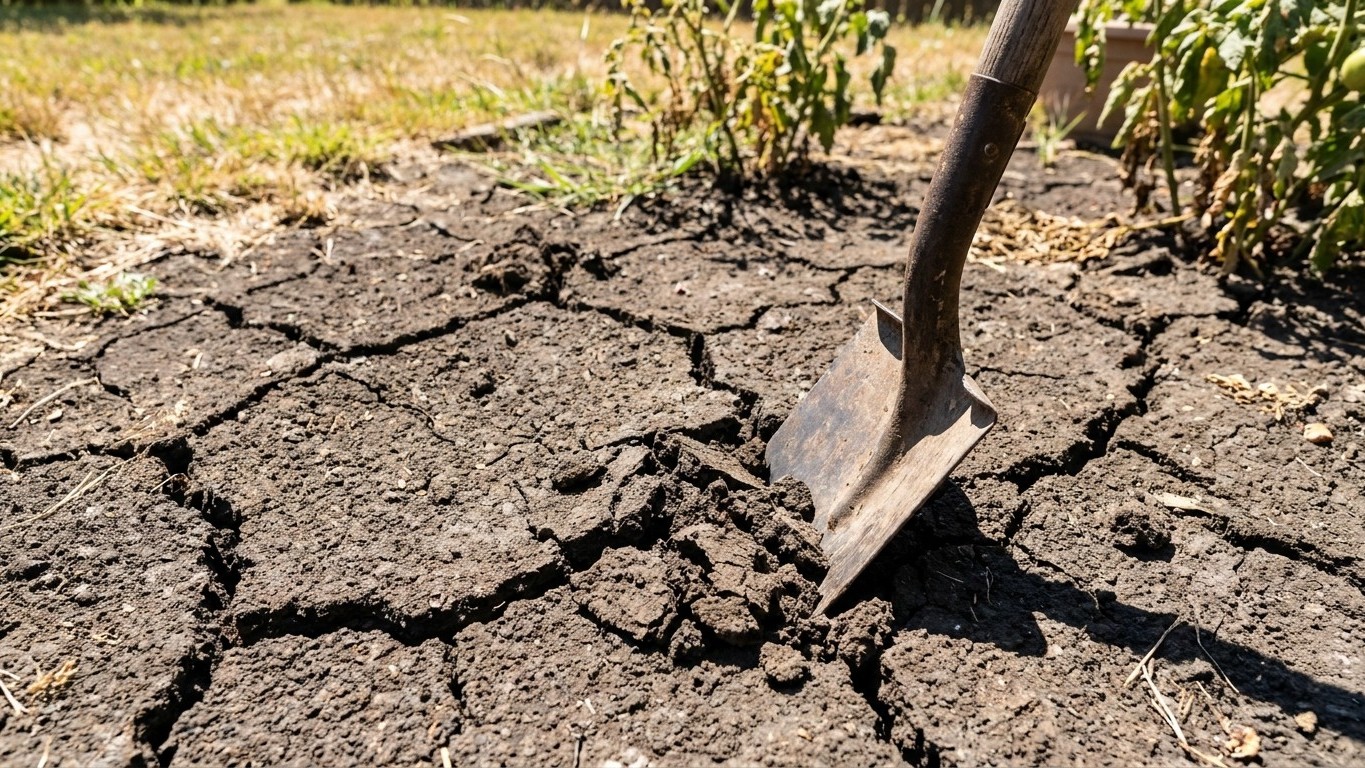

Dig a spade into typical Texas ground and odds are you’ll hit clay that either cracks like a dry lakebed or clings to your boot like wet cement. That’s not bad luck. It’s the Houston Black series, the soil USDA points to as representative of the state, and its numbers explain almost everything a Texas gardener fights every season.
What is under your garden

The Houston Black series is a Vertisol, a shrink-swell clay that opens into wide cracks when the weather turns dry and turns to a sticky, shoe-stealing paste after rain. USDA’s Soil Survey Geographic Database lists the representative surface horizon of this series with a pH around 7.9, meaning it sits solidly on the alkaline side. The texture runs 20 percent sand, 54 percent clay, and 26 percent silt, which is a heavy clay by any measure. Organic matter averages about 3.0 percent, and drainage is rated moderately well drained.
| Reading | Value |
|---|---|
| Surface pH | about 7.9 (alkaline) |
| Sand | 20 percent |
| Clay | 54 percent |
| Silt | 26 percent |
| Organic matter | about 3.0 percent |
| Drainage class | moderately well drained |
Here’s the honest caveat: this is the soil chosen to represent Texas, not a guarantee about the dirt behind your house. The state stretches from Piney Woods sand to Panhandle loam to Hill Country limestone rubble, and any lot a builder has scraped, graded, or backfilled during construction is its own animal entirely, usually compacted subsoil with none of the topsoil’s structure or nutrients. Treat the numbers above as a description of a tendency, not a lab result for your yard.
Reading your own ground in five minutes
Grab a handful of moist soil and roll it between your fingers and thumb, trying to push out a ribbon. Clay-heavy soil like Houston Black will form a long, slick ribbon, sometimes over two inches before it breaks. Loam gives a short, crumbly ribbon. Sandy soil won’t ribbon at all; it just falls apart. That single test tells you more in thirty seconds than most gardeners learn in a year of guessing.
For a longer read, fill a clear jar about a third full of soil, top it off with water, shake it hard, and let it sit overnight. Sand settles first and forms the bottom layer within minutes. Silt follows, settling out over a few hours. Clay stays suspended longest and forms the thin top layer, sometimes taking a full day to clear. A jar dominated by a thick clay layer confirms you’re dealing with something close to the state soil. A jar with a fat sand layer and thin clay tells a very different story, and the fixes below won’t all apply the same way.
Testing before you amend
Guessing at soil amendments is how gardeners end up dumping sulfur on ground that’s already acidic, or lime on soil that’s already alkaline, wasting money and setting plants back a full season. A real soil test measures pH, phosphorus, potassium, and often micronutrients like iron and zinc, none of which you can judge by eye or by how the dirt feels in your hand.
Given that Houston Black soils run alkaline at roughly pH 7.9, a Texas gardener can reasonably expect their own ground to lean the same direction, especially in the Blackland Prairie belt running through central Texas. But expecting is not knowing. Soil pH can swing a full point or more within a few miles depending on parent rock, drainage, and decades of what’s been added to the bed.
How to pull a sample that actually means something
- Choose four or five spots scattered across the bed or lawn area you’re testing, avoiding spots right next to a foundation, driveway, or old ash pile.
- At each spot, dig a small core six to eight inches deep, which is roughly where most vegetable and lawn roots feed.
- Mix all the cores together in a clean bucket, breaking up clumps and removing rocks, roots, and mulch.
- Let the mixed sample air-dry on a tray or newspaper for a day before bagging it, since wet samples can skew lab readings.
- Label the bag with the location and intended use (vegetable garden, lawn, flower bed) and send it to your local extension office.
The results usually come back within one to two weeks and list pH along with pounds-per-acre or parts-per-million figures for major nutrients. That report, not the state average, is what should drive what goes into your wheelbarrow.
Amending it
Houston Black’s pH of about 7.9 points in one clear direction: this ground almost never needs lime, and adding it to already-alkaline clay is a common, costly mistake. The clay and sand figures point just as clearly toward a heavy-soil strategy built on organic matter rather than quick fixes.
Correcting alkaline pH
At a pH near 7.9, lime should never go on this ground. Instead, elemental sulfur is the slow, honest tool, gradually converting to sulfuric acid through soil bacteria and nudging pH downward over one to three growing seasons, not overnight. Organic matter works alongside it, since decomposing compost and leaf mold release organic acids that buffer pH naturally. High alkalinity locks up iron, and the classic sign is chlorosis, yellow leaves with the veins staying stubbornly green, especially on azaleas, blueberries, and other acid-loving plants that struggle in Blackland clay. Chelated iron products offer a fast patch, but only sulfur and organic matter fix the underlying number.
Working with heavy clay
At 54 percent clay, this soil holds nutrients and water well but drains slowly and compacts easily underfoot. Organic matter, compost, aged manure, shredded leaves, worked in a few inches at a time over successive seasons, is the only amendment that reliably improves structure. Never add sand to clay hoping to lighten it; the two together can set up almost like concrete, a mistake repeated in yards across the state. Just as important: never work this clay while it’s wet. Tilling or digging wet Vertisol soil destroys what structure it has and can take years to undo.
Building organic matter
At roughly 3.0 percent organic matter, this soil has a reasonable baseline but benefits from steady additions. A one-inch layer of compost worked into the top few inches each spring and fall, over two to three years, measurably improves how the clay drains and how easily roots push through it. This is a three-season project, not a weekend one, and gardeners expecting instant results from a single bag of compost are usually disappointed.
Drainage and compaction
Houston Black soil carries a moderately well drained rating, which in practice means water moves through it, but slowly, and standing water after a heavy rain is common rather than alarming. The shrink-swell behavior compounds this: the same clay that cracks into fissures during a dry August can seal shut and puddle for days after a soaking rain in spring.
The percolation test
Dig a hole about one foot deep and roughly the same width, fill it completely with water, and let it drain once. Then fill it a second time and time how long it takes the water level to drop one inch. Anything faster than half an hour per inch drains quickly; one to two hours per inch is typical of moderately well drained clay like Houston Black; anything beyond four hours per inch signals a real drainage problem, often from compaction rather than the clay itself.
What the drainage class means in practice
- Avoid walking or driving equipment on clay beds when they’re wet, since this is when compaction does the most damage.
- Skip double digging; it disturbs clay structure without fixing the underlying drainage, and most extension agronomists have moved away from recommending it.
- Build raised beds filled with a blended topsoil-compost mix for vegetables and anything that resents wet feet, rather than fighting three years of amendment on ground that will always drain slowly.
- Reserve true clay-lovers, ornamental grasses, certain natives, and drought-tolerant perennials, for the parts of the yard you’re not amending.
On genuinely heavy Houston Black ground, a raised bed is often the honest answer rather than a stubborn multi-year amendment project. Gardeners who accept that early save themselves a lot of frustrated digging.
Local help
Texas A&M AgriLife Extension runs the state’s soil testing program through county offices statewide. A basic routine test covering pH and major nutrients is inexpensive, and once results arrive, a county agent will walk through what the numbers mean for your specific bed. Find your local office and submission details at agrilifeextension.tamu.edu.
Common questions
Is all Texas soil alkaline clay like the Houston Black series?
No. Houston Black is the series USDA lists as representative of the state, common across the Blackland Prairie, but East Texas has acidic sandy soils, the Panhandle has different loams, and Hill Country ground often sits over limestone with its own drainage quirks.
Can I just add lime to Texas soil to improve it?
Not if your soil resembles the Houston Black series. At a pH near 7.9, lime pushes already-alkaline ground further away from where most vegetables and ornamentals thrive. A soil test should confirm your actual pH before any lime goes down.
Why does my clay soil crack in summer and turn sticky in spring?
That’s classic shrink-swell behavior in Vertisol clay like Houston Black. High clay content means the soil expands when wet and contracts sharply when dry, opening deep cracks that can swallow small tools.
How long does it take to fix compacted clay soil?
Expect two to three growing seasons of regular organic matter additions to see real improvement in structure and drainage. For anything sooner, a raised bed with amended soil is the more realistic option.
Related guides
- New Mexico Soil: What You Are Digging Into, and How to Improve It
- Oklahoma Soil: What You Are Digging Into, and How to Improve It
- Utah Soil: What You Are Digging Into, and How to Improve It
- Growing Peppers in Texas
- Will Spinach Bolt Early in Texas
- When to Sow Parsnips in Texas
- Louisiana Soil: What You Are Digging Into, and How to Improve It
- Kentucky Soil: What You Are Digging Into, and How to Improve It