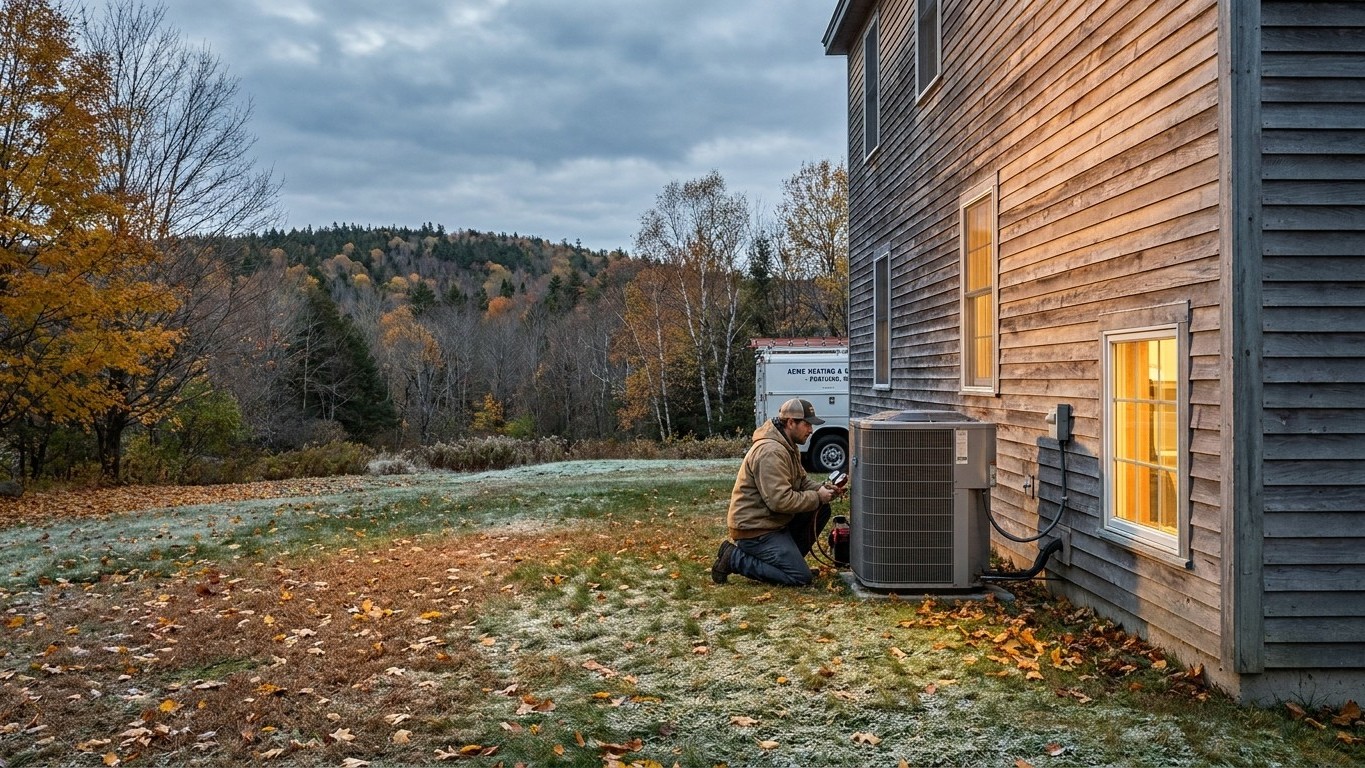

In Maine, heating demand typically begins in September, when the average monthly temperature first drops below the 65°F threshold used to calculate heating degree days. The season builds through fall, peaks in January, and stretches across roughly ten months before easing off in July, the only month that climbs back above that 65°F mark.
When the heating season starts in Maine

September is the pivot point. That’s the first month at Portland International Jetport, the National Weather Service reference station for southern Maine, where the average monthly temperature (61.6°F) falls under the 65°F base line NOAA uses to count heating degree days. Once a month’s average dips below that number, homes statistically need supplemental heat to stay comfortable, even if plenty of warm afternoons remain on the calendar.
That’s an average, not a forecast. A monthly normal is built from thirty years of data, smoothing out the wide swings any single September can bring. Some years deliver a cold snap in the first week of the month; other years coast comfortably into October before a furnace kicks on. Treat September as the month to get ready, not a date circled on the wall calendar.
From there, the numbers climb steadily. Demand peaks in January, the coldest month in the thirty-year record, with 1,271 heating degree days packed into thirty-one days. The season doesn’t let go easily either, it takes until July for the monthly average to climb back over 65°F and shut off heating demand entirely. That’s close to ten months of the year where a Maine home is, on average, working to stay warm.
The monthly breakdown below shows how that demand is distributed across the year. Each number represents heating degree days for that month, a measure of how far the average temperature fell below 65°F, and how long it stayed there.
| Month | Heating Degree Days |
|---|---|
| January | 1,271 |
| February | 1,088 |
| March | 956 |
| April | 613 |
| May | 325 |
| June | 89 |
| July | 10 |
| August | 16 |
| September | 145 |
| October | 459 |
| November | 748 |
| December | 1,074 |
Data source: NOAA National Centers for Environmental Information, U.S. Climate Normals 1991-2020, Portland International Jetport, ME.
How hard the winter works here
Annually, Portland Jetport logs about 6,795 heating degree days, against just 447 cooling degree days. That lopsided split tells the real story of a Maine winter: this isn’t a climate that trades a hot summer for a cold winter in equal measure. It’s a place where the furnace, boiler, or heat pump does the heavy lifting nearly year-round, while air conditioning stays a minor player.
Heating degree days work as a rough stand-in for fuel use. A house that sees twice the degree days of another location will, all else being equal, burn roughly twice the fuel to stay at the same temperature. That makes the 6,795 figure a useful yardstick for what a Maine home is up against, even before a single gallon of oil or kilowatt of electricity gets counted.
What the annual number can’t show is shape, and that’s exactly what the monthly table above fills in. Two places can post the same yearly total, one with a long, mild season stretched over many months, the other with a short, brutal stretch concentrated in midwinter. Maine’s pattern runs long: meaningful heating demand from September through May, with the heaviest months (December, January, February) carrying the bulk of the load. It’s less a spike and more a marathon.
What most homes in Maine actually heat with
Fuel oil and kerosene lead the way in Maine homes, a legacy of a housing stock built well before natural gas pipelines reached deep into the state’s small towns and rural counties. Furnaces and boilers split the equipment side, with steam or hot-water systems more common here than in most of the country.
| System / Fuel | Share of Homes |
|---|---|
| Furnace | 46% |
| Steam or hot-water boiler | 31% |
| Fuel oil or kerosene | 49% |
| Natural gas | 17% |
| Propane | 16% |
| Electricity | 10% |
Data source: U.S. Energy Information Administration, Residential Energy Consumption Survey (RECS) 2020, state-level tables for space heating and space heating fuel.
That heavy reliance on fuel oil shapes daily life for a lot of Maine households. Oil furnaces and boilers deliver strong, steady heat and handle the state’s long, cold stretches without complaint, but they depend on a full tank and a working delivery schedule, run dry in January and there’s no quick fix. Boilers paired with steam or hot-water radiators heat evenly and quietly, though they punish neglect: skip the annual bleed-and-inspect on a hot-water system and trapped air pockets leave radiators cold at the top while the boiler works overtime trying to compensate.
None of this is a verdict on what’s best. A share of the market reflects what got installed decades ago, often tied to whichever fuel was cheapest or most available at the time a house went up, not a judgment on which system suits a particular home today. A newer build or a recent renovation might make an entirely different choice look smarter for that specific house.
Run it once before you need it
September, right as heating demand statistically begins, is the window to test the system before the first real cold arrives and every technician in the state is already booked solid. Work through it in this order, the sequence matters, because the first few steps catch the most common, cheapest-to-fix problems.
- Turn the thermostat down, then back up several degrees above room temperature, and listen for a full cycle: the system should fire, run smoothly, and shut off without banging, rattling, or a burning-plastic smell (a brief dusty odor on first firing of the season is normal and should fade within a few minutes).
- Check and, if needed, replace the furnace filter, a clogged filter restricts airflow, forces the blower to work harder, and is one of the most common reasons a system underperforms all winter.
- Clear the space around vents, radiators, or the outdoor unit of a heat pump. Furniture blocking a vent or leaves packed around a heat pump’s outdoor coil chokes performance before the system even gets a fair shot.
- Test every carbon monoxide alarm in the home and confirm batteries are fresh; any fuel-burning furnace or boiler produces carbon monoxide, and a working alarm is the one safeguard that catches a problem before it becomes dangerous.
- Look over accessible ductwork for obvious gaps, disconnected sections, or crushed runs. The U.S. Department of Energy notes that in a typical house, about 20%-30% of the air moving through the duct system is lost to leaks, holes, and poorly connected ducts, which means a furnace or boiler can be running perfectly and a room can still stay cold simply because the air never gets there.
- If the system won’t hold a cycle, trips a breaker, or throws an error code, stop there and call a licensed technician rather than troubleshooting further, this is the point where a homeowner’s checklist ends and a professional’s begins.
A reader who only manages the first three steps has still covered the ones that catch the most frequent early-season failures. The rest builds on that foundation.
What turning it down is actually worth
The U.S. Department of Energy states plainly: “You can save as much as 10% a year on heating and cooling by simply turning your thermostat back 7-10°F for 8 hours a day from its normal setting.”
That’s a yearly figure tied to a specific setback held for a specific stretch of hours, covering both heating and cooling combined, not a per-degree rule and not a heating-only number. It’s worth reading exactly as written, because the shorthand version that circulates, savings scaled per degree, isn’t what the Department of Energy actually found.
In a state where meaningful heating demand runs from September through May, that 8-hour setback window has a lot more hours to work with over the course of a year than it would somewhere with a short, mild winter. A nightly setback, or one timed to an empty house during the workday, applies across most of the calendar here rather than a narrow slice of it.