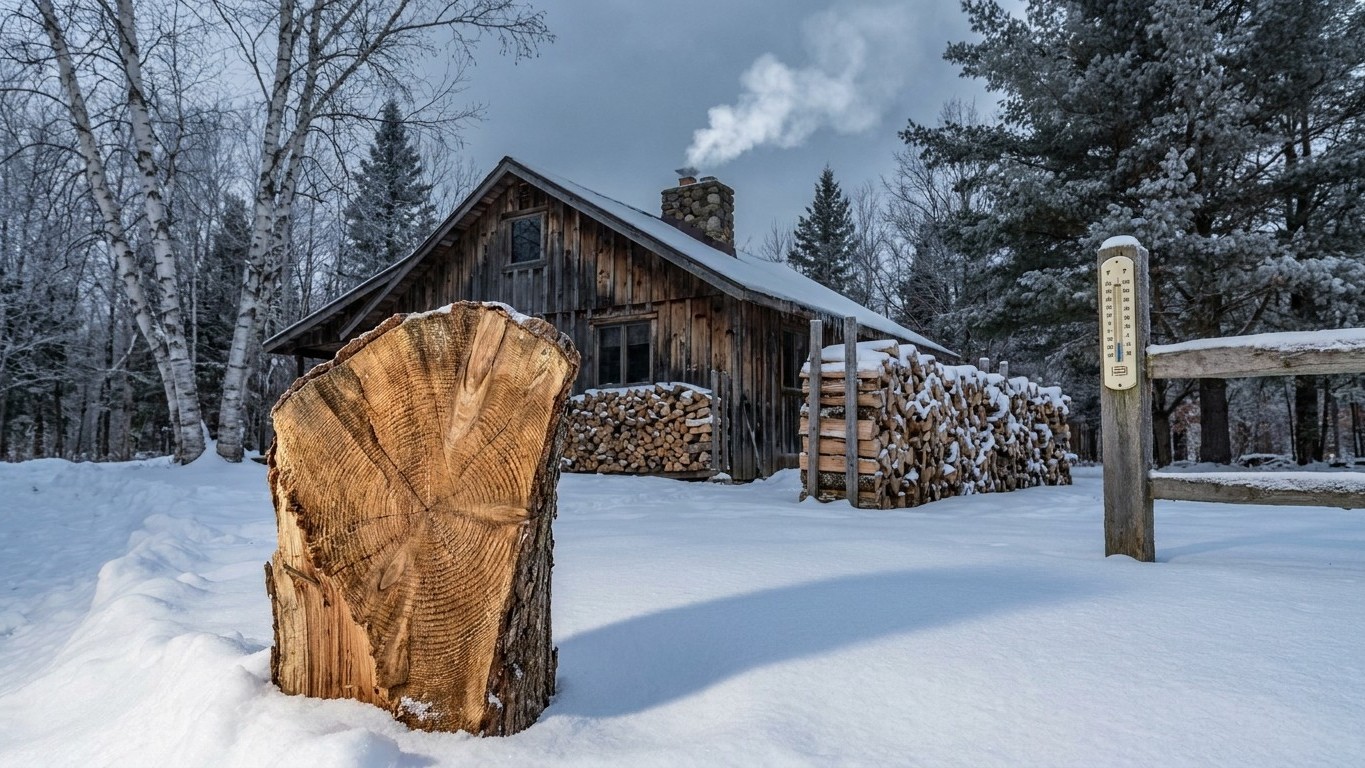

Firewood in Maine means planning around a average low of 15.6°F in the coldest month, measured at the Portland reference station. That number is the reason a dense hardwood cord matters here more than in milder states, and it shapes how much wood you split, how you season it, and which species are worth the truck trip to fetch.
How cold it actually gets here

Portland’s coldest month averages a nightly low of 15.6°F, based on NOAA’s 1991-2020 Climate Normals. That’s not a record cold snap, it’s the routine overnight temperature you’re heating against for weeks at a stretch. Inland and northern Maine run colder still, so if you’re in Aroostook County or the western mountains, treat 15.6°F as a floor, not a worst case.
A figure like this decides everything else about heating with wood. It decides whether you need three cords or six. It decides whether a light, fast-burning softwood is a nice-to-have for ambiance or a poor choice for the January stretch when the woodstove is the only thing standing between the pipes and a freeze. Below 40°F, firewood stops being décor. At 15.6°F, it’s infrastructure.
What heating through that cold actually requires
Heating through a winter that bottoms out in the mid-teens means the stove or furnace runs long overnight burns, often eight hours or more between reloads, and it means the wood feeding it has to carry enough stored energy to still be putting out heat at 2 a.m. when the fire is coals, not flame. That’s a density problem, not just a supply problem. Two cords of a light wood and two cords of a dense one are the same volume, 128 cubic feet each, but they are not the same number of hours of heat.
This is also why a lot of Maine households don’t treat wood as the whole answer. Plenty of homes run wood heat alongside oil, propane, or a heat pump, using the stove for the bulk of the season and the backup system for the coldest snaps or for when nobody’s home to feed the firebox. If that’s your setup, the cold figure still matters, it just changes the question from “how do I survive on wood alone” to “how much oil or propane can I displace.”
Either way, the mid-teens average low is the number to plan against, not the occasional negative-degree night that makes the local news. Winters here run cold enough, long enough, that a casual approach to species and seasoning shows up fast as a wood pile that runs out in February.
Which woods are worth the effort here
Density is the variable that matters most once you’re heating against a 15.6°F average low, because a cord is a fixed volume, 4 feet by 4 feet by 8 feet, and a denser cord simply packs more wood fiber, and more stored energy, into that same box. Michigan State University Extension puts well-seasoned hardwood at roughly 20 million BTU per cord on average, the equivalent of about 145 gallons of #2 fuel oil or 215 gallons of LP gas. That average hides a wide spread, though: a cord of a dense hardwood can run well above that figure, while a cord of a light softwood runs well below it.
In practical terms, dense hardwoods, oak, sugar maple, yellow birch, and white ash among them, are what you want feeding the stove overnight during the cold stretch. They burn slower, hold coals longer, and give you the overnight burn a mid-teens low demands. Red oak in particular is worth seeking out for heat value, though it comes with a catch covered in the next section: it dries slowly and needs extra time seasoned before it’s ready to burn.
Lighter woods, white pine, spruce, and fir, are not a heating strategy on their own in a Maine winter. They’re for starting a fire fast, for the shoulder-season evenings in October or April when you want quick warmth without committing a big log, and for kindling. Asking a softwood to carry an overnight burn at 15.6°F is asking it to do a job it isn’t built for.
Species compared
| Species | Heat value vs. average hardwood cord | Smoke | Sparks |
|---|---|---|---|
| Oak (incl. red oak) | Above average, dense, long overnight burn | Low once seasoned | Low |
| Sugar maple | Above average | Low | Low |
| Yellow birch | Above average | Low to moderate | Low |
| White ash | Above average, dries relatively fast | Low | Low |
| White pine | Well below average | Higher, sooty | Higher |
| Spruce / fir | Below average | Higher | Higher |
None of this matters much, though, if you can’t actually get the species seasoned and dry. Availability from local sellers and woodlots often decides the mix more than the table does, and a modest hardwood you can buy already split and dry beats a premium species still sitting green in someone’s yard.
How much wood a winter takes
There’s no honest single number for “how many cords a Maine winter needs,” because the answer depends on three things that vary by house, not by state line. Any number you see published without those variables attached is close to useless for your specific situation.
- The cold itself: a 15.6°F average low in Portland is a different demand than the colder averages inland and up north, so your regional pocket within Maine shifts the estimate before anything else does.
- How well the house holds heat: insulation, air sealing, window quality, and even how the house is oriented to wind all decide how much of the heat you generate actually stays inside.
- Whether wood is primary or supplemental heat: a household running the stove as the sole heat source burns through cords at a different rate than one using it for the living room in the evenings while a furnace handles the rest of the house.
The mechanism that makes these variables matter isn’t small. A poorly insulated house in a hard winter can burn through double the wood a tight, well-sealed house uses in that same winter, in that same climate, at that same 15.6°F average low. That’s not a rounding difference, it’s the gap between three cords and six. Air leaks around doors, an uninsulated attic, and old single-pane windows all show up directly in the wood pile.
The practical move is to run your own version of this estimate rather than trust a generic figure. Start with your local cold, be honest about your house’s insulation, and be clear about whether wood is carrying the whole load or just part of it. From there, track what you actually burn through one full winter, and you’ll have a number that’s specific to your house rather than a statewide guess.
Drying wood in this climate
Seasoning matters more than species almost everywhere, and Maine’s climate has its own rhythm that shapes how long that seasoning takes. The target, regardless of where you live, is wood at 20 percent moisture or less by the time it hits the firebox. Green, freshly cut wood can sit above 60 percent moisture, and every bit of that water has to boil off before the wood gives you any usable heat, which is exactly why a green log hisses, smokes, and struggles to catch instead of burning clean.
What dries wood is airflow and time, not sunshine sitting on top of a pile. Split rounds stacked with gaps between them, off the ground, and ideally with a top cover that still lets air move through the sides, will typically reach that 20 percent target after one full summer of seasoning. Skip the splitting and just leave rounds sitting whole, and that timeline stretches out considerably, because bark and unsplit surface area trap moisture in.
Red oak is the named exception worth remembering: its cell structure makes it dry more slowly than most other hardwoods, so a single summer often isn’t enough. If oak is part of your wood plan, buy or cut it further ahead than everything else, or expect to burn it a season later than the rest of the stack.
This is where the 15.6°F average low connects directly back to a seasoning mistake. Wood cut and split in spring for that same winter is, in most cases, nowhere near dry by the time the cold arrives in December. It’s the single most common misstep among people new to burning wood in Maine: they assume a few warm months is enough, split in April, and end up feeding a mid-teens winter night with wood that’s still closer to 40 or 50 percent moisture. The fix isn’t complicated, it’s just timing. Wood for this winter should already be split and stacked from last spring or earlier, and wood you’re splitting now is really for next winter.