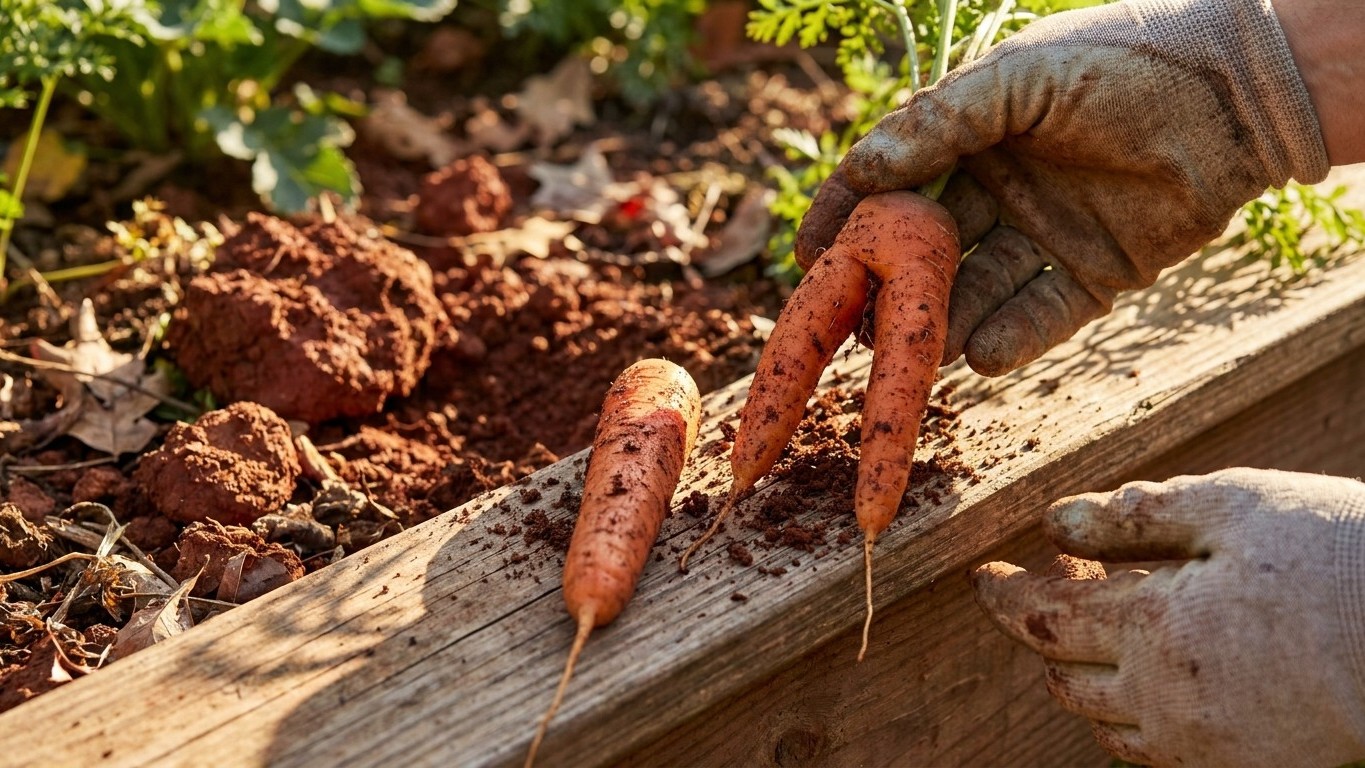

Manitoba’s farmland soil runs alkaline and silty rather than sandy, with enough clay in the mix to slow drainage across a good stretch of the province. That combination means yes, carrots can fork here, especially in compacted or clay-heavy ground, but it isn’t a foregone conclusion. The fix is the one gardeners reach for anywhere heavy soil meets a root crop: work in compost, loosen the ground deep with a fork or spade, or skip the guesswork entirely and grow in a raised bed filled with something looser.
The short answer
The soil most often mapped across Manitoba’s farmland is a Chernozem, the deep, dark grassland soil the prairies are famous for, rich in organic matter and naturally fertile. It covers 41 percent of the province’s mapped surface, more than any other soil order, with Gleysolic soils running second. Averaged across more than 2,500 mapped soil components, the surface layer works out to 45 percent sand, 24 percent clay and 31 percent silt, a loam that leans silty more than sandy. Organic matter sits around 5.5 percent, generous by most garden standards, and the median surface pH lands near 7.6, meaning the ground tends alkaline rather than neutral. Drainage is classed as imperfect, so water moves through slower than a true well-drained loam would allow.
For carrots, that’s a mixed report card. Utah State University Extension is direct about what the crop wants: deep, sandy, well-drained soil rich in organic matter. Heavy or rocky soil makes the root fork, and the remedy for heavy ground is plenty of compost worked in, paired with double digging to loosen the layers below the topsoil. Manitoba’s dominant soil clears the organic-matter bar easily, 5.5 percent is more than most backyard beds start with, but the imperfect drainage and the real clay fraction are exactly the conditions that push a taproot sideways instead of letting it drive straight down, splitting it into two or three legs by harvest.
The same two fixes that solve this everywhere apply here too: dig deep and loosen the native ground, working compost in well below the surface, or bypass the digging altogether and build a raised bed filled start to finish with a loose, sandy mix.
None of this is a diagnosis for your own yard. Manitoba’s agricultural belt alone is mapped into hundreds of distinct soil series, and the figures above are a median pulled from thousands of samples, not a promise about the dirt under your tomato cages. River-bottom ground, drained wetland, or a lot a builder graded and filled can sit nowhere near that median. Treat the provincial numbers as a starting point for what the region’s soil tends to do, alkaline, silty, slow to drain, and then confirm what’s actually in your bed with a look and a feel, which is the next step.
The test that settles it in your own garden
A provincial average describes millions of acres. It says nothing about the raised bed by the back fence or the strip along the garage where the carrots are actually going in. The only way to know what you’re working with is to dig, look, and feel it for yourself.
- Dig a test hole where the carrots will actually grow, going as deep as a full shovel blade will let you. Carrots need loose ground for the whole length of the root, not just a nice top layer, so a hole that stops at a few inches won’t tell you much.
- Look at what changes with depth. A layer of dense, compacted soil, or a band studded with stones, is often the real reason a carrot forks, more than the topsoil color ever suggests.
- Pull out any stones bigger than a pea and set them aside. A row littered with small rocks will deflect roots sideways no matter how rich the soil above is.
- Grab a handful of moist soil from the hole and squeeze it. Sand falls apart the instant you open your hand. Clay holds together in a slick ribbon. A loam holds its shape briefly, then crumbles on its own, which is the texture carrots handle best.
- Refill the hole with water and watch how it moves. Soil that swallows water quickly drains fast enough for carrots. Soil where water sits and lingers on the surface is the imperfect drainage that leads back to forking and rot at the root tip.
- Match what you found against what carrots want: deep, loose, and free-draining. If the hole showed compaction, stones, or standing water, plan on working compost in deep or building up instead of digging down.
What goes wrong here
- Forking in heavy or compacted ground. A clay-heavy pocket or a hardpan layer a few inches down deflects the taproot sideways instead of letting it grow straight, and the carrot splits into legs. The remedy is loosening the ground well below the surface with a digging fork, mixing in compost as you go, or sidestepping the native soil entirely with a raised bed filled with a looser mix.
- Poor germination during a hot, dry stretch. Carrot seed is slow to sprout under the best conditions, and it needs steady surface moisture to do it at all. A dry, hot run of days can crust the soil surface and stall germination completely, leaving gaps in the row. Covering the row lightly with mulch or a board until seedlings show, and keeping the surface consistently damp rather than letting it dry and then soaking it, keeps germination on track.
- Splitting from uneven watering. Once roots have sized up, a dry spell followed by a heavy soak makes the carrot swell too fast, and the skin cracks along the length of the root. Watering on a steady schedule, rather than letting the bed dry out and then flooding it, prevents the swings that cause the splits.
- Alkaline surface soil tying up nutrients. A median pH near 7.6 runs alkaline enough to lock up certain micronutrients over time, which shows up as slow, uneven growth rather than dramatic damage. Working compost or other organic matter into the bed over several seasons nudges the chemistry gradually, which is a steadier fix than trying to force a swing with a single application of anything.
Common questions
Do all carrot varieties fork the same way in heavy soil?
The source behind this guidance doesn’t single out any one variety, and for good reason: forking is driven far more by soil condition than by which seed packet you picked. Heavier or rockier ground can make nearly any carrot fork, so the fix is soil preparation, not variety shopping.
How long do carrots take to mature from seed in Manitoba?
Carrots are sown directly in place, never transplanted, and typically run 70 to 100 days from seeding to harvest, per Utah State University Extension. That window is counted from the day the seed goes into the ground, not from any later date, since there’s no transplant step in this crop’s timeline.
Is a raised bed really necessary, or does double digging work just as well?
Both are legitimate fixes for heavy soil. Double digging loosens the native ground in place and works compost in deep, while a raised bed sidesteps the native soil altogether by filling with a looser mix from the start. Either approach solves the forking problem as long as it’s done deep enough for a full-length root.
Does Manitoba’s alkaline soil affect carrot flavor or color?
That’s not something the cited source addresses. What is documented is that alkaline soil can limit how well certain nutrients are taken up, which affects growth and vigor. Any claim about flavor or color shift tied to pH would be going beyond what’s actually established here.