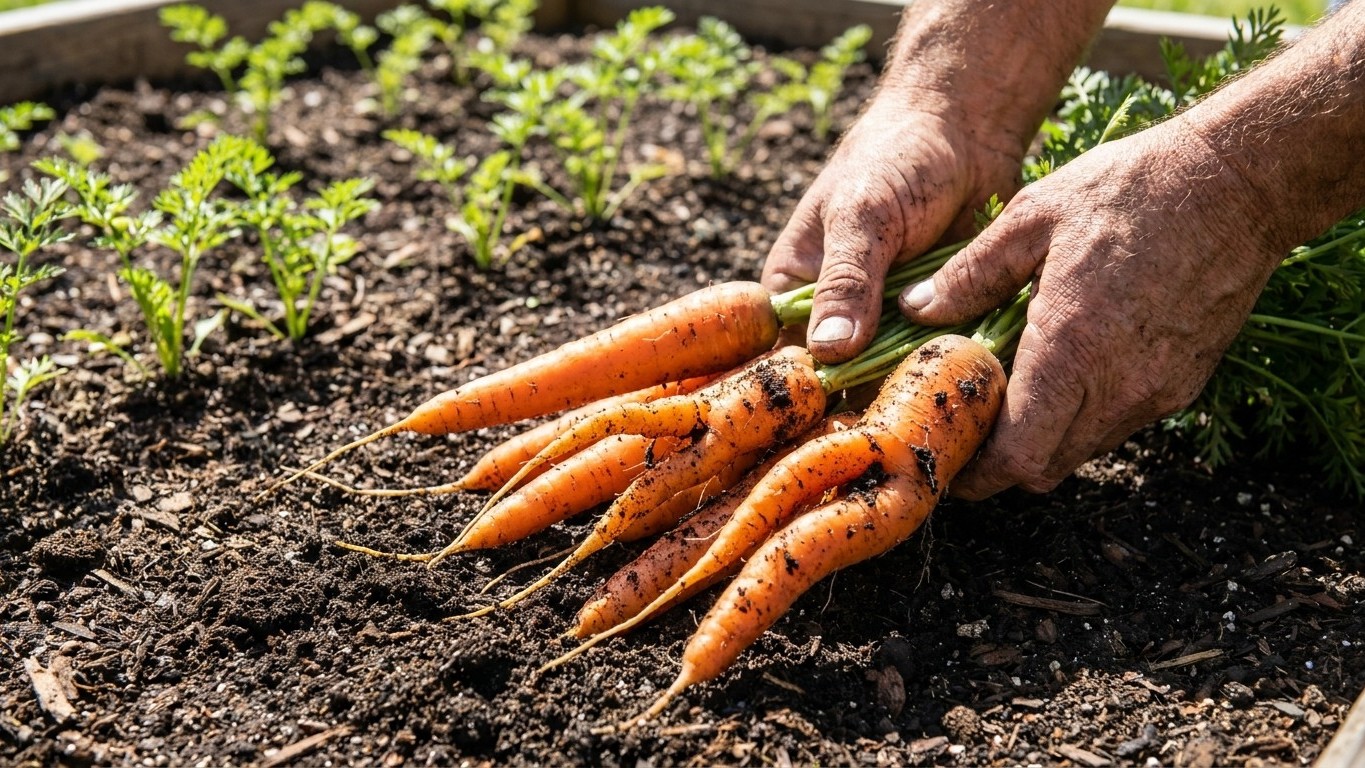

In Manitoba, carrots go into the ground as soon as the soil can be worked in spring, weeks ahead of the last frost, because carrot seed shrugs off cool ground better than most vegetables. Count backward from your target harvest using 70 to 100 days from seeding, never from a transplant date, since carrots are sown directly and never moved. But the calendar is only half the story here: the province’s dominant prairie soil decides whether that root grows straight or forks before it ever reaches those 70 days.
The short answer
The soil most often mapped across Manitoba’s farmed regions is a Chernozem, the dark, organic-rich grassland soil the prairies are known for. It covers 41 percent of the mapped surface, with Gleysolic soils as the next most common. Where it shows up, the surface layer runs to a median pH near 7.6, on the alkaline side, and the texture sits in loam-to-silt territory: about 45 percent sand, 24 percent clay, and 31 percent silt. Organic matter averages around 5.5 percent, which is generous by garden standards, but the drainage class is listed as imperfect. That combination, according to Agriculture and Agri-Food Canada’s Canadian Soil Information Service, describes the median of more than 2,500 mapped soil components across the province.
Carrots want the opposite of heavy, slow-draining ground. Utah State University Extension is blunt about it: carrots need deep, sandy, well-drained soil rich in organic matter, and heavy or rocky soil makes the root fork instead of growing straight down. Manitoba’s typical profile is a mixed picture. The organic matter is on the reader’s side, Chernozem soil is naturally fertile and dark for a reason. But a quarter clay content paired with imperfect drainage is exactly the kind of ground that resists a carrot’s taproot and holds water longer than the crop wants around its shoulders.
None of that means carrots are off the table. It means the fix Utah State University Extension recommends for heavy soil, working in plenty of compost and double digging the bed, is the default move for most Manitoba vegetable gardens, not an occasional extra step. Where the clay runs even heavier than the provincial median, or where drainage is worse than imperfect, a raised bed filled with a lighter, blended mix sidesteps the problem outright instead of fighting it season after season.
Treat all of this as a starting point, not a verdict on your own yard. A province spans hundreds of individual soil series, and the numbers above are a median drawn from thousands of mapped components across the agricultural belt, not a reading of any one backyard. River bottoms, old muskeg, and any lot a builder has scraped, filled, or compacted with equipment can sit far outside that median in either direction. The only way to know what you’re actually working with is to look at your own dirt.
The test that settles it in your own garden
The provincial numbers describe a tendency, not your bed. Here is how to find out what you’re actually growing carrots in.
- Dig a narrow hole in the spot you plan to seed, deep enough to see past the topsoil into whatever lies beneath it. Note where the color or texture changes, and whether you hit rock, gravel, or a dense, hard layer before the root zone a carrot would need.
- Sift through what you pulled out and look for stones and rock fragments. Even small ones scattered through the profile will deflect a growing taproot and cause forking, no matter how good the topsoil looks on the surface.
- Take a handful of moist soil from a few inches down and rub it between your fingers. Gritty means sand, smooth and sticky means clay, silky and floury means silt. Most garden soil is a blend, and the balance you feel tells you whether you’re closer to the light, loose ground carrots prefer or the heavier end of the spectrum.
- Fill the hole with water and watch what happens. Water that disappears steadily suggests decent drainage. Water that sits and lingers, or that comes back after the surrounding ground looks dry, points to the same imperfect drainage that shows up in the provincial soil data, and it means raised beds or heavy amending are worth planning for before you sow.
None of these steps require a lab, and none of them should be skipped just because the provincial average sounds workable. A single yard can hold a strip of decent loam next to a low corner that never drains, and carrots will tell you the difference within a season either way.
What goes wrong here
- Forking in heavy, clay-leaning ground. Manitoba’s typical soil sits at roughly a quarter clay with imperfect drainage, and that resistance splits or deflects the taproot into forked, stubby carrots. The remedy is the one Utah State University Extension gives for heavy soil generally: work in generous compost and double dig the bed before sowing, or skip the fight entirely with a raised bed filled with lighter soil.
- Poor germination during a hot, dry spell. Carrot seed is small and sits shallow, and it dries out fast once the surface bakes. A thin, spotty stand after seeding is usually a sign the top inch of soil went dry between waterings rather than a problem with the seed itself. Keeping that surface consistently damp, with light, frequent watering or a thin mulch layer, until seedlings are up solves most of it.
- Splitting roots from uneven watering later in the season. A carrot that grows through a dry stretch and then gets soaked all at once tends to crack open along the root. This is less about the province’s soil chemistry and more about a watering routine that swings between drought and flood. A steadier schedule, rather than a bigger single soaking after neglect, keeps the root growing at one pace instead of surging and splitting.
All three problems trace back to the same tension: Manitoba’s dominant soil brings useful organic matter and fertility to the table, but its texture and drainage work against a crop that wants loose, even, well-drained ground from the day it’s sown to the day it’s pulled.
Common questions
Can I sow carrots in Manitoba’s clay soil without amending it?
You can, but expect forked and stubby roots. With roughly a quarter clay content and imperfect drainage typical of the province’s soil, an unamended bed usually resists a straight taproot. Compost and double digging, or a raised bed, are the fixes named by Utah State University Extension for exactly this situation.
Does Manitoba’s soil pH suit carrots?
The median surface pH across the province’s mapped agricultural soil runs around 7.6, on the alkaline side. The sourced facts here don’t specify an ideal pH range for carrots, so treat this as background on the region’s chemistry rather than a pass or fail reading for your own bed, and confirm your own soil’s pH before drawing conclusions.
How deep does the soil need to be for carrots in Manitoba?
No specific depth figure is published in the sourced data used here. What is established is that carrots need deep, well-drained ground free of rock and heavy compaction, so digging down to check for stones, hardpan, or a shallow subsoil layer in your own bed matters more than any provincial average.
Does the organic matter in Manitoba’s soil help carrots grow?
It should help. The province’s typical Chernozem soil carries around 5.5 percent organic matter, well above what many garden soils start with, and that fertility works in a carrot’s favor. The texture and drainage are the harder obstacles, and they’re the ones worth addressing with compost, double digging, or a raised bed before sowing.