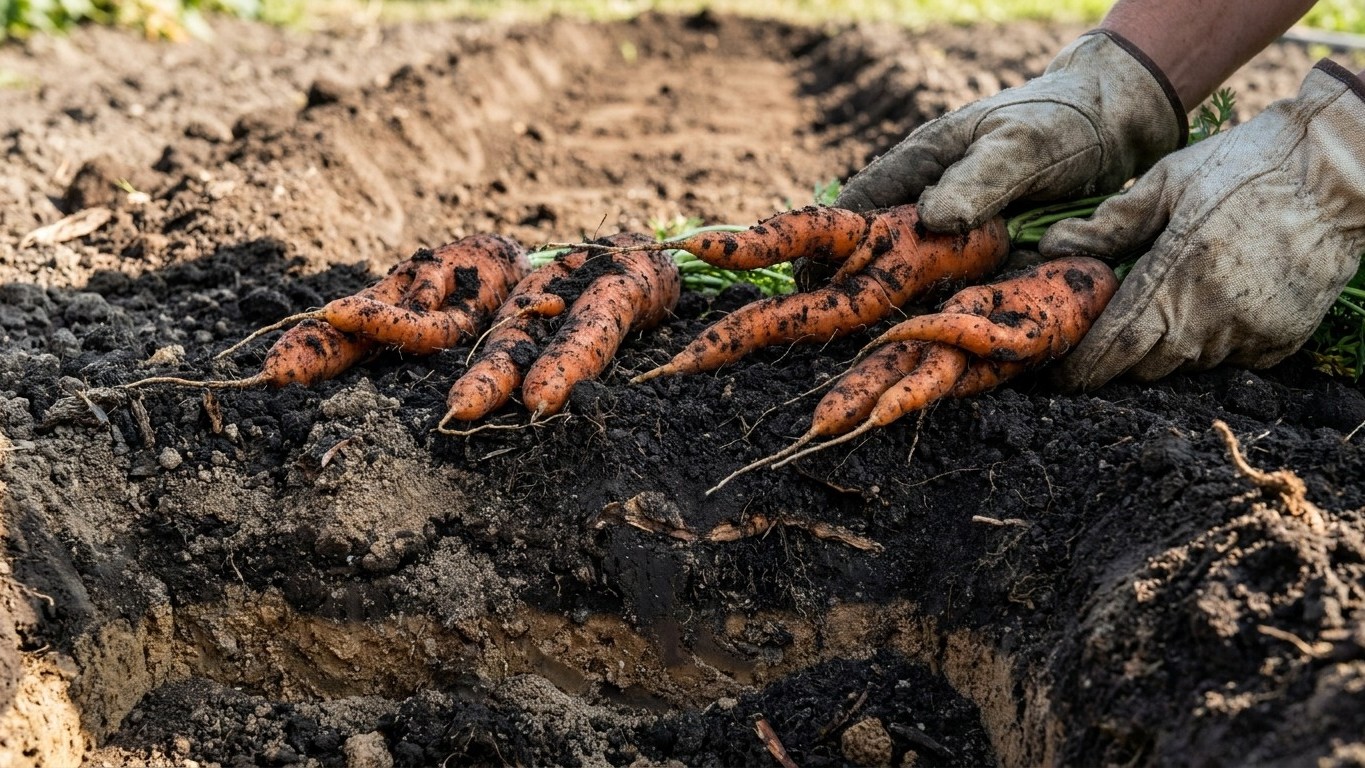

Manitoba’s typical garden soil runs 45 percent sand, 24 percent clay and 31 percent silt, a loam that leans alkaline (median pH around 7.6) and drains imperfectly. That combination doesn’t guarantee forked carrots, but it doesn’t rule them out either, so it’s worth asking Will Carrots Fork in Manitoba Soil? before you plant. The fix, when it’s needed, is usually compost and double digging rather than a different variety.
The short answer
Across the mapped agricultural soils of Manitoba, the dominant profile is a Chernozem, the dark, organic-rich grassland soil the prairies are known for. It covers 41 percent of the mapped surface, more than any other soil order in the province, with Gleysolic soils coming in second. The median surface sample runs 45 percent sand, 24 percent clay and 31 percent silt, which puts it in loam to silt loam territory, and it carries about 5.5 percent organic matter, a healthy figure by any standard. The pH sits around 7.6, meaning alkaline rather than acidic. Drainage is classed as imperfect, which is the middle ground between a soil that sheds water fast and one that sits wet for days after rain.
For carrots, that profile is a mixed bag. The organic matter is good news since carrots want soil that’s fertile and easy to push a root through. The clay content and the imperfect drainage are the parts to watch. Utah State University Extension is blunt about this: carrots want deep, sandy, well-drained soil rich in organic matter, and heavy or rocky ground makes the root fork instead of growing straight down. At 24 percent clay, Manitoba’s typical soil isn’t heavy clay by a long shot, but combined with imperfect drainage it can still compact into a crust or hold water long enough near the surface to deflect a taproot around a clump or a stone.
The remedy USU Extension gives for heavy ground is straightforward: work in plenty of compost and double dig the bed, turning the soil to a full spade’s depth and breaking up the layer below so roots aren’t hitting a compacted pan a few inches down. Where drainage is genuinely poor, or the ground has been driven over, built up with fill, or left uncultivated for years, a raised bed filled with a loose, sandy mix sidesteps the problem entirely rather than fighting it season after season. Once the bed is prepped, the next question is timing, and When to Sow Carrots in Manitoba covers that in detail.
None of this describes any one garden with certainty. Manitoba’s agricultural zone alone spans hundreds of individual soil series, and the median figures above are drawn from over 2,500 mapped soil components across the province. A garden near a river bottom, one built on fill, or one sitting in a low spot that collects runoff can look nothing like the provincial median. This is a starting point for guessing what your ground tends to do, not a diagnosis of what it actually does.
The test that settles it in your own garden
The only way to know what your carrots will actually meet underground is to look at the dirt yourself. None of the following steps require lab equipment, just a shovel, a bit of patience, and a rainy day to watch what happens.
- Dig a hole at least a foot deep where you plan to sow. Note how far down you can go before hitting a hard, compacted layer, heavy clay, or a bed of stones. That depth is roughly how long a straight carrot root has before it’s forced to bend or split.
- Check for stones and rubble as you dig. Even small pebbles a few inches down can split a taproot into two forks as it tries to grow around them.
- Feel the texture of a handful of moist soil. Sandy soil falls apart and feels gritty. Clay soil holds together, feels slick, and can be rolled into a ribbon between your fingers. Loam sits in between, holding a loose clump without turning to mud.
- Watch how water drains. Dig a hole about a foot deep, fill it with water, let it drain once, then fill it again and time how long it takes to empty. Water still standing after several hours points to the kind of imperfect or poor drainage that pushes carrots toward forking and rot.
- Compare what you found to the compost-and-double-dig fix. If the hole was easy to dig, free of stones, and drained within a reasonable time, your soil is likely close to what carrots want already. If it fought you at every step, that’s your answer: work in compost, double dig, or build a raised bed rather than hoping the next packet of seed does better.
When to sow here
Carrots are sown directly into the ground. There’s no transplanting step and no seedling tray to count from, so every date below runs from the day seed goes into soil, not from any later planting.
- Start from the average last spring frost. At Winnipeg Richardson International Airport, the Canadian Climate Normals for 1981 to 2010 put that date at May 23. That’s a mean, not a guarantee. In roughly one year out of two, frost arrives after May 23, so treat it as the midpoint of a window rather than a safe cutoff, especially in northern or upland districts that run behind Winnipeg’s climate.
- Check the soil temperature before sowing. Carrot seed needs soil at a minimum of 40 F to germinate at all. Pushing seed into ground colder than that mostly wastes the seed, since it will sit without sprouting and risk rotting in wet, cold soil.
- Count backward two to three weeks from May 23. That puts the earliest sowing window somewhere around the start to the middle of May, soil conditions allowing. Carrots tolerate a light frost on the seedlings better than most garden crops, which is why gardeners sow ahead of the last frost date rather than after it.
- Aim for the germination sweet spot of 55 to 65 F if you want the fastest, most even sprouting. Early May soil in Manitoba often sits below that range, which means germination may take longer near the start of the window and speed up as the soil warms through the month.
- Succession sow into early summer if you want a longer harvest, moving sowings later as the season warms, since the underlying soil temperature and moisture needs don’t change, only the calendar does.
What goes wrong here
- Forked roots in heavy, compacted ground. Clay content and imperfect drainage combine to create dense patches or a compacted layer that deflects the taproot. Work in compost and double dig the bed before sowing, or move to a raised bed filled with a loose mix if the underlying soil resists improvement.
- Poor or patchy germination during a hot spell. Carrot seed germinates best at 55 to 65 F, and a stretch of unusually warm, dry weather right after sowing can dry out the top inch of soil faster than the seed can sprout. Keep the seedbed consistently moist with light, frequent watering until seedlings are up, rather than one deep soak that then dries out.
- Splitting roots from uneven watering. Carrots that go through a dry stretch and then get a heavy rain or deep watering tend to split as the root swells suddenly. Regular, even moisture through the growing season prevents the swing that causes it.
- Stunted or misshapen roots from stony soil. Even where the clay and drainage numbers look fine, a bed with buried stones or rubble a few inches down will split roots just as reliably as heavy clay does. The dig test above catches this before a season is wasted on it.
- Slow starts from sowing into soil that’s still too cold. Jumping the gun before soil hits 40 F risks seed rotting in the ground rather than germinating, which shows up as bare patches gardeners often blame on bad seed rather than cold soil.
Checking this against your own county
Everything above describes the province’s agricultural soils in general terms, drawn from a median across thousands of mapped samples and one weather station’s climate record. Your own garden, your own soil, and your own local frost pattern can all sit some distance from those figures. Manitoba Agriculture publishes guidance and local contacts for growers across the province, and it’s worth checking their site at gov.mb.ca/agriculture for anything specific to your district, from soil testing services to local frost expectations that may differ from the Winnipeg station used here. That’s the resource to lean on once you’ve done the dig-and-drain test in your own bed and want to compare notes against what’s known locally.
Common questions
Does Manitoba’s alkaline soil hurt carrots?
The province’s typical surface pH sits around 7.6, which is alkaline. The facts available here don’t give a specific pH preference for carrots, so this page can’t say whether that level helps or hinders growth. A soil test through a local service is the way to check pH against what your specific carrot planting needs.
Can I sow carrots before May 23 in Manitoba?
Yes, and it’s generally recommended. Carrots are typically sown two to three weeks before the average last frost date, which in Winnipeg falls around May 23. That puts many plantings in early to mid-May, provided the soil has already reached the 40 F minimum needed for germination.
Why do my carrots keep splitting into two roots?
Forking comes from something physical blocking the taproot as it grows down, most often heavy or compacted soil, buried stones, or rubble a few inches below the surface. Digging a test hole to check for these before sowing, and working in compost where the ground is dense, addresses the cause directly.
Is a raised bed necessary for carrots in Manitoba?
Not always. It depends on what your own dig-and-drain test shows. Where soil is loose, reasonably free of stones, and drains within a few hours, in-ground sowing after amending with compost is usually enough. Where drainage is poor or the ground is compacted throughout, a raised bed filled with a loose, sandy mix sidesteps the problem more reliably than repeated double digging.