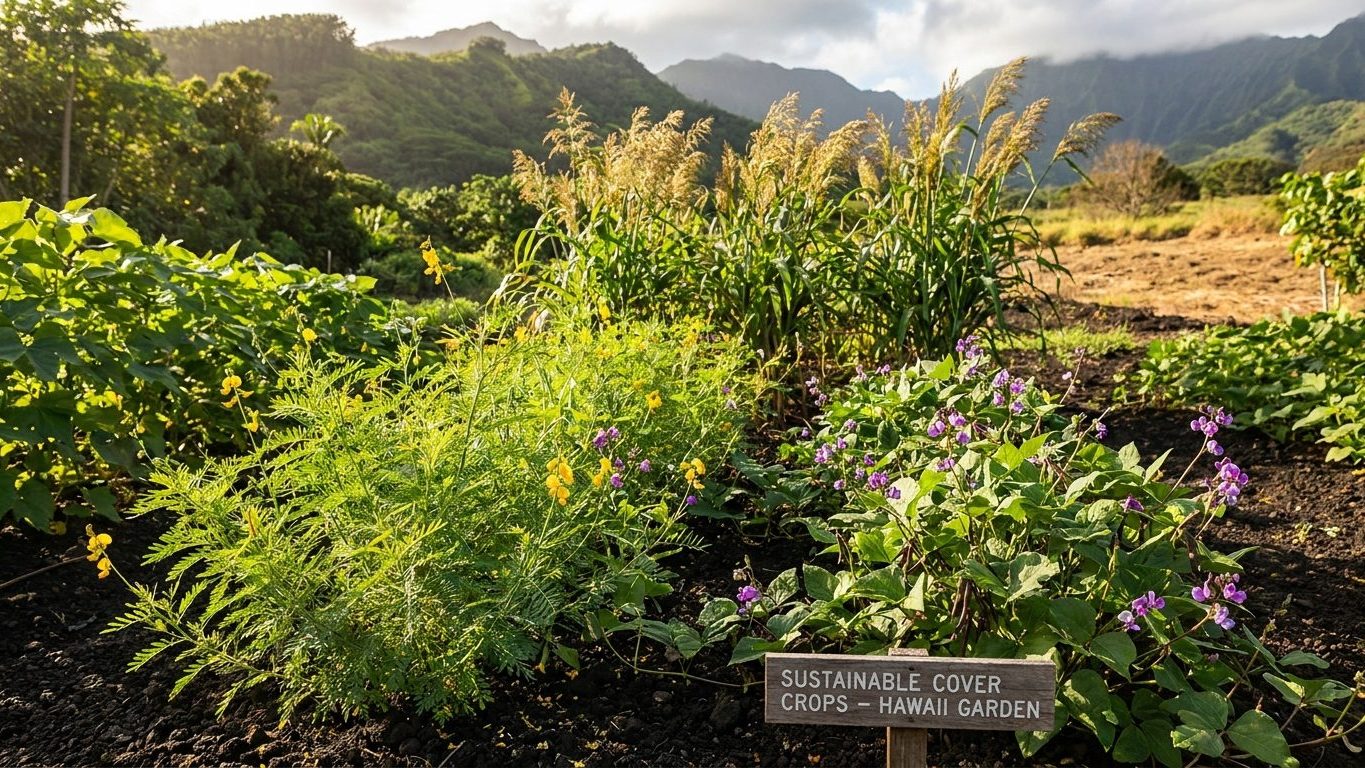

The best Cover Crops for Manitoba are the ones bred for a 122-day season and a January that averages -6.6°F: fall rye, spring oats, field peas, and tillage radish. Anything built for a long, hot summer, cowpeas, forage soybean, sorghum-sudangrass, runs out of time here before it delivers the soil-building payoff it’s grown for.
The short answer for Manitoba
Manitoba’s growing season runs from the average last spring frost on May 23 to the average first fall frost on September 22. That’s 122 days, and it’s the number that should drive a cover crop choice, not the maturity date printed on a seed bag grown for a milder climate. Those two dates are averages from Environment and Climate Change Canada’s 1981-2010 normals for the Winnipeg Richardson station, which means frost arrives later than May 23 or earlier than September 22 about half the time. Treat the window as narrower than it looks on paper.
Inside that window, the crops that perform reliably split into three groups, and picking one comes down to what job needs doing before the ground freezes.
| Type | Examples | Fit for a 122-day window | Winter behavior in zone 3b |
|---|---|---|---|
| Cereal | Fall rye, spring oats | Oats establish fast in spring; rye is usually seeded after a cash crop comes off | Fall rye overwinters green; oats winterkill reliably |
| Legume | Field peas, red clover | Peas fix nitrogen within weeks; clover is slower but can carry into a second year | Red clover survives if snow cover is decent; peas winterkill |
| Brassica | Tillage radish, mustard | Both mature fast, often 45-60 days to full growth | Both winterkill hard, leaving loose residue by spring |
Fall rye stands apart because it’s one of the few cover crops that actually keeps growing through a Manitoba winter, resuming in spring before most cash crops are even planted. Field peas and oats work as a short-window fix between a wheat harvest and freeze-up, adding nitrogen or biomass without any expectation they’ll survive to spring. Tillage radish and mustard fit the same short-window slot but bring a different benefit: their taproots break up compaction, and their guaranteed winterkill means no herbicide pass is needed to clear them out before next year’s crop goes in.
What will not work here
Warm-season cover crops are the clearest failure category. Sorghum-sudangrass, cowpeas, and forage soybean covers all need sustained soil and air temperatures well above 70°F for weeks at a stretch to establish properly, a stretch that a Manitoba summer, even at its warmest, rarely holds long enough. These crops are staples in places like Kansas or Missouri; seeded on the Prairies, they germinate slowly, grow thin, and get caught by the September 22 average frost before they’ve built meaningful biomass.
Winter survival is the second failure point, and it’s a hardiness issue, not a season-length one. Crimson clover and hairy vetch are popular cover crops in the U.S. Midwest and South, but both are typically rated hardy only to roughly USDA zone 4 or 5 for reliable overwintering. Manitoba’s reference zone, at Winnipeg, is 3b in the Canadian system, and the mean daily minimum for the coldest month there is -6.6°F, a figure that already sits below what those two legumes are bred to survive. Seed either one expecting a spring return and there’s a real chance of a bare, dead stand instead.
Dense, closely spaced legume stands carry a third risk that shows up less in the cold-hardiness conversation. The Red River Valley can run humid in late summer, and thick clover or vetch stands seeded too tight hold moisture at the crown longer, which invites foliar disease pressure that a more open stand would avoid. None of this means legumes are off the table in Manitoba. Field peas, seeded and winterkilled on purpose, sidestep both the hardiness problem and the disease-pressure problem simply by not being asked to survive winter at all.
The pattern across all three failure modes is the same: crops asking for either more heat or more winter mildness than the province actually delivers.
What changes across Manitoba
Manitoba is not one climate, and the 3b hardiness rating cited above belongs specifically to the Winnipeg reference station used in Natural Resources Canada’s Plant Hardiness Zone data, not to the whole province. That figure is built from seven climate variables under the Canadian system, and it does not convert to a USDA number; NRCan itself notes there’s no simple crosswalk between the two scales, so it shouldn’t be read against the U.S. zone figures used elsewhere on this site.
What matters for a reader outside Winnipeg is that a province this size spans a real range of conditions. Northern Manitoba runs colder and shorter-seasoned than the Red River Valley in the south, and there is no single hardiness number that covers a farm near The Pas the same way it covers one near Winnipeg or Morden. A cover crop plan built strictly on the 3b figure risks being too optimistic for the north and unnecessarily cautious for the warmer southern valley.
The practical move is to check where a specific property falls rather than assume the Winnipeg reading applies. Natural Resources Canada’s Plant Hardiness Zone map lets a reader look up their own municipality directly, and that number, not the provincial average, should be the one weighed against any cover crop’s cold tolerance. A grower in a river valley with good snow retention may get away with red clover surviving winter; the same clover seeded on an exposed northern quarter section with thin snow cover is a different bet entirely.
Where to check this for your own county
This page answers the question at the provincial level, using Winnipeg-area frost and hardiness data as the reference point. A county or municipal-level recommendation will always beat that, because local trial results account for soil type, snow retention, and microclimate in a way a provincial average can’t.
Manitoba Agriculture, at gov.mb.ca/agriculture, is the place to look for that finer detail. Two things are worth searching for specifically once there: the local planting and seeding-date guidance for the region a reader actually farms or gardens in, and any variety trial results for cover crops tested in that specific area rather than provincewide. Manitoba Agriculture regularly runs field-level trials comparing cover crop mixes for weed suppression, nitrogen contribution, and winter survival, and those results are broken down by growing region rather than given as one blanket recommendation for the whole province.
That local data matters most for exactly the two failure points already covered here: whether a legume that’s borderline hardy at the Winnipeg reference point has a realistic shot in a specific district, and how tight the real usable season is once local frost timing, not the provincial average, is factored in. A grower near the Manitoba-North Dakota border works with a meaningfully longer season than one farming closer to the Saskatchewan or Ontario boundary further north, and the provincial page can’t capture that difference the way a regional trial report can.
Checking this against your own garden
No frost date or hardiness zone beats what’s actually happening in a specific plot of ground, and three simple checks tell a grower more than any provincial average.
Soil warmth by hand is the first. Pushing a hand a few inches into the soil in spring and feeling for real warmth, not just thawed ground, is a better signal than the calendar for when a fast crop like oats or tillage radish will actually take off. Cold, wet soil that feels barely above freezing will sit a seed in place for days even after the average frost date has passed.
The first flush of flowers on a fast cover crop like buckwheat or mustard is the second signal worth watching. A quick jump from seedling to flower in a warm, sheltered spot points to a genuinely longer effective season on that ground than the provincial average suggests; a slow, delayed flush in a low-lying or shaded corner is a sign that spot runs cooler than the rest of the property.
The appearance of the first true leaves, the second set that follows the initial seed leaves, on any cover crop is the third check. That’s the point a stand has actually rooted in and started real growth, and the timing of that moment, tracked year to year on the same piece of ground, builds a far more accurate local calendar than any single frost date ever will.