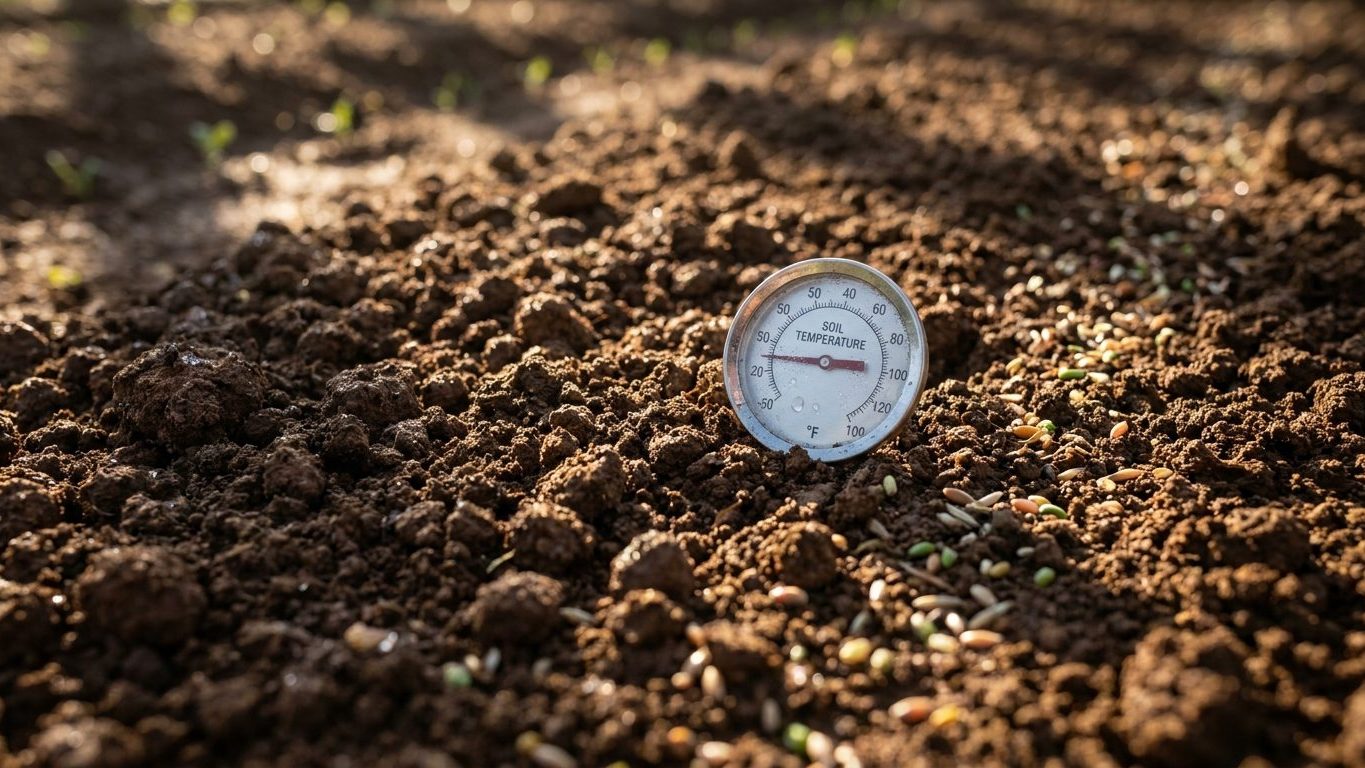

The short answer: cover crops in Saskatchewan go into the ground once the soil itself has warmed, not the moment frost risk fades, and they come out mechanically before the ground locks up for winter. The province’s brief season and its cold, Canadian zone 3a climate narrow the list of workable species to those that establish quickly, either winterkill cleanly or actually survive the cold, and finish their job before the first hard freeze.
When the soil is warm enough in Saskatchewan
The real question isn’t “what’s the frost date” so much as “how long after the frost date do I wait.” At the SASKATOON SRC station, Environment and Climate Change Canada’s Canadian Climate Normals (1981-2010) put the average last spring frost at May 18. That figure comes straight from the official ECCC climate normals API, and it needs a caution attached every time it’s used: it’s a mean date, not a guarantee. In roughly half of all years, frost arrives later than May 18. Treat it as the midpoint of a window, not a green light.
Soil temperature lags behind the frost date
Cover crops don’t germinate on a calendar date, they germinate at a soil temperature, and soil warms slower than air does. A patch of ground can sit well above freezing in the air while the top few inches of soil are still cold and slow, which delays germination and rots seed that goes in too early. That gap between “frost risk is over” and “soil is actually warm enough” is the part the average frost date can’t tell you. It’s also why a garden in a low, shaded, or northern part of the province can run weeks behind Saskatoon’s own numbers. A province isn’t one climate; it’s a patchwork of microclimates layered onto that Saskatoon baseline.
Species matter here too. Cool-tolerant grasses and some legumes will push through soil that’s still on the cool side, while others simply sit and wait, doing nothing useful, until the ground catches up. That’s a species-level decision, not a brand-level one, and it’s one reason seed racks organized by mix name aren’t much help for this particular timing question.
On rates: how much seed to put down per square foot or per acre depends on the species, the seeding method, and the source of the seed, and getting it wrong either wastes seed or wastes the season. That number belongs to your local Saskatchewan agriculture and agribusiness service, not to a generic online rule of thumb.
Termination is the other piece worth settling before sowing, not after. This isn’t the place for a chemical burn-down. Cover crops here get taken out mechanically, by mowing, crimping, cutting, or simply letting the first hard frost do the work for you if you’ve picked a species that dies back on its own.
How long the season lasts here
Run the two ECCC averages together and the frost-free window in Saskatchewan comes out to roughly four months, from the May 18 last spring frost to the September 18 first fall frost at the SASKATOON SRC reference station, both drawn from the same 1981-2010 Canadian Climate Normals. That’s about 123 days on paper. In practice it’s shorter, because both dates are means, not promises, and a late spring frost or an early fall one eats into that window from either end.
What a four-month window actually allows
Four months is enough to think about a second sowing in some years, but it isn’t the generous six- or seven-month window a milder territory gets. That changes the whole planning conversation. In a longer season, gardeners can treat a first cover crop planting as a warm-up act, terminate it, and get a second one established before the real fall crop or before winter closes the garden down. In Saskatchewan, the first sowing is often the only sowing that matters, which raises the stakes on timing it well and picking a species that does the most work in the time available.
It also changes whether transplanting is worth the trouble. Direct-sown cover crops don’t lose time to root shock, but a transplant can buy back a week or two of that scarce four-month window if the species tolerates it. Whether that trade makes sense depends on the specific crop and the specific year, which is exactly the kind of decision the succession sowing guide on this site walks through in more detail.
The bigger lesson is that Saskatchewan’s window rewards decisiveness. There isn’t much slack for a false start, a reseed after a failed germination, or a leisurely “we’ll get to it” approach to termination. Everything gets compressed into roughly four months, and the calendar doesn’t negotiate.
Heat and water in Saskatchewan
Here’s where a lot of general cover-crop advice goes sideways for this province. Most of that advice is written for territories where summer heat is the limiting factor, where the real planning question is how many scorching days a crop has to survive and how much rain it’ll get to offset them. That’s not the Saskatchewan story. This is a northern Prairie climate, and the number that actually governs what survives here isn’t a heat count, it’s a cold one.
Winter, not summer, sets the rules
The mean daily minimum temperature in the coldest month at the Saskatoon reference station is -5.3°F, per the ECCC Canadian Climate Normals (1981-2010). That single figure, combined with the province’s Canadian hardiness zone of 3a (from Natural Resources Canada’s Plant Hardiness Zone by Municipality data, 1991-2020 normals), decides which cover crop species make it through winter alive and which ones simply die back into a mulch. That NRCan zone number is worth flagging clearly: it’s the Canadian system, built on seven climate variables, and it does not convert to a USDA zone. A Canadian 3a is not comparable to any single USDA number, so don’t try to line it up against a US zone map.
What that -5.3°F figure means in practice is straightforward. A species that shrugs off mild winters elsewhere and gets treated as a hardy perennial in a warmer territory turns into an annual here, full stop, killed outright by the first serious cold snap. That’s not a downside, it’s often the plan. A crop that reliably winterkills at zone 3a temperatures does its termination for free, no mowing, no crimping required, just a hard frost doing the job overnight.
The other side of that same coin is oats, which behaves completely differently depending on where it’s grown. In a mild coastal territory, oats can overwinter and turn into a weed problem the following spring. In Saskatchewan’s zone 3a cold, that same species reliably dies at the first hard freeze, turning what’s a management headache elsewhere into one of the simplest, lowest-maintenance choices available here. Climate context changes the verdict on a species entirely, and this is the clearest example of it.
Which cover crops suit Saskatchewan
Given a roughly four-month window and a hard winter that kills anything not built to survive it, the species question sorts itself by a few plain criteria: how fast it establishes, whether it’s meant to winterkill or overwinter, and how it terminates.
| Type | Fit for Saskatchewan’s season | How it exits |
|---|---|---|
| Fast-establishing cool-season grasses (oats, and similar species) | Good fit for a short window; grows quickly once soil is warm | Reliably winterkilled by zone 3a cold, no cutting required |
| Cool-season legumes (field peas, and similar species) | Fits the window if sown promptly after soil warms | Usually winterkilled; biomass left to break down as mulch |
| Brassicas (forage radish, mustard, and similar species) | Fast growth suits the compressed season | Typically winterkilled; residue breaks down over winter |
| Overwintering species (winter rye, hairy vetch, some clovers) | Needs a fall sowing timed against the September frost date | Survives winter; terminated mechanically the following spring |
Why no cultivar gets named here
Notice that table talks in species, never in cultivar names or seed mix brands, and that’s deliberate. Which specific variety of oats or field peas performs best in a given district depends on local trial results that only a provincial extension service actually tracks. Saskatchewan is large enough that a variety proven in the south doesn’t necessarily hold up in a northern or upland district running weeks behind the Saskatoon baseline used throughout this page. Naming a cultivar here would be a guess dressed up as advice.
The same caution applies to seeding rates and to any nitrogen contribution claimed for a legume. Both depend on the specific species, the biomass it actually produces, and when it gets terminated, none of which this page can know for a specific garden. The honest answer, every time, is to route that question to the province’s own agriculture and agribusiness service, where the recommendations are built on trials actually run in Saskatchewan conditions rather than averaged across a continent.