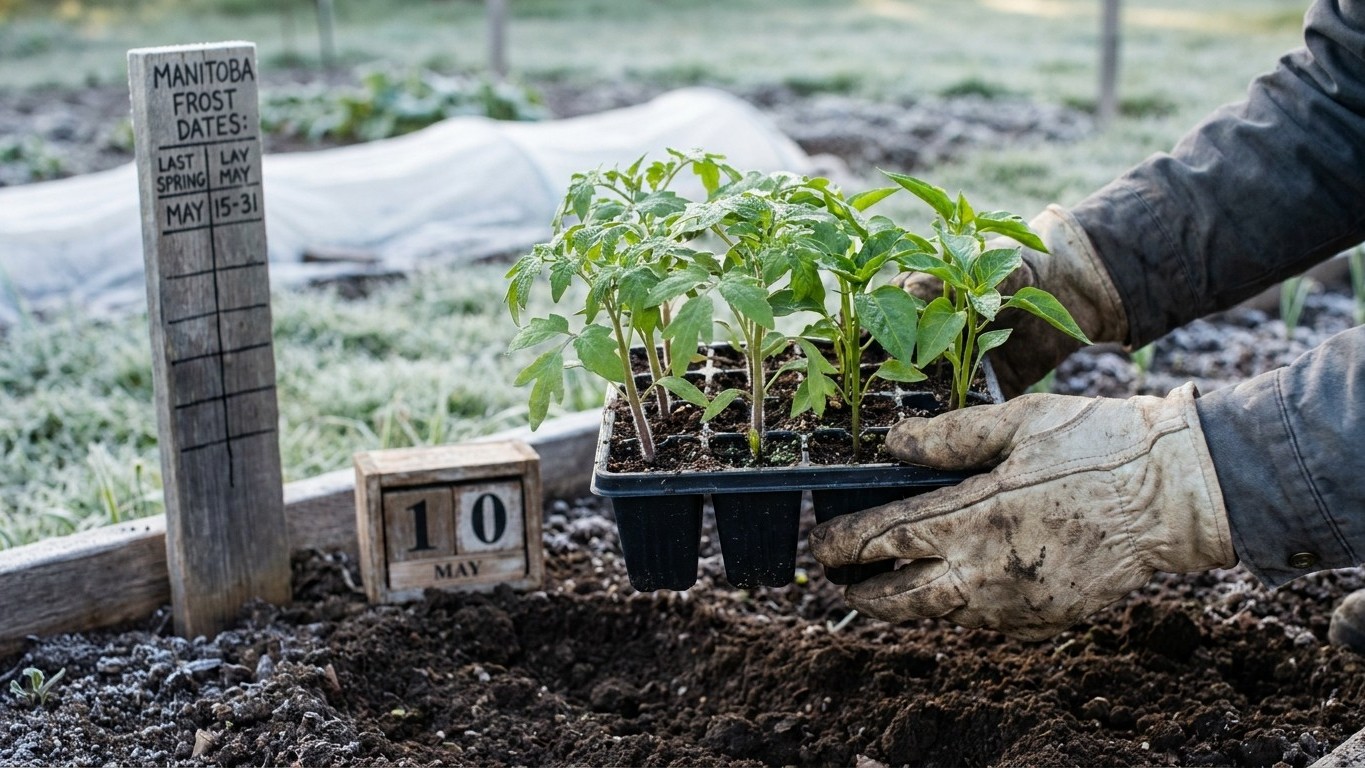

The short answer: Manitoba gardeners work with a frost-free window of roughly 122 days, from an average last spring frost on May 23 to an average first fall frost on September 22, inside Canadian hardiness zone 3b. That window, not the zone label, is what actually decides what you can grow here.
How long your season really is

Three numbers frame everything about gardening in Manitoba. The hardiness zone for the reference station is 3b on the Canadian plant hardiness zone system, a distinct method based on multiple climate variables rather than a single measurement. Canada’s system runs on seven climate variables instead of one, and Natural Resources Canada is blunt about it: there’s no clean conversion between the two scales, and a single Canadian zone can overlap nine different USDA zones. So treat 3b as its own number, tied to the Winnipeg reference station, not as a stand-in for a US zone.
The dates matter more day to day. Average last spring frost lands on May 23. Average first fall frost lands on September 22, a marker that also shapes seasonal traditions like knowing When to Carve a Pumpkin in Manitoba before the cold sets in. Subtract one from the other and you get about 122 frost-free days to work with, start to finish.
That number rules out a lot before you even pick a seed packet. Crops that need 100, 110, 130 days to mature outdoors from direct seed, some winter squash, certain long-season tomatoes, most dry beans grown for storage, are a gamble here unless you start them indoors weeks early and transplant out already several inches tall, a constraint that makes Growing Pumpkins in Manitoba particularly dependent on choosing shorter-season varieties. Warm-season fruiting crops face the same math, which is why Growing Peppers in Manitoba usually means starting seed indoors long before the last frost date, and the same short-season logic applies to Growing Potatoes in Manitoba, where timing seed potatoes around that frost window still determines the size of the eventual harvest, and it’s also why Growing Sweet Corn in Manitoba depends on picking varieties bred for short seasons, a contrast to hardy perennials, since Growing Asparagus in Manitoba shrugs off that same frost window once establisheding early-maturing varieties suited to that same 122-day window. Faster-maturing root crops fare better within the same window, which is part of why Growing Beets in Manitoba remains a reliable choice for gardeners working within these constraints, a logic that extends just as well to Growing Carrots in Manitoba, to Growing Parsnips in Manitoba, and to quick, cool-season leafy crops, since Growing Spinach in Manitoba fits comfortably inside the same short frost-free window. A 122-day window sounds generous until you remember the plant needs to germinate, grow, flower, and ripen fruit inside it, not just survive inside it.
The averages themselves deserve a second look, because an average is not a promise. Half of all years, by simple math, see frost arrive later than May 23 in spring or earlier than September 22 in fall. Some years split the difference kindly. Others don’t. A gardener who plants tender seedlings the week after the average last frost date is playing the same odds as someone who bets on a coin coming up heads because it came up heads last time. The dates come from the Winnipeg Richardson International Airport station, and a province this size isn’t one climate: northern districts and higher ground can run two or three weeks behind that station in both directions, shortening the usable window further.
What the summer does to a garden here
Here’s the number that separates Manitoba from a lot of the rest of this cocon: zero. The average number of days per year that reach 90°F or hotter, at the reference station, is 0.0. Heat stress, the kind that shuts tomato flowers down and sends lettuce bolting in a hot spell, is essentially not part of the Manitoba growing season in an average year.
That sounds like good news, and in one sense it is. There’s no midsummer dead zone here the way there is in hotter parts of the country, no stretch where cool-season crops simply refuse to grow and warm-season ones stall out from heat stress. Manitoba’s season behaves more like one continuous run than two shoulder seasons bookending a scorched middle.
The tradeoff is warmth, or the lack of consistent heat. Crops that need real sustained warmth to ripen, peppers, eggplant, melons, tend to limp along in a climate that rarely pushes past the upper 80s. That’s less a matter of frost dates and more a matter of accumulated heat over the season, and it’s a separate constraint from the frost-free window discussed above. A gardener here isn’t racing the clock against a killing heat wave. They’re racing it against a summer that may simply never get hot enough, long enough, for certain fruit to fully mature before fall frost returns.
The other number worth sitting with is winter, even though it falls outside the growing season itself. The coldest month’s average daily minimum runs -6.6°F at the reference station. That figure has nothing to do with what you can plant in May, but it decides which perennials, shrubs, and fruit trees survive from one year to the next, which is why zone 3b, cold as it is, still matters for anything you’re not planning to dig up and start over every spring.
What tends to go wrong in Manitoba
No Canadian provincial service publishes an equivalent home-garden pest list, so the pests worth naming here come from extension research across the border, at NDSU and the University of Minnesota, tracking the same growing conditions and many of the same crops. The biology crosses the border freely. The calendar doesn’t always match exactly, so use these as a starting list, not a schedule, and confirm identification through your own provincial channels before acting on anything.
Early in the season, cabbage maggot targets young brassica transplants, cabbage, broccoli, and their relatives, feeding on roots just below the soil line while the plants still look fine above ground until they suddenly wilt. Colorado potato beetle shows up as plants bulk up through early summer, both adults and larvae stripping foliage off potato plants and, less often, their tomato and eggplant relatives. By midsummer, squash vine borer becomes the one to watch for anyone growing squash or pumpkins, boring into stems at the base and causing a plant that looks healthy one week to collapse the next. Later in the season, spotted wing drosophila targets soft fruit, raspberries, cherries, and similar crops, laying eggs in fruit that’s still ripening rather than waiting for it to overripen the way most fruit flies do.
Four pests, four different points in the season, is a more useful mental model than a long checklist of every insect that’s ever been photographed in a Manitoba garden. Watch for the damage pattern that matches your crop and the calendar window, and you’ll catch most problems before they spread.
Where to check before you plant
Everything above describes conditions at one reference station, not the whole province. Manitoba spans a wide range of latitude, and growing conditions in the Interlake region or the far north look nothing like conditions near the Red River Valley. A planting calendar built around the Winnipeg averages can run two or three weeks off in either direction once you’re far enough from that reference point.
Manitoba Agriculture is the right first stop for anything specific to your part of the province, from current pest advisories to crop-specific planting guidance: gov.mb.ca/agriculture. From there, your local regional office or conservation district can usually narrow things down further, since they track conditions closer to your own soil and microclimate than any provincewide figure can.
The numbers above set the outer limits of what a Manitoba season allows. The details of any one crop, exact seeding dates, spacing, days to maturity for a specific variety, belong on that crop’s own page, where they can be worked out against these same frost dates without repeating them here.
Where to Go Next for Specific Crops
The frost dates and cold-month averages above play out differently depending on what you’re actually trying to grow, and that’s worth working through crop by crop rather than in the abstract. If garlic is on your list, the planting guide on growing garlic in Manitoba gets into why the province’s long, cold winters actually do the vernalizing work for you, no refrigerator required, and what that means for timing your fall planting. If it’s the lawn you’re trying to get right, the piece on Manitoba lawn care explains why this is a cool-season grass zone through and through, with zero days a year hitting 90°F and winter lows that rule out warm-season options entirely. And if you’re chasing ripe tomatoes before the season closes, the guide to growing tomatoes in Manitoba lays out the real window you’re working with, an average last spring frost near May 23 and first fall frost around September 22, and how to plan varieties and planting dates around it.