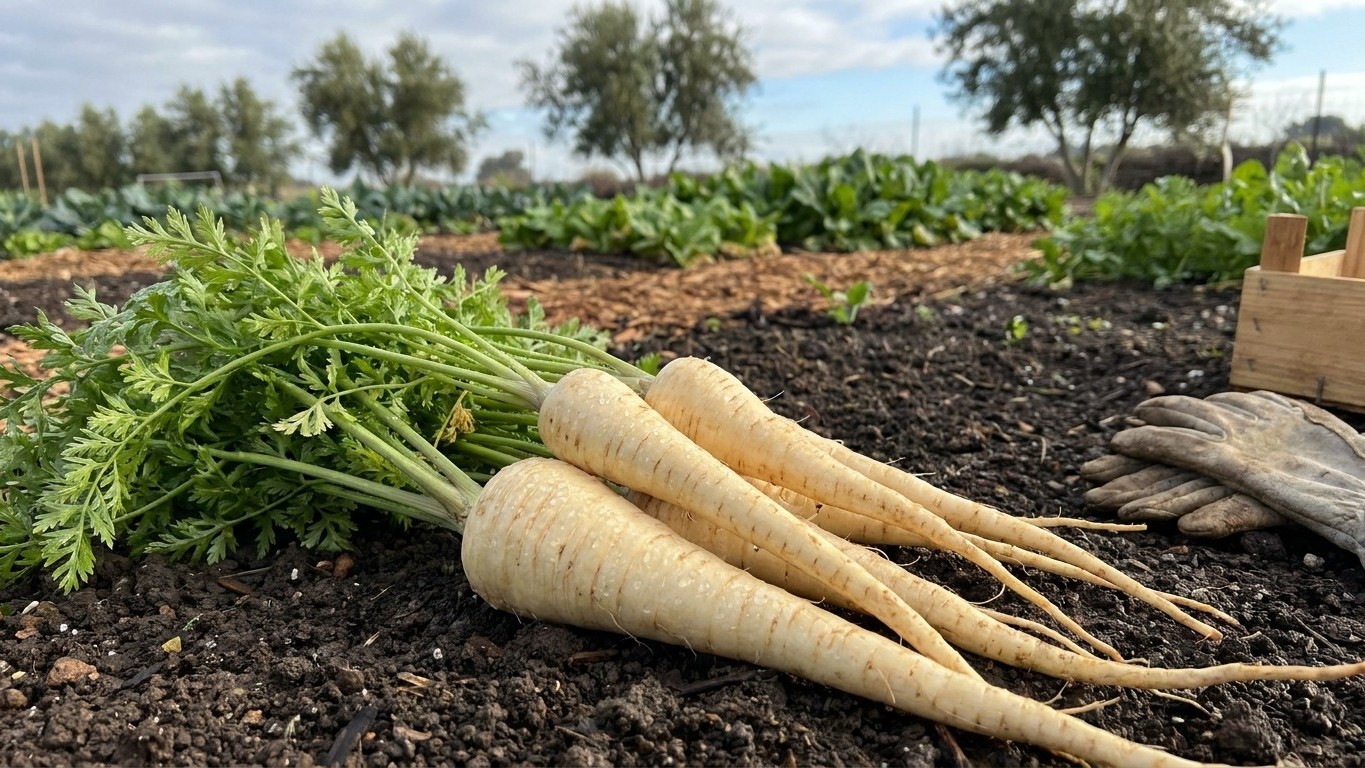

None of the fifteen pests that regional extension services track for this part of the northern Plains are listed as parsnip specialists. The closest match is Japanese beetle, a generalist leaf feeder that will land on parsnip foliage the same way it lands on hundreds of other plants. Everything else on the documented list targets tree fruit, brassicas, alliums, cucurbits, or trees, not a carrot-family root crop growing in a Manitoba garden.
Which pests attack parsnip in Manitoba

NDSU Extension and University of Minnesota Extension, the two bordering-state services that document garden and landscape pests across the region that includes Manitoba’s growing conditions, list fifteen species active here: Apple maggot, Boxelder bug, Cabbage maggot (Delia radicum), Colorado potato beetle, Corn earworm, Emerald ash borer, Japanese beetle (Popillia japonica), Onion maggot (Delia antiqua), Spotted wing drosophila (Drosophila suzukii), Squash bug, Squash vine borer, Striped cucumber beetle, Swede midge, Three-lined potato beetle, and Yellowheaded spruce sawfly.
That’s a long list, and most of it has nothing to do with a parsnip bed. Apple maggot works on tree fruit, not roots in the ground. Boxelder bug feeds on boxelder and maple seed, and turns up as a fall nuisance indoors, never on vegetable foliage. Emerald ash borer bores into ash wood exclusively. Yellowheaded spruce sawfly strips spruce needles. None of these four species has any reason to cross paths with a garden row.
Three more are root or growing-point specialists on entirely different plant families. Cabbage maggot tunnels into the roots of cabbage, broccoli, radish, and turnip, cole crops, not carrot-family roots. Onion maggot does the same job inside onion and other allium roots. Swede midge targets the growing point of brassicas, including rutabaga, which is where the confusion comes from: “swede” is simply the British name for rutabaga, a root vegetable, but the insect is a brassica pest, not a carrot-family pest, and parsnip isn’t in that family at all.
Six more belong to cucurbits or solanaceous crops. Squash bug, squash vine borer, and striped cucumber beetle all work squash, pumpkin, and cucumber vines. Colorado potato beetle and three-lined potato beetle feed on potato-family foliage: potato, tomato, eggplant, ground cherry. Corn earworm targets corn ears and tomato fruit. Spotted wing drosophila attacks thin-skinned fruit like raspberries and cherries. None of these seven touches a root vegetable’s foliage or roots.
A pest documented for tree fruit, brassica roots, or cucurbit vines does nothing to a parsnip patch, no matter how often its name shows up in the same regional pest list. That leaves one species worth watching: Japanese beetle, a generalist that feeds on foliage across hundreds of plant species and doesn’t discriminate by crop family.
When each one shows up, and what it does first
The other fourteen species keep to their own calendars entirely, tied to apple bloom, ash trees, brassica transplants, or cucurbit vines, not to a parsnip row. That’s why this section only needs to track one insect.
Parsnip is sown directly in place, and germination alone takes 14 to 21 days, so the earliest weeks of a parsnip bed show nothing but bare soil and a slow scatter of seedlings. Manitoba’s growing season, framed by a mean last spring frost of May 23 and a mean first fall frost of September 22, gives a direct-seeded parsnip roughly four months to reach the 100 to 120 days it needs from seeding to maturity. Both frost dates are averages, meaning in one year out of two the actual frost lands later than that, so the safe assumption is a slightly shorter window than the calendar suggests.
Japanese beetle activity builds during the warmest stretch of summer, once parsnip foliage has filled in and the canopy is well established, several weeks into that 100 to 120 day cycle rather than at the seedling stage. Adults feed in groups, usually on the sun-exposed top of the canopy during the warmest part of the day, and the first sign is rarely a hole punched clean through a leaf. It’s a lacy, skeletonized patch, where the beetles have eaten the softer tissue between the veins and left the veins themselves standing like a net.
Because the beetles feed in clusters, damage tends to appear on a few plants first, then spread outward across the bed over a matter of days rather than showing up evenly all at once. Checking the top leaves in the middle of a warm afternoon, when the beetles are most active, is a more reliable way to catch the problem early than checking at dawn or dusk, when adults are sluggish and tucked lower in the foliage.
Telling the damage apart from everything else
Parsnip beds run into plenty of problems that have nothing to do with insects, and mistaking one for the other means treating a plant for a pest it never had. Wait the full 14 to 21 day germination window before assuming a bare row is pest damage and resowing on top of seed that simply hasn’t sprouted yet.
| Symptom | Likely cause | What distinguishes it |
|---|---|---|
| Lacy, skeletonized patches on upper leaves | Japanese beetle feeding | Beetles visible in clusters during warm daytime hours; veins left intact, softer tissue eaten between them |
| Forked or branched roots | Heavy or stony soil deflecting the taproot, or overwatering encouraging side branching | Dig a small profile: stones or clay layers point to soil texture; consistently soggy ground without drainage points to watering, not insects |
| Patchy or missing germination | Old seed, or simply still within the 14 to 21 day germination window | No chew marks or insect activity at soil level; seed hasn’t had time to sprout yet |
| Pale or yellowing foliage without chew marks | Nutrient deficiency or drought stress | Discoloration is even across the leaf rather than patchy; no frass, no visible insects |
| Wilting despite regular watering | Root rot or waterlogged soil | Progresses from the oldest leaves inward; roots often discolored when lifted, with no tunnels or chew marks |
A forked root is worth calling out on its own, since it has two separate causes that get merged too often: heavy or stony ground that deflects the growing tip, and overwatering or excess nitrogen that pushes the root to branch instead of growing straight down. Neither one involves an insect, and neither one is fixed by a pest treatment. When a symptom doesn’t clearly match a row on that table, the reliable next step is sending a photo or a sample to a local agricultural office rather than guessing.
What actually works here, and what is a waste of time
Since only one insect out of the fifteen documented species has any real reason to visit a parsnip bed, the practical response stays simple. Hand-picking Japanese beetles works well because the adults are sluggish in cool morning hours and drop easily into a container of soapy water when disturbed. A physical barrier put in place before beetles arrive stops far more damage than any treatment applied after the leaves are already skeletonized. A lightweight floating row cover over young parsnip foliage during the warmest weeks of summer keeps adults off the plant entirely, and since first-year parsnip is grown for the root rather than for flowers or seed, the cover can stay on longer than it would over a crop that needs pollinator access.
What doesn’t help is spraying anything preventively before damage actually shows up. Fourteen of the fifteen species on the regional list will never touch a parsnip bed no matter what’s applied, so a broad treatment aimed at covering every possibility mostly wastes time and money on pests that were never a risk here. Treating forked roots or a patchy stand with any kind of pesticide is another dead end, since neither one is insect damage to begin with, and no product changes soil texture or a watering habit. Any decision about an actual product, timing, or rate belongs with a local agricultural office, since registration and recommendations vary by region and this page doesn’t prescribe one.
Where to check this for your own county
The record behind this page comes from NDSU Extension and University of Minnesota Extension, two bordering-state services that document pest activity across the northern Plains and prairie region that includes Manitoba’s growing conditions. Neither one is Manitoba’s own provincial authority, so a reader wanting confirmation specific to their own yard has good reason to check with a Manitoba provincial agriculture office or a local municipal horticulturist rather than treating a border-state list as the final word.
A species documented across an entire region doesn’t mean it’s present in a specific yard. Japanese beetle sightings, in particular, cluster unevenly, often heavier near urban shade trees and ornamental plantings than in more remote rural gardens, so what’s confirmed at the provincial or state level says little about what’s actually feeding on one particular parsnip row.
Before treating anything, the more useful move is bringing a photo of the actual damage, or a physical sample if one is available, to the nearest agricultural office and asking directly whether Japanese beetle, or anything else, has been confirmed in the area this season. Confirmed sightings shift from year to year, and a local office will know what’s actually been reported nearby rather than what’s simply possible on paper.
Common questions
Does parsnip have a dedicated pest documented in Manitoba?
Not in the sourced regional record. The fifteen species tracked by NDSU Extension and University of Minnesota Extension target tree fruit, brassicas, alliums, cucurbits, or trees. The closest match to a parsnip bed is Japanese beetle, a generalist foliage feeder rather than a root-crop specialist.
Why doesn’t Swede midge threaten parsnip despite the name?
“Swede” refers to rutabaga, a brassica-family root vegetable, and the midge targets brassica growing points. Parsnip belongs to the carrot family, an entirely different plant group that this insect doesn’t feed on.
What causes forked parsnip roots if it isn’t a pest?
Two separate things, not one: heavy or stony soil that deflects the growing taproot, and overwatering or excess nitrogen that encourages the root to branch. Neither involves an insect, and digging a small soil profile usually shows which one applies.
When does parsnip taste best in this climate?
Flavor comes from frost exposure converting stored starch to sugar, not from surviving a particular hardiness zone. With a mean first fall frost of September 22 and roots that tolerate cold well below that, roots can stay in the ground through several frosty weeks before harvest, well past that mean date in most years.