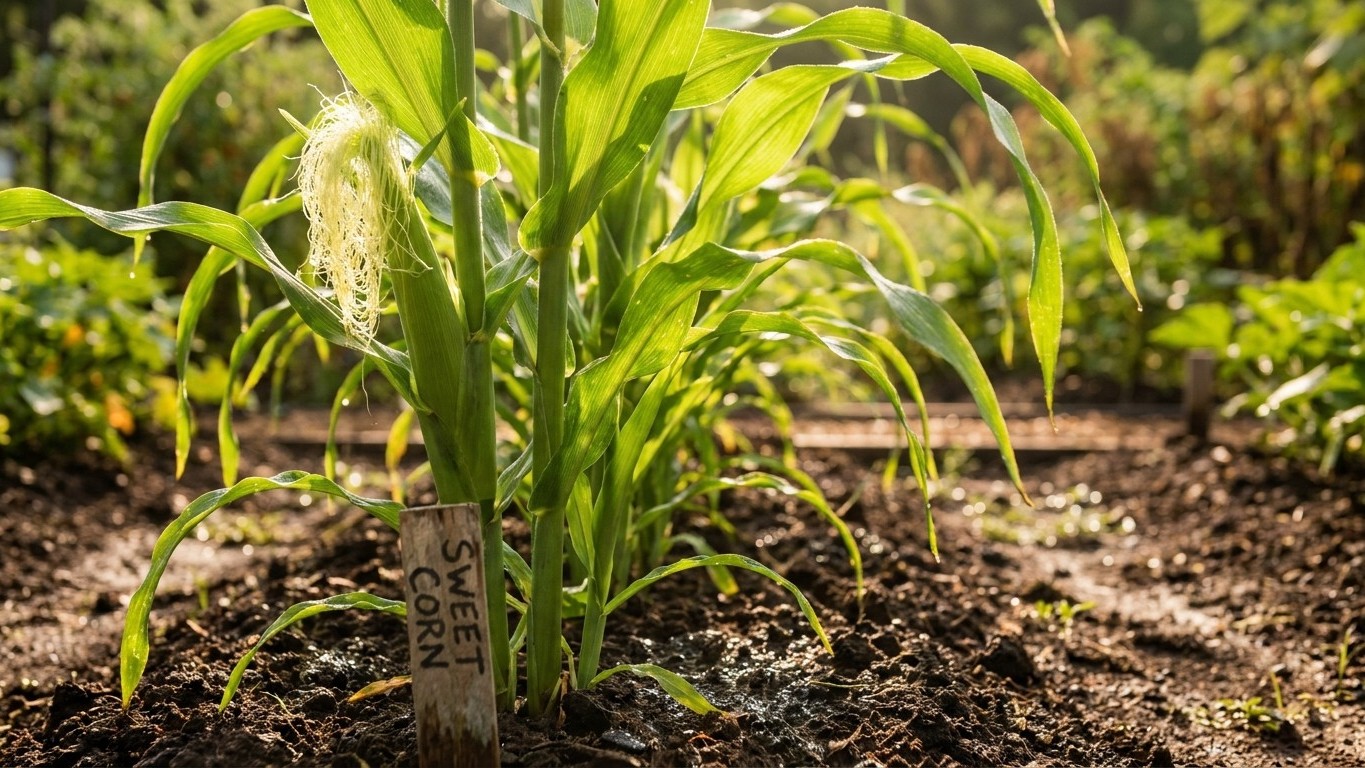

Sweet corn can ripen in Manitoba, but only inside a narrower window than the frost dates alone suggest. A fast variety bred for 60 to 65 days generally has room to mature before autumn shuts things down. A variety pushing toward 90 days is gambling against a growing season that, on paper, looks generous but in practice runs shorter once soil temperature enters the equation.
The short answer
Here’s what the frost dates don’t tell you: sweet corn doesn’t start its clock on the last frost date. It starts when the soil itself reaches 60 F, and that threshold arrives well after the air has stopped freezing. Around Winnipeg, the average last spring frost falls on May 23. Soil doesn’t jump to planting temperature that same week. It warms gradually, lagging behind air temperature by a stretch of time this data doesn’t quantify precisely, but the lag is real and it matters more in a place like Manitoba than in a milder climate, because the soil here starts from a deeper winter cold.
That matters because the 60-to-90-day maturity window sweet corn needs has to fit between whenever the soil actually clears 60 F and whenever the first fall frost arrives. The average first fall frost lands on September 22. Do the arithmetic from the average last spring frost to the average first fall frost and you get roughly 122 days of frost-free ground. That sounds like plenty of room for a 90-day variety. It isn’t, once you subtract the real delay between “frost has passed” and “soil is warm enough for corn seed.”
Both of those frost dates are averages, not guarantees. Environment and Climate Change Canada’s normals mean that in one year out of two, frost arrives later than May 23 in spring, and earlier than September 22 in fall. Half the time, the actual window is shorter than the 122-day figure implies. Treat these numbers as the midpoint of a range, not a date you can plant or harvest by with confidence.
There’s also the matter of heat, not just frost-free days. This station records zero days a year averaging 90 F or hotter. Sweet corn doesn’t strictly need scorching heat, but it does need consistent warmth to push through its maturity stages at the pace seed packets assume. A season with no really hot stretches can drag maturity out longer than the stated day count, even when frost stays away.
And Manitoba isn’t one climate. The Winnipeg Richardson station sits in the warmest part of the province’s growing belt. Northern districts and higher ground run weeks behind these averages, which means gardeners outside the Winnipeg area should treat this window as optimistic, not standard.
Does a late variety fit here?
A 60-day variety
A variety maturing in roughly 60 days has real breathing room in this climate. Even accounting for the soil-warming lag after the average May 23 frost, and even in a year where frost holds off later than usual in spring or arrives earlier than usual in fall, 60 days generally fits inside what’s left of the season. This is the type of maturity length that gives Manitoba gardeners a buffer against a below-average year, rather than requiring everything to go right.
A 90-day variety
A 90-day variety is a different story, and the honest answer is that it does not reliably fit. Start the clock only after soil hits 60 F, which already eats into the 122-day average frost-free stretch. Add the fact that half of all years bring an earlier fall frost or a later spring frost than the averages used here. Add the further fact that a summer averaging zero days above 90 F won’t necessarily deliver the steady heat that pushes a long-season variety through its final stretch on schedule. Stack those three factors together and a 90-day sweet corn variety is running against the edge of what this climate offers, with little margin if the season runs even slightly behind average. Gardeners drawn to a late variety for its flavor or ear size should treat it as a genuine risk here, not a safe bet with a wide cushion.
| Factor | 60-day variety | 90-day variety |
|---|---|---|
| Fits average frost-free window (122 days) | Comfortably | Tight to none |
| Buffer if frost arrives earlier than average | Yes | Little to none |
| Affected by soil-warming lag after last frost | Manageable | Significant risk |
| Affected by low summer heat accumulation (0 days above 90 F) | Minor | Notable delay risk |
What goes wrong here
- Sown when soil is still too cold. Planting sweet corn before soil reaches 60 F leads to slow, uneven germination or outright seed rot, especially since Manitoba’s soil takes real time to catch up after the last spring frost. The remedy is to check soil temperature directly with a soil thermometer rather than planting off the calendar frost date, since the two are not the same event.
- A variety too late for the season. A 90-day type planted here is racing a frost-free window that averages only about 122 days and runs shorter in half of all years. The remedy is straightforward: favor a variety on the shorter end of the 60-to-90-day range Utah State University Extension describes, and treat anything pushing toward 90 days as a gamble rather than a routine choice for this territory.
- Sweetness lost because two types tasselled together. This one has nothing to do with frost dates or soil temperature. Standard sweet corn (su), sugary enhanced (se), and supersweet (sh2) types cross-pollinate freely, and if their tassels shed pollen at the same time, the sh2 or se ears lose the sweetness they were grown for. No isolation distance is published for this problem, so don’t rely on spacing alone. The remedy is timing: stagger plantings so the different types don’t tassel during the same window, and grow each type in its own block of three or more rows rather than mixing types row by row.
Common questions
What’s the earliest safe date to plant sweet corn in Manitoba?
There’s no single safe date on the calendar, because the trigger is soil temperature, not the frost date. Planting should wait until soil reaches 60 F, which typically comes after the average last frost of May 23, not on that date itself.
Is a 90-day sweet corn variety ever a good idea here?
It’s a risk rather than a routine choice. With an average frost-free window of about 122 days, a soil-warming lag after the spring frost, and years where frost arrives earlier or later than average, a 90-day variety has little margin for error in this climate.
Do I need a set distance between different corn types to protect sweetness?
The source behind this guidance does not publish an isolation distance. What matters is timing: su, se, and sh2 types must not tassel at the same time, and each type should be grown in its own block of three or more rows.
Does Manitoba’s lack of really hot days affect sweet corn?
Yes. This region averages zero days a year at 90 F or above. That absence of intense heat can slow the pace at which corn moves through its maturity stages, which matters most for longer-season varieties already working with a tight window.