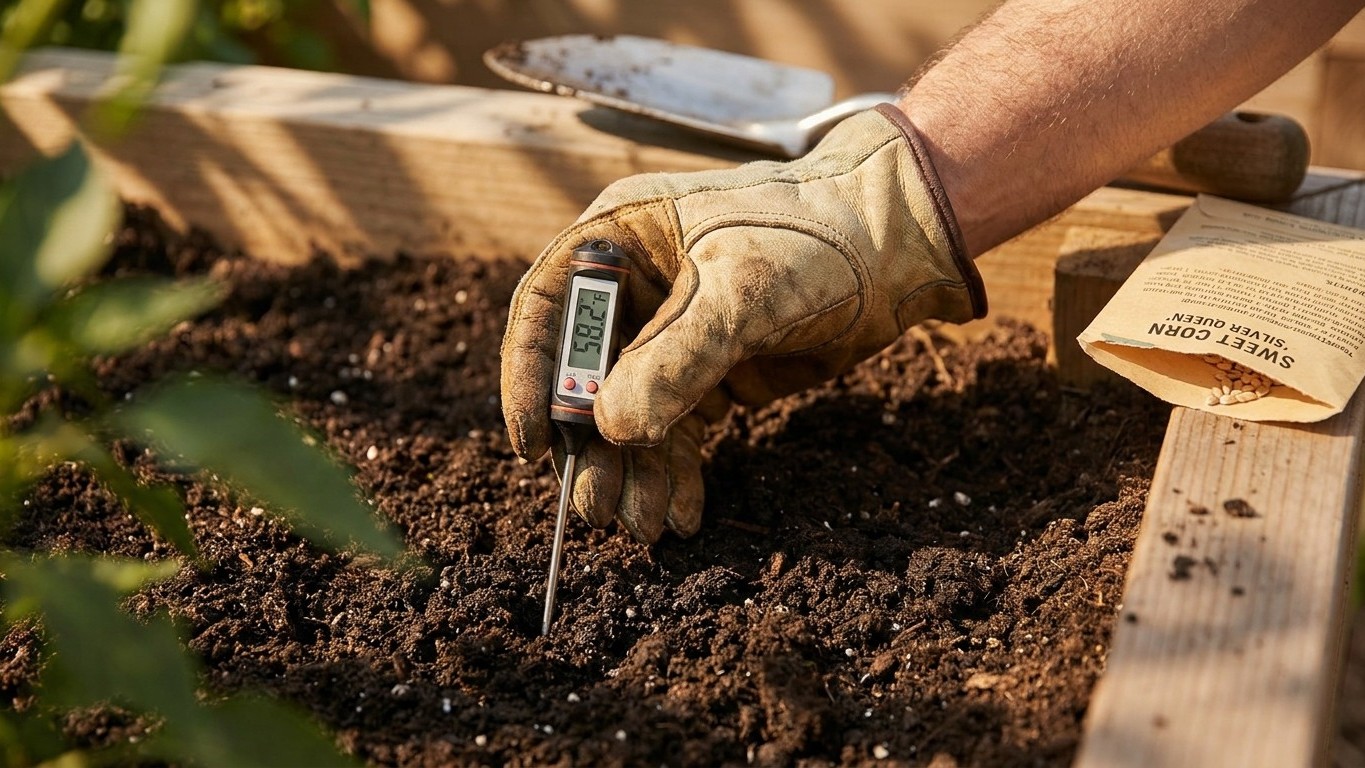

In Manitoba, sweet corn seed goes into the ground once soil temperature holds above 60 F, which typically lands in the first half of June, roughly two to three weeks after the average last spring frost of May 23. From there, a 60-day variety fits comfortably before the average first fall frost on September 22, while a 90-day variety leaves little room to spare.
The short answer
Here’s where a lot of gardening advice trips people up: the last frost date and the “safe to plant corn” date are not the same thing. Environment and Climate Change Canada puts the average last spring frost at Winnipeg Richardson International Airport at May 23. That’s a mean figure pulled from three decades of climate normals, which means in roughly half of all years, frost shows up later than that. Treat it as the middle of a range, not a green light.
Sweet corn doesn’t care about frost dates directly. What it cares about is soil temperature, and Utah State University Extension is specific on this point: soil needs to sit above 60 F before seed goes in. Corn seed sown into cold, wet soil rots or germinates unevenly, and neither of those outcomes gets fixed later in the season. Air warms faster than soil, so the ground beneath a Manitoba garden bed is still cold for a stretch after that May 23 frost average has come and gone. No official soil-temperature normal is published for this station the way frost dates are, so the honest answer is: test the soil yourself with a simple thermometer pushed a few inches down, rather than counting days on a calendar.
Once soil clears that 60 F threshold, the countdown starts. Sweet corn needs 60 to 90 days from planting to harvest, depending on the variety. The other end of the season is the first fall frost, averaging September 22 at the same reference station. Between May 23 and September 22 sits a 122-day frost-free window on the calendar. But since planting can’t start right at the frost date, the usable stretch is shorter than that math implies. A grower who waits for soil to genuinely warm, likely into early or mid June, is working with something closer to 100 days before that average fall frost returns.
That’s enough room for a shorter-season sweet corn. It’s tight for anything pushing toward the 90-day mark, and the next section works through why.
Does a late variety fit here?
A 60-day variety
A variety maturing in roughly 60 days from planting has real breathing room in this climate. Planted in early June once soil has warmed, it would be ready for harvest by early August, well ahead of the September 22 average frost. That built-in cushion matters because Manitoba summers don’t deliver much extra heat to speed things along: Environment and Climate Change Canada’s normals for the reference station show an average of 0.0 days per year reaching 90 F or higher. Corn is a warm-season crop that develops faster with heat, and a summer with essentially no days that hot means growth runs closer to the slow end of a maturity rating than the fast end. A 60-day variety absorbs that lag without pushing into risky territory.
A 90-day variety
A 90-day variety is a harder sell here. Planted as soon as soil clears 60 F, likely sometime in early June, harvest lands somewhere around early September, only a few weeks ahead of that September 22 average frost date. And because that frost date is a mean, not a guarantee, in half of all years the actual frost arrives later, but in the other half it arrives earlier. A cool, slow spring that delays soil warming by even a week pushes harvest dangerously close to, or past, that frost line. Add in the region’s essentially zero days above 90 F, meaning the heat units that would otherwise speed a long-season variety toward maturity simply aren’t there, and the case against a 90-day variety gets stronger. It isn’t that a 90-day sweet corn is impossible in Manitoba. It’s that the margin for error, a late spring, a cool June, an early autumn cold snap, is thin enough that most gardeners are better served by something shorter.
What goes wrong here
- Soil sown too cold. Seed goes in the week after the average frost date because that’s the date people remember, but the ground hasn’t caught up yet. The fix is patience: check soil temperature directly rather than working off the frost date alone, and wait until it consistently reads above 60 F before dropping seed.
- A variety too late for the season. A 90-day variety gets planted with the same start date that would suit a 60-day one, and the harvest window gets swallowed by the calendar. The fix is matching the maturity rating to the actual frost-to-frost stretch available here, favoring the shorter end unless there’s a strong reason not to.
- Sweetness lost to a neighbor, not the weather. This one has nothing to do with soil or frost. Utah State University Extension notes that sweetness is lost when standard (su), sugary-enhanced (se), and supersweet (sh2) types tassel at the same time nearby. Cross-pollination between types dulls the flavor even when everything about planting date and variety choice was done right. There’s no published isolation distance to fall back on here, so the working fix is timing and layout: stagger planting dates so different types don’t tassel together, and grow each type in its own block of three or more rows rather than mixing types through the same rows.
Common questions
Can I plant sweet corn right after the last frost in Manitoba?
Not reliably. The average last frost falls on May 23, but soil typically needs longer than that to clear the 60 F mark sweet corn requires. Planting on the frost date alone risks cold, slow-germinating seed.
How do I know if a variety’s maturity rating fits my season?
Compare the days-to-maturity number against the stretch between when your soil actually warms above 60 F and the average first fall frost, September 22 at the Winnipeg reference station. A 60-day variety has a comfortable cushion; a 90-day one has very little.
Does Manitoba get hot enough for sweet corn to mature quickly?
Not especially. The reference station averages 0.0 days a year at or above 90 F, so there’s little extra heat to push a slow variety along faster than its rating suggests.
Why did my sweet corn taste starchy instead of sweet even though I planted on time?
That’s usually a pollination issue, not a planting-date one. If a standard, sugary-enhanced, or supersweet type tasseled at the same time as a different type nearby, cross-pollination can dull sweetness regardless of when or how well the crop was sown.