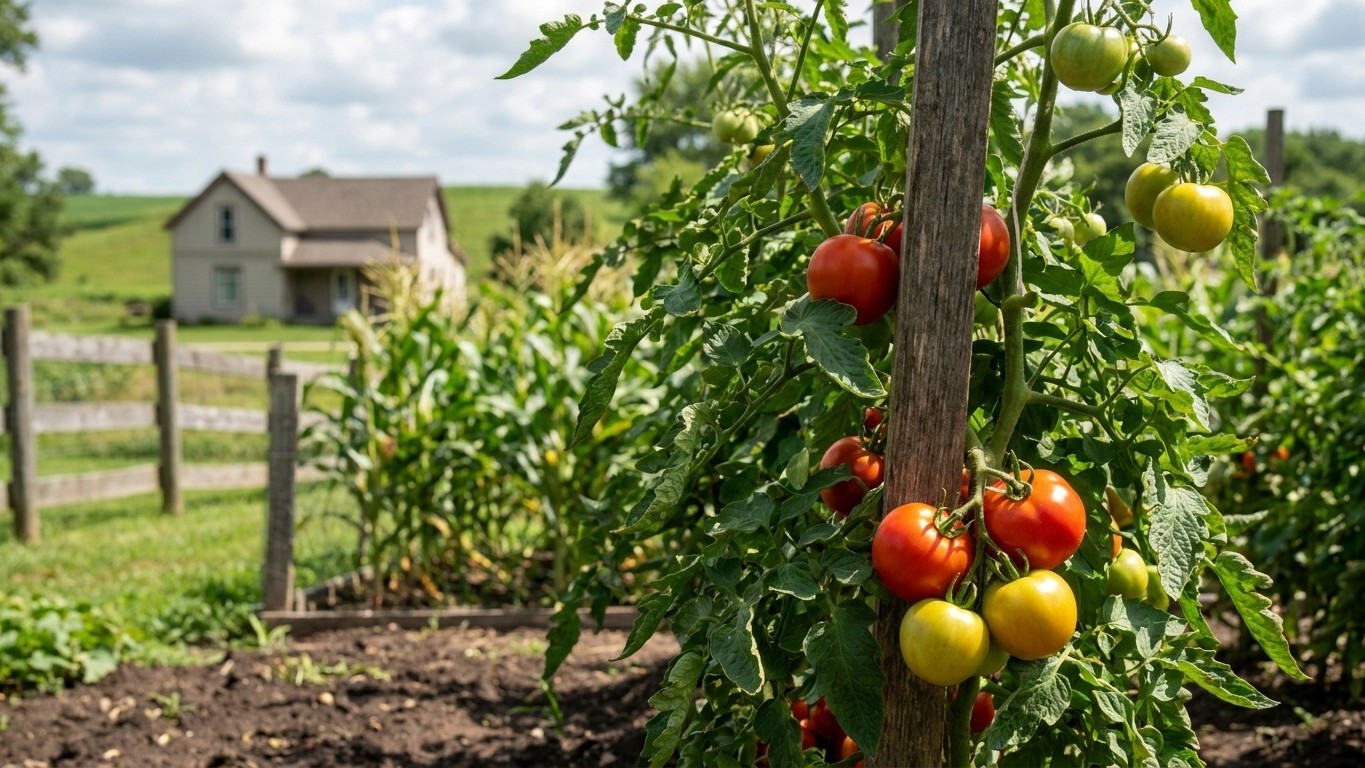

The short answer: pick ripe or near-ripe tomatoes before the first fall frost, and don’t wait for a calendar date to make that call. At Winnipeg Richardson International Airport, the average first fall frost lands September 22, but that’s a midpoint, not a promise. Anything still green or just starting to blush when a hard freeze is forecast should come inside, because a Manitoba tomato left on the vine through frost is a tomato you’ve lost.
When to pick tomatoes in Manitoba
The number that matters most here isn’t a single date, it’s a window, and Manitoba’s window is tight. Environment and Climate Change Canada’s 1981-2010 normals put the average last spring frost at Winnipeg Richardson Int’l A at May 23 and the average first fall frost at September 22. Subtract one from the other and you get roughly 122 days of frost-free growing, measured at a single airport station in a province that stretches from the U.S. border to Hudson Bay.
The mean date is not a safe date
Here’s the part growers miss: an average frost date means frost arrives later than that in about half the years on record, and earlier in the other half. September 22 is the fifty-fifty point, not a guarantee you get to keep picking past it. Some seasons hand you an extra two or three weeks of ripening time on the vine. Others end abruptly in early September. Treat the date as a planning anchor and watch the actual forecast once you’re within ten days of it.
Reading the plant, not just the calendar
Ripening on the vine slows down well before frost actually hits. Once night temperatures start dipping into the low 50s Fahrenheit, tomatoes stop coloring efficiently, even if the days are still warm. That’s your cue to start harvesting anything that has broken color, meaning it shows the first streak or blush of pink, yellow, or red rather than solid green. Fruit at that “breaker” stage will finish ripening off the vine reliably. Fruit that’s still hard and fully green is a gamble, and one worth understanding before you decide what to pick and what to leave.
Manitoba’s hardiness zone for the Winnipeg area sits at 3b under the Canadian system, according to Natural Resources Canada’s Plant Hardiness Site using 1991-2020 normals. That’s a different scale than the USDA zones used south of the border, built from seven climate variables instead of one, so don’t try to line it up against a U.S. zone map. What it tells a Manitoba gardener plainly is that the season is short and the margin for error at both ends, spring and fall, is thin. Growers north of Winnipeg or at higher elevation should expect that frost-free window to be shorter still, not longer.
What to do with the green ones
Not every green tomato is the same tomato, and sorting them correctly before frost decides whether your harvest turns into dinner or compost. There are really two categories worth knowing: mature green fruit that has reached full size and a slightly lighter, glossier green, and immature green fruit that’s still small, hard, and matte-skinned. The first ripens off the vine. The second, in most cases, doesn’t, no matter how long you wait.
Sorting before you harvest everything
Give each fruit a quick check by size and skin. Mature green tomatoes are at their full variety size, feel slightly less rock-hard than younger fruit, and often have a faint waxy sheen. If you press gently and the fruit gives just a little, that’s a good sign it’s mature enough to finish ripening indoors. Immature green tomatoes are smaller, feel dense all the way through, and show no give at all under light pressure.
When a hard frost is coming and there’s no time to sort fruit by fruit, some Manitoba gardeners pull the whole plant and hang it upside down in a garage or shed, letting the tomatoes ripen while still attached to the vine. This works reasonably well for mature green fruit already close to size, less well for tomatoes that were still small when the frost warning came.
The immature ones aren’t wasted
Fruit too young to ripen isn’t a lost cause, it’s a different ingredient. Firm, immature green tomatoes are the standard choice for pickling or frying precisely because they hold their shape and don’t turn mushy the way a half-ripe one would. Sort your harvest into three piles rather than two: ripe or nearly ripe for the table now, mature green for the ripening bowl, and small hard immature green for the kitchen as-is. That third pile is the one people throw out by mistake, and it’s often the easiest to use right away.
Ripening indoors, and how long they keep
Once mature green or breaker-stage tomatoes are inside, the goal is steady warmth and a bit of patience, not sunlight and definitely not the refrigerator. Tomatoes ripen through their own ethylene gas production, and that process runs best at normal room temperature, somewhere in the 65 to 75 Fahrenheit range that most houses already sit at through early fall.
Setting them up to finish
Spread fruit in a single layer, stem side up if possible, in a shallow box or on a tray, and keep them somewhere out of direct sun. Contrary to the old kitchen-windowsill habit, sunlight doesn’t speed ripening and can actually cause uneven softening or splitting on one side of the fruit. A paper bag with a couple of tomatoes inside traps the ethylene the fruit gives off, which can nudge things along faster than an open tray, especially for stubborn mature green fruit that’s slow to start.
Check the batch every day or two. Ripening tomatoes go from green to breaker to fully colored over a period that varies fruit by fruit, since size, variety, and how mature the fruit was at picking all play a role. Pull each tomato out as it finishes rather than waiting for the whole batch to turn at once, because they won’t ripen in unison.
Keeping them once they’re ripe
A tomato that’s fully ripe and unrefrigerated will generally hold for several days on the counter before quality starts to drop, less if the room is warm, longer if it’s cool and stable. The refrigerator extends that window but at a real cost: cold temperatures below about 55 Fahrenheit damage the membranes inside the fruit, which is why refrigerated tomatoes so often come out mealy and flat-tasting. If you have more ripe fruit than you can use in a few days, cooking them down, freezing, or canning does more for quality than the fridge ever will.
What goes wrong here
Most of the trouble with Manitoba’s fall tomato harvest traces back to one habit: treating the average frost date as a fixed deadline instead of a rough midpoint. Growers who plan around September 22 as a hard stop sometimes get caught by an earlier cold snap, and just as often leave fruit on the vine past that date in years when frost holds off, missing extra weeks of ripening they could have used.
The mistakes that cost the most fruit
- Waiting for full color on the vine and losing the whole plant to a sudden overnight freeze
- Refrigerating tomatoes to “make them last,” which ruins texture instead of preserving it
- Piling ripening fruit two or three layers deep, so the ones on the bottom bruise and rot before they’re checked
- Assuming an immature green tomato will ripen indoors the same way a mature green one does, and tossing out fruit that was actually fine for pickling
The scale problem
Manitoba’s frost data here comes from one station, Winnipeg Richardson International Airport, and that single reading gets stretched to cover a province with wildly different microclimates. A garden in the Interlake or farther north can run a shorter season than the Winnipeg figures suggest, sometimes by weeks. If your frost dates have consistently landed earlier or later than the averages cited here, your own garden’s history is a better guide than any regional normal. For growing advice tailored to local conditions, Manitoba Agriculture publishes region-specific guidance at gov.mb.ca/agriculture.
Common questions
Is September 22 a safe date to leave tomatoes on the vine in Manitoba?
No. It’s the average first fall frost at the Winnipeg Richardson Int’l A station over the 1981-2010 normals period, which means frost arrives later than that in roughly half of all years and earlier in the other half. Watch the actual forecast as the date approaches rather than treating it as fixed.
Will a fully green, hard tomato ripen if I bring it inside?
Rarely, and not reliably. Fruit that’s still small and dense all the way through, with no give under light pressure, generally lacks the internal development needed to finish ripening off the vine. Fruit that’s already reached full size with a slight give is a much better candidate.
Should I put ripening tomatoes on a sunny windowsill?
No. Ripening runs on ethylene gas the fruit produces itself, not on light. A sunny spot can actually cause uneven softening or splitting. Room temperature out of direct sun works better.
Why do refrigerated tomatoes taste bland?
Temperatures below about 55 Fahrenheit damage the internal membranes of a tomato, which is what leads to that mealy texture and flattened flavor. Keep ripe fruit on the counter and use it within a few days instead.