
In Manitoba, the tomato pests that actually show up are a short list dictated by a short season: cutworms and flea beetles at transplant, aphids and tarnished plant bug through early summer, Colorado potato beetle and hornworm at midseason, and spider mites when August turns dry. What Manitoba mostly doesn’t get, thanks to winters that reset the clock, is worth knowing too.
What this comes down to in Manitoba

Winnipeg’s climate normals put the average last spring frost at May 23 and the average first fall frost at September 22, a window of roughly four months that also caps how many generations most insects can squeeze in here. That short frost-to-frost stretch, combined with a Canadian hardiness zone of 3b for the Winnipeg area, means Manitoba tomato patches deal with fewer pest cycles than a garden three zones warmer, but the ones that do show up arrive on a predictable calendar tied to soil warming and plant stage.
Cutworms
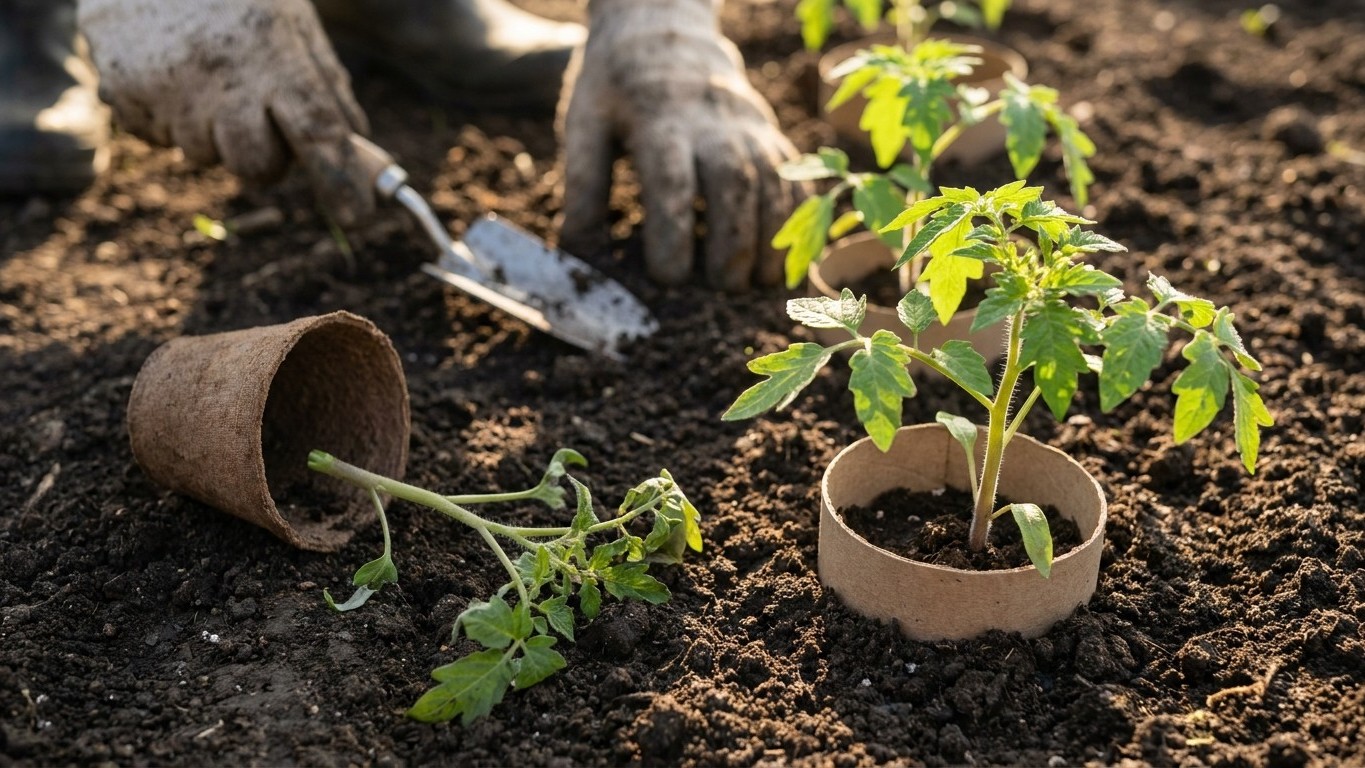
These show up the moment transplants go into the ground, usually right around the average frost date itself. The culprit is a fat, greasy-grey to brown caterpillar, about an inch long when full grown, that curls into a C-shape when disturbed and hides in the top inch of soil by day. It’s the larval stage that does the damage, chewing a young stem clean through at the soil line overnight, so a healthy seedling is just gone by morning. A cardboard or foil collar pushed an inch into the soil around each stem stops it cold.
Flea beetles
Also an early-season arrival, hitting seedlings and fresh transplants within days of warm soil. Look for tiny, shiny black beetles, about the size of a pinhead, that jump like fleas when you brush the leaves. Both adults and their tiny white larvae feed, but it’s the adult stage that leaves the telltale sign: dozens of small, round shot-holes peppered across young leaves. Row cover over transplants until they’re established is the most reliable fix, since insecticide timing is hard to hit on such a small, mobile pest.
Aphids
These build up through June and July, clustering in soft green, yellow, or pink colonies on the undersides of leaves and along new growth. It’s the wingless adults and nymphs, both tiny and pear-shaped, that do the damage by sucking sap and leaving leaves curled and sticky with honeydew. A strong jet of water knocks most colonies down, and insecticidal soap handles the rest without harming the beneficial insects that usually show up to help.
Colorado potato beetle
This one peaks in midsummer and overwinters as an adult in Manitoba soil, so it’s already waiting when tomatoes (a nightshade relative of its preferred potato) start putting on foliage. The adult is unmistakable, a rounded beetle about a third of an inch long with bold black-and-yellow stripes down its back. The reddish, humpbacked larvae do the worst of the defoliation, stripping leaves down to the veins. Hand-picking both adults and the bright yellow-orange egg clusters on leaf undersides keeps small plantings ahead of it.
Tarnished plant bug
Active from early to midsummer, this is a small, mottled brown-and-bronze bug about a quarter inch long with a distinctive yellow triangle marking on its back. Adults and nymphs both feed by piercing buds and young fruit, causing catfacing (scarred, deformed fruit) and dropped blossoms rather than obvious leaf damage. Keeping the garden free of weedy hosts nearby and removing damaged fruit early limits how much it spreads.
Tomato hornworm
This shows up later, from mid to late summer, as the season’s biggest and most dramatic pest. It’s a thick, green caterpillar that can reach four inches long, with white diagonal stripes and a curved horn near the tail end, and it’s the larval stage doing all the eating. Damage appears as entire branches stripped bare almost overnight, along with dark green pellets of frass on lower leaves. Hand-picking works well since the caterpillar is easy to spot once you know the frass gives away its location.
Two-spotted spider mite
These turn up late in the season, usually during a hot, dry stretch in August. The mites themselves are nearly invisible without a hand lens, pale yellow-green with two dark spots, but fine webbing on leaf undersides and a stippled, bronzed look to the foliage give them away. Both nymphs and adults feed by piercing cells, and heavy infestations can defoliate a plant fast in dry heat. Regular overhead watering to raise humidity, or insecticidal soap on the undersides of leaves, usually brings them back under control.
Working it out for your own garden
The fastest way to sort out which pest you’re actually looking at is to work backward from three clues: the calendar, the plant part affected, and what the damage looks like. A seedling that vanishes overnight in late May, right around that average May 23 frost date, points straight to cutworms, not aphids. Shot-holes on the same young leaves a week or two later point to flea beetles instead. Neither of those pests explains curled, sticky new growth in July, which is almost always aphids.
Damage location matters as much as timing. Chewed stems at soil level mean cutworms. Skeletonized leaves higher up the plant, stripped down to bare veins, mean either Colorado potato beetle larvae or tomato hornworm, and the size of the culprit tells you which: potato beetle larvae are small and reddish, hornworms are large and green. Deformed, scarred fruit with no obvious chewing on the leaves points to tarnished plant bug, since that insect targets buds and young fruit rather than foliage. A bronzed, dusty look to leaves in a hot dry week, especially with fine webbing underneath, is the signature of spider mites and nothing else on this list.
A weekly walk-through, checking the undersides of a handful of leaves and the base of each stem, catches most of these before they do serious damage. Because Manitoba’s frost-to-frost window is short, there’s little room to lose weeks to a pest that got ahead of you; a plant that loses its first month to cutworms or flea beetle damage may not have enough season left to recover and still ripen fruit before the average September 22 first fall frost. If a plant is struggling and none of the above symptoms match, it’s worth ruling out disease or watering stress before assuming it’s a pest at all, since the two are easy to confuse and call for very different fixes.
What changes across the state
Manitoba is not one growing region, and pest pressure shifts with it. The Red River Valley south of Winnipeg runs warmer and has a longer effective season than areas farther north, which generally means more generations of fast-breeding pests like aphids and spider mites over a summer. The Interlake region, sitting between Lake Winnipeg and Lake Manitoba, tends to stay cooler and more humid in early summer, which can slow flea beetle buildup but also favors aphid colonies that like moderate, damp conditions. Farther north into the Parkland and beyond, a shorter, cooler season generally means fewer pest generations overall, but also a narrower window to react if something does take hold, since there’s less season left to recover in.
Elevation and exposure play a smaller but real role too. A garden in a low, sheltered spot that warms early in spring may see cutworm and flea beetle activity a little sooner than one on higher, more exposed ground nearby. Urban gardens in Winnipeg itself often run slightly warmer than surrounding rural areas due to the heat retained by pavement and buildings, which can nudge pest activity earlier by a matter of days rather than weeks. None of these differences change which pests show up, only roughly when and how much pressure they bring, so the identification and timing details above still apply across the province.
The mistakes this state punishes
The costliest mistake in Manitoba is treating a warm stretch in early May as permission to skip cutworm protection at transplant. Soil can feel warm on top while nights still dip low enough to keep cutworm larvae active near the surface, and a week of losses can wipe out a good chunk of a planting before anyone notices. Collars around every stem at transplant time, not just the ones that look vulnerable, cost almost nothing and prevent the problem outright.
The second mistake is skipping row cover on transplants because flea beetle damage looks minor at first. On a short season, leaf damage in the first two weeks isn’t cosmetic, it’s lost photosynthetic capacity the plant needed to reach fruit set before frost. Covering transplants until they’re a few inches tall and clearly established avoids the setback entirely rather than trying to spray it away after the fact.
The third is assuming a cold Manitoba winter wipes out every pest for next year. Colorado potato beetle adults overwinter successfully in soil here, so a bed that had a beetle problem one summer is very likely to have adults waiting again the following spring. Rotating where tomatoes and potatoes are planted from year to year, rather than assuming winter handled it, keeps that population from building.
Checking this against your county
Everything above is built on Winnipeg’s climate normals and pest patterns typical of the province’s growing regions, not a guarantee for any single yard. Local microclimate, soil, and even which neighboring gardens are hosting pests can shift the timing by days or weeks in either direction. For a check against your specific area, Manitoba Agriculture is the right next stop, along with your local county or municipal extension office for pest reports specific to your part of the province.
Common questions
Do tomato hornworms survive Manitoba winters?
Hornworms overwinter as pupae in the soil, and Manitoba’s cold winters kill a portion of that population, but enough survive in sheltered soil to make the pest a reliable midsummer visitor most years.
What’s the very first pest to watch for after transplanting tomatoes in Manitoba?
Cutworms are typically the first threat, since they attack stems right at soil level within days of transplanting, often right around the average May 23 frost date.
Are Colorado potato beetles a big problem for tomatoes here?
They’re a real but secondary concern, since tomatoes are less preferred than potatoes, but a beetle population built up on nearby potato plants will readily move to tomato foliage.
Does Manitoba get whiteflies or other warm-climate tomato pests?
Manitoba’s short season and cold winters generally keep warm-climate pests like whiteflies from establishing outdoors, though they can occasionally arrive on greenhouse-started transplants brought in from warmer regions.