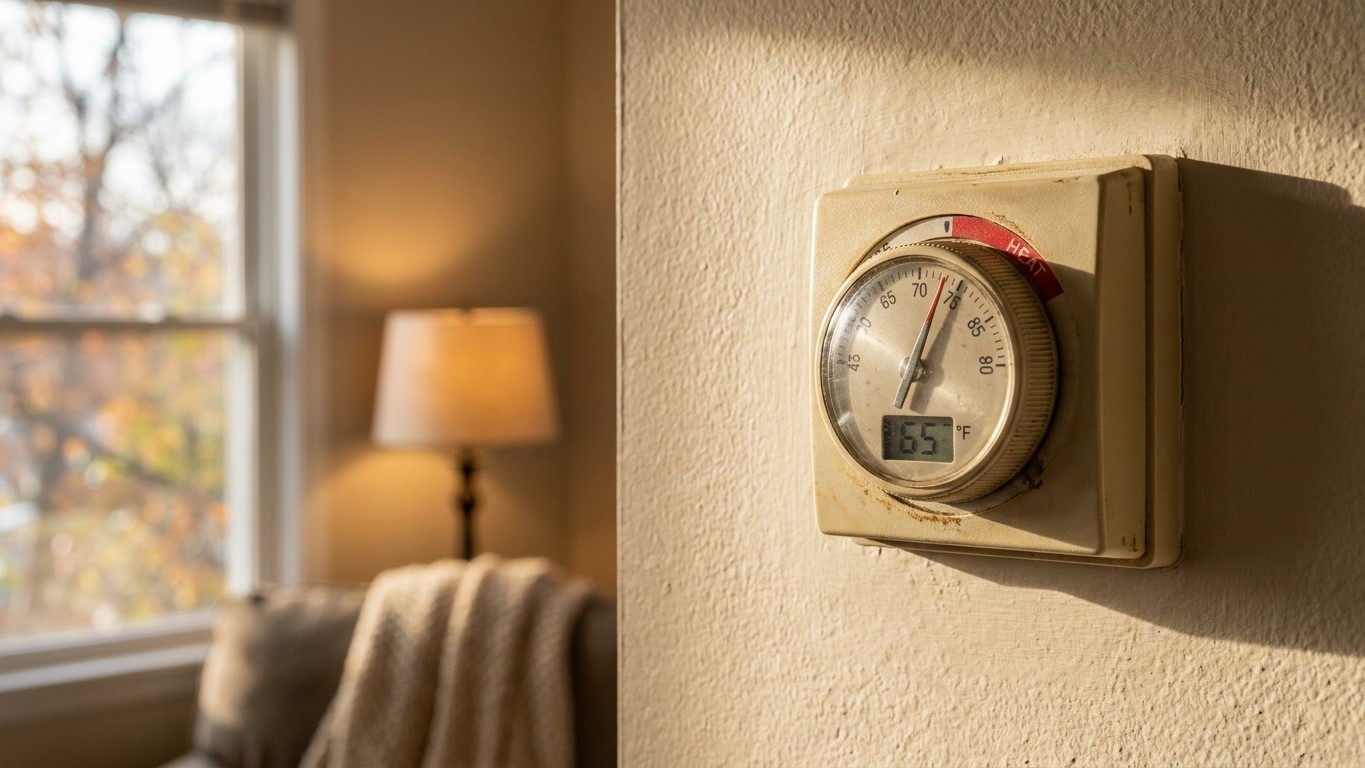

In Maryland, heating season opens in October, the month when the average temperature first drops below the 65°F mark used to calculate heating degree days. Demand climbs through the fall, peaks in January, and the season runs roughly eight months before the mean temperature climbs back above 65°F in June.
When the heating season starts in Maryland
That October start point isn’t a date on a calendar. It’s a 30-year average pulled from a single weather station, Baltimore Washington International Airport, and it means the typical month crosses the threshold, not the exact week your furnace clicks on. Some years the first real cold snap lands in late September; other years it holds off until November. The monthly normal smooths all of that into one number, so treat October as the season’s center of gravity rather than a start line you can circle on a wall calendar.
January carries the heaviest load of the year, and the table below shows why. It’s built from monthly heating degree days, a measure of how far the average daily temperature falls below 65°F, added up across every day in the month. Higher numbers mean more fuel burned to hold the same indoor temperature.
| Month | Heating Degree Days |
|---|---|
| January | 951 |
| February | 794 |
| March | 642 |
| April | 318 |
| May | 109 |
| June | 11 |
| September | 36 |
| October | 260 |
| November | 544 |
| December | 820 |
Notice July and August are missing from that table entirely. Neither month carries any heating degree days at Baltimore’s reference station, meaning the furnace or heat pump has nothing to do during peak summer. Everything else on the calendar, from a light dusting in September to the long haul from November through February, shows up as a number above.
What the table makes visible is the shape of the season, not just its length. The climb from September’s 36 to January’s 951 isn’t a straight line. It accelerates hard through October and November, then holds near its peak for two full months before easing off just as fast heading into spring. A system that’s been coasting in October is working at full capacity by December.
How hard the winter works here
Add up every month on that table and Baltimore lands at about 4,484 heating degree days a year, measured against the same 65°F base. Since degree days are essentially a stand-in for fuel use, a house that sees roughly twice that number, say 9,000, is burning roughly twice the fuel to stay at the same indoor temperature, all else equal. Maryland’s total puts it in the middle range for the mid-Atlantic, not the deep-freeze territory of the upper Midwest, but nowhere close to the mild-winter South either.
The annual figure alone can be misleading, though. Two places can share the same yearly total and still feel completely different to live in, one with a long, mild season that barely dips below the threshold for eight months, another with a short, brutal one that hits hard for twelve weeks and then quits. The monthly table above is what separates those two stories. Baltimore’s pattern leans toward the second type: a real ramp-up, a sustained peak from December through February, and a fairly quick fade by April. That matters for how a household plans, because a furnace here spends less time idling at partial output and more time running near its rated capacity through the coldest stretch.
For context, Baltimore also averages about 1,322 cooling degree days a year, which puts summer demand well below winter demand. Heating, not cooling, is the bigger annual load on a typical Maryland home’s energy budget.
What most homes in Maryland actually heat with
Federal survey data on how Maryland households actually heat their homes shows a clear leader, with electric heat pumps a distant but real second choice.
| System or Fuel | Share of Homes |
|---|---|
| Furnace | 64% |
| Central heat pump | 19% |
| Steam or hot-water boiler | 7% |
| Natural gas (as heating fuel) | 49% |
| Electricity (as heating fuel) | 41% |
| Fuel oil or kerosene | 7% |
Propane’s share wasn’t reported clearly enough for the survey to publish a number, which isn’t the same as saying no Maryland homes run on it.
A furnace being the most common setup says more about what was cheap and available when Maryland’s housing stock went up than about what’s best for any one house today. That distinction matters, because a furnace paired with natural gas is a different animal than a furnace running on fuel oil, and neither is automatically the right call for a specific home, budget, or roof layout.
What a forced-air furnace is good at: recovering fast after a cold snap, because it can push a large volume of hot air through ductwork quickly. What it struggles with: even heat distribution in a house with long duct runs or rooms far from the unit, and it depends entirely on that ductwork being sealed and clear. The one maintenance item that gets skipped most often, and punishes homeowners for it every single winter, is the air filter. A clogged filter starves airflow, forces the blower to work harder, and can shorten the life of the whole system. It’s a five-minute check that most furnace owners put off for months.
Run it once before you need it
The worst night to discover a heating problem is the first genuinely cold one, when every HVAC technician in the state is already booked solid. The fix is running the system weeks earlier, in October, while there’s still slack in the schedule and the weather outside is forgiving enough to open a window if something smells off.
- Switch the thermostat to heat and let the system run for a short cycle, five to ten minutes, while you stand near the unit and listen. Rattling, grinding, or a burner that won’t light on the first try are worth noting now, not in January.
- Expect a faint burnt-dust smell the first time heat runs after months of dormancy. That’s normal, it’s just dust burning off the heat exchanger or elements, and it should clear within a few minutes. A smell that lingers or gets stronger is different and worth a second look.
- Pull the filter and check it against a light source. If you can’t see light through it, replace it. This single step does more for airflow and efficiency than almost anything else on this list.
- Walk the house and clear anything blocking vents, radiators, or baseboard units, furniture pushed against a register, curtains draped over a radiator, boxes stacked near the outdoor heat pump unit. Airflow blocked at the source means a room that never quite warms up.
- Test every carbon monoxide alarm in the house by pressing the test button. Combustion appliances that haven’t run in months are exactly the equipment that can develop a leak, and a working alarm is the cheapest insurance available against it.
- If the system short-cycles, trips a breaker, fails to ignite, or the smell from step two doesn’t fade, stop testing and call a technician. Same goes for any sign of soot, standing water near a boiler, or a thermostat that won’t hold a setting.
Even a furnace that passes every one of those checks isn’t delivering all its heat to the rooms that need it. “In a typical house, about 20%-30% of the air that moves through the duct system is lost due to leaks, holes, and poorly connected ducts.” according to the U.S. Department of Energy. That’s air, and the heat it carries, escaping into an attic or crawlspace instead of a living room, on a system that might otherwise be running perfectly.
What turning it down is actually worth
The Department of Energy puts a specific number on the payoff for dialing the thermostat back: “You can save as much as 10% a year on heating and cooling by simply turning your thermostat back 7-10°F for 8 hours a day from its normal setting.” That’s a yearly savings figure tied to a specific setback range held for a specific stretch of hours each day, covering both heating and cooling combined, not a per-degree formula and not a heating-only number.
In a state where the heating season stretches across roughly eight months, from October’s first chill through the long haul of winter into the fade-out by April, that 8-hour setback window has a lot more days to work with than it would somewhere with a three-month season. A programmable or smart thermostat set to pull back overnight or during work hours doesn’t need to be reprogrammed for the coldest stretch of January versus the milder edges of October and April; the same setback keeps paying off across the whole span, just with more heat to shave off during the deep-winter months shown in the table above.