
Carrots are ready when the tops are full and the orange shoulders show at the soil line, which is a count of days from seeding rather than a date on the calendar. Once they are out of the ground, the clock changes. Chill them at 33 °F in high humidity, and cut the tops off first. Leave the greens on and the roots go soft in about two weeks.
When carrots are ready in Maryland
The signal in the row
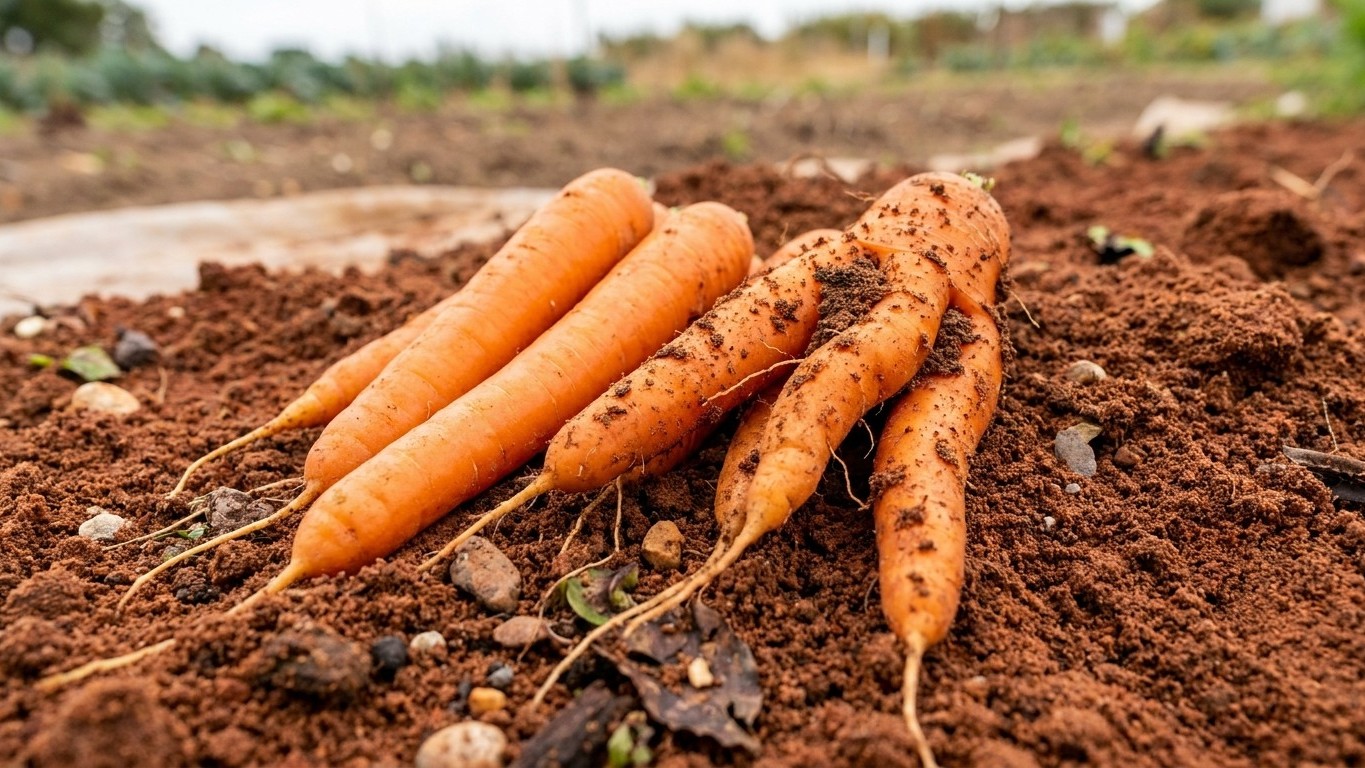
Look for the shoulders: the top of each root pushing up and turning orange at the soil surface, under a thick canopy of ferny leaves. Brush the dirt from one and pull it. If the color runs deep and the root looks like the one pictured on the seed packet, the row is ready. Counted from the day the seed went in, that usually takes 70 to 100 days. Clemson Cooperative Extension narrows it to “about 65 to 75 days after planting” for its own region.
The spread is wide because the source names no variety, and neither does this page. Days to maturity on your packet is the number to trust, and the test pull settles the rest. Pull one root before you pull the row. It costs you a single carrot.
Counting from seeding, not from the calendar
Carrots are sown in place. There is no transplant date and no second start, so every one of those days runs from the moment the seed went into the ground. A spring sowing on April 1 puts the harvest window between about June 10 and July 10. A late-summer sowing on August 1 points to about October 10 through November 9. That is plain arithmetic, not a Maryland forecast.
Local frost dates are not published on this page, and guessing at them would only put false precision in front of you. Look up the first fall frost and last spring frost for your own county through your local extension office, then count forward or back from them. Cool weather slows growth, so a fall sowing tends to run toward the long end of the range.
Ground matters too. Utah State University Extension describes carrots as wanting deep, sandy, well-drained soil rich in organic matter, and says heavy or rocky soil makes the root fork. The soil USDA lists as representative of Maryland, the Sassafras series, is sandy: 67 percent sand, 10 percent clay and 23 percent silt in the surface layer, and well drained. It is also an old, leached Ultisol, naturally acid, with surface pH about 5.3 and organic matter about 1.6 percent. So the region’s ground tends to suit carrots on texture and drainage, and to want compost.
That is the state’s typical soil, not necessarily what is under your rows. River bottoms, hill country and any lot a builder has scraped or filled will differ. Two checks settle it at home. Send a sample for a lab soil test, since the source gives no pH target and your own number is the only one worth acting on. Then try a jar test: shake a scoop of soil in water and let it settle, and sand, silt and clay form separate layers. If yours is heavy, the fix is a raised bed or double digging with plenty of compost. More on that in Will Carrots Fork in Maryland Soil? and in the broader guide, Growing Carrots in Maryland.
Keeping them, and for how long
The numbers from the source
Clemson Cooperative Extension’s Home & Garden Information Center puts it this way: “Store them at 33 °F and high humidity to prevent wilting. Bunched carrots (plants with tops on) can be stored for about 10 to 14 days.” Those are the figures to write down: 33 °F and high humidity. The source gives no humidity percentage, and this page will not invent one.
Notice how narrow the target is. Water freezes at 32 °F, so 33 °F is one degree above freezing. It is not a cellar temperature, and it is not a pantry temperature. A reader who stores carrots at 50 °F loses them to sprouting and softening in a fraction of the time.
Cut the tops first
The tops are the catch. Leaves keep drawing moisture out of the root long after harvest, so the carrot shrivels while the greens stay perky. That is why bunched carrots keep only about 10 to 14 days. Twist or cut the greens off close to the crown the day you pull them, and the root stops feeding a plant that no longer has soil.
Brush off loose dirt, then pack the trimmed roots somewhere that holds humidity: a perforated plastic bag or a lidded container with a damp cloth over them. Trimmed roots can keep for months, but treat that as a ceiling reached only under ideal conditions, at 33 °F with high humidity and sound roots. A warmer spot, a nicked root or a damp bag will cut it short.
Check them every week or two. One soft carrot can spoil the ones touching it. Pull it out, wipe the container dry, and eat the oldest first.
Where in the house that actually is
Room by room
Start with the refrigerator. It is the only ordinary appliance that gets near 33 °F. But the dial on the door is not a thermometer, and the back of the shelf can run cold enough to freeze a root while the front stays mild. The crisper drawer, with the carrots in a perforated bag, is the usual compromise. A second refrigerator in the garage or basement holds its temperature better than any room will, if you have one.
Any heated room is too warm: kitchen, pantry, mudroom, finished basement. Even a cool one will sit well above 33 °F, and the carrots will sprout and go limp. A garage swings with the weather, so it can be near-perfect on a cold afternoon and freezing or warm a few days later. An unheated basement or cellar comes closest in a Maryland winter, but many sit warmer than 33 °F, especially near the furnace or water heater. Nobody can tell you which yours is without measuring.
The thermometer check
Set a thermometer where the carrots would sit, ideally a min/max model that records the swing, and read it for several days before the harvest goes in. Skip that step and you find out about a bad spot when the roots turn soft. In a refrigerator, put a thermometer in a glass of water on the shelf you plan to use and check it the next day. Water reads the average and ignores the brief swings from opening the door.
If the spot reads well above 33 °F, use it for a smaller batch you will eat soon. If it dips to 32 °F or lower, move the carrots before the cold snap arrives, not after.
What goes wrong here
Freezing where you thought it was safe
An unheated garage, shed or outbuilding is fine until a hard night. Frozen carrots look normal in the box, then turn limp and watery once they thaw. Prevention is cheap: a min/max thermometer in the space, and a plan to carry the crate indoors when the forecast drops. Marginal spots also deserve a blanket or an insulated cooler with the carrots inside.
A damp autumn
Wet weather brings wet roots, and wet roots in a sealed bag turn slimy. Look for soft dark patches, fuzzy mold at the crown, or a sour smell when you open the container. The sandy, well-drained Sassafras type of ground tends to shed water, but heavier yard soil holds it. Pull carrots after a dry spell when you can, let them air-dry for a few hours out of direct sun, and brush off soil rather than washing them before storage. Chewed or ragged tops before harvest are a separate problem, covered in What Eats Carrot in Maryland, and When.
A glut nobody can eat
Sow one long row all at once and the whole row matures inside the same couple of weeks. The refrigerator fills, and the ones left over go soft. The fix is a season ahead: seed short rows a few weeks apart so the harvest spreads out, and count each one separately from its own seeding day. When a glut has already arrived, cook and freeze portions, or give bags away while the roots are still crisp. Storage at 33 °F buys time, but only a maximum of it.
Common questions
How can I tell carrots are ready without pulling the whole row?
Pull a single test carrot. Full, dense tops and orange shoulders at the soil line are the plant’s signal. Compare the root you pull with the size on your seed packet, and count the days from seeding, since carrots are never transplanted.
Do carrots keep longer with the tops on?
No. Clemson Cooperative Extension gives about 10 to 14 days for bunched carrots with tops on. The leaves keep drawing moisture from the root, so cut them off first. Trimmed roots can keep for months, but only as a maximum under ideal conditions.
Can I store carrots in a Maryland garage?
Only if a thermometer says it stays near 33 °F. A garage swings with the weather, running too warm on mild days and risking a freeze during a cold snap. Track it with a min/max thermometer for a few days first.
What if my soil is nothing like the state soil?
Plenty of Maryland gardens are. The Sassafras series is only what USDA lists as representative of the state, and yours may be heavier, rockier or scraped-over fill. A lab soil test gives your own pH, and a jar test shows your sand, silt and clay. Heavy ground calls for a raised bed or double digging with compost, as Utah State University Extension advises.