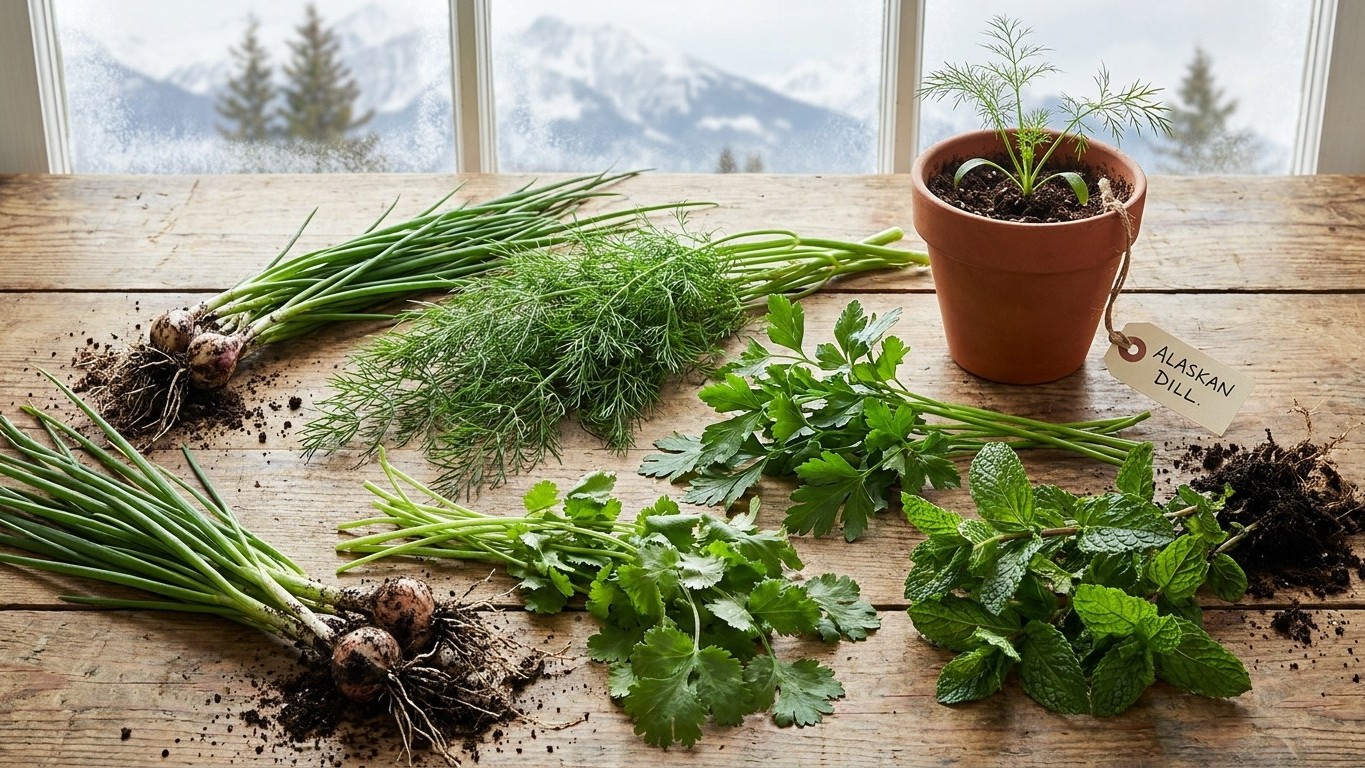

The best herbs for Maryland split into two clear groups: hardy perennials like thyme, sage, oregano, chives, and mint, which shrug off the state’s winter lows and belong in nearly every yard, and heat-sensitive annuals like basil, dill, and cilantro, which need the soil to warm up first and often need a second sowing once summer humidity peaks.
The short answer for Maryland
Maryland’s growing season runs from a last spring frost between April 3 and April 16 to a first fall frost between October 26 and November 5, based on NOAA’s 1991-2020 climate normals. That gives most of the state something in the range of six and a half to seven months of frost-free growing, which is generous by Mid-Atlantic standards but not tropical. The number that actually decides which herbs survive the winter, though, isn’t the frost window. It’s the coldest month’s mean daily minimum: 25.4°F at the Baltimore reference station. That figure tells you what a plant experiences on an average night in January, not a record cold snap, and it’s the line that separates herbs you can leave in the ground from herbs you have to treat as annuals or bring indoors.
Sorted by type, the decision looks like this. Hardy perennial herbs, thyme, sage, oregano, chives, tarragon, and mint, tolerate winters colder than what Maryland typically delivers, so they hold up across the state’s whole hardiness range without special care. Woody Mediterranean herbs, rosemary and bay laurel especially, sit closer to the edge; they can survive a mild Maryland winter in a sheltered spot but often don’t make it through a harsher one without mulch, a cold frame, or a pot that comes indoors. Warm-season annuals, basil above all, need the soil itself to warm past the mid-50s before they’ll germinate or transplant well, which usually means waiting a week or two past the last frost date rather than planting on it. Cool-tolerant annuals and biennials, cilantro, dill, parsley, do better sown a little earlier or held for a fall crop, since they bolt fast once summer heat sets in.
The state’s hardiness zone range, 5b to 8a on the USDA map, matters here too. That’s a wide spread for one state, and it means the “safe” list of perennial herbs is really the list that survives the coldest end of that range, zone 5b, comfortably. Thyme, chives, and oregano clear that bar easily. Rosemary, rated hardy only to about zone 7 in most nursery guides, does not, which is why it behaves differently depending on where in Maryland you’re standing.
What will not work here
Rosemary left outdoors year-round is the herb most likely to disappoint a new Maryland gardener, and the reason traces straight back to that 25.4°F average January minimum. That’s the mean, not the floor, so a bad cold snap in a low-lying yard or anywhere west of the Piedmont routinely drops well below it. Rosemary planted against a south-facing wall in a milder pocket of the state might sail through winter; the same plant in an open bed in a colder county often doesn’t leaf out in spring. Treating it as a container plant that comes inside for winter, or accepting it as an annual, avoids the guessing game entirely.
Basil sown too early fails for a different reason. The calendar says frost is done by mid-April in much of the state, but basil doesn’t care about frost so much as cold soil; it stalls, yellows, or rots when set out into ground that hasn’t caught up with the air temperature yet. Gardeners who plant basil the same weekend they plant peas are usually planting it two to three weeks too soon. Waiting until the soil itself feels warm, not just the daytime air, saves the trouble of a second planting.
Maryland’s summer humidity, driven by its position along the Chesapeake Bay, punishes herbs planted too close together. Basil and oregano set at nursery-tag spacing often develop powdery mildew or downy mildew by midsummer once air stops moving between the leaves. Wider spacing than the tag suggests, plus watering the soil rather than the foliage, heads off most of this. Herbs from genuinely dry climates, French tarragon and some lavender varieties among them, also struggle here for the same reason: they tolerate cold well enough but resent the wet, sticky air of a Maryland July more than the cold of a Maryland January.
Cilantro planted for a summer harvest is close to a lost cause anywhere in the state. It bolts to seed within weeks once temperatures climb, no matter how much water it gets. Treating it as a spring and fall crop, not a summer one, works with the plant instead of against it.
What changes across Maryland
A hardiness range of 5b to 8a is not a small spread, and it means there is no single frost date or single safe-perennial list for the whole state. The mountainous far west, Garrett and Allegany counties, sits at the cold end of that range, with frost arriving weeks earlier in fall and lingering weeks later in spring than the statewide window of April 3 to April 16 and October 26 to November 5 suggests. The Eastern Shore, by contrast, runs milder, closer to the warm end of the range, with a longer effective season and better odds for herbs like rosemary surviving outdoors.
What that means in practice: a reader in the western highlands should push spring planting later and pull a fall garden in earlier than the statewide dates imply, and should be more cautious than average about leaving woody Mediterranean herbs outdoors over winter. A reader on the Eastern Shore or in the milder parts of the Baltimore-Washington corridor has more room to experiment, both with an earlier basil planting and with overwintering marginal herbs in a sheltered spot.
None of this can be settled from a state-level page, and it shouldn’t be guessed at from a zip code either. The USDA Plant Hardiness Zone Map is built for exactly this, showing zone by location down to a fine grid, and it’s the tool to check rather than assuming your county matches the Baltimore reference figures used here.
Where to check this for your own county
The University of Maryland Extension, at extension.umd.edu, publishes county-level detail. That’s the resource to check next, and it’s worth being specific about what to look for once there: a local planting calendar for your county rather than the state as a whole, and any herb variety trial results specific to Maryland conditions, since not every rosemary or thyme cultivar performs the same way in Chesapeake humidity.
A county recommendation will always beat a state one, for a simple reason: it’s built on data closer to your actual soil and microclimate. This page works from statewide climate normals and a single reference station in Baltimore. County extension offices work from local frost records, local soil surveys, and often from test plots run in that county specifically. If the state page here says thyme is reliable everywhere in Maryland, and a Garrett County extension note says a particular thyme cultivar underperforms in the mountain counties, the county note wins.
Extension offices also field direct questions, by phone or email, from gardeners in their own county, which a general reference page can’t do. If a rosemary plant died over a mild-seeming winter, or basil bolted early despite a normal planting date, a local extension agent can usually explain why faster than searching for an answer. That kind of feedback loop, over a season or two, ends up being more useful than any single planting date on this page.
Checking this against your own garden
Every date and figure above describes an average. The actual garden in front of you is the better guide, and three simple observations beat a calendar every time.
Soil warmth by feel is the first. Push a hand into the bed where basil or other tender herbs will go; if the soil feels cool and damp rather than mild, it hasn’t caught up to the air temperature yet, no matter what the frost date says. Waiting a few more days here almost always beats planting on schedule.
The first true leaves on any seedling are the second signal. Seed-leaf pairs (the first, rounded leaves that emerge) don’t tell you much, but the first true leaves, shaped like the mature plant’s foliage, mean the seedling has enough root and energy to handle a move outdoors or a light frost if one sneaks in.
New growth on perennial herbs after winter is the third. Thyme, sage, and oregano that push visible new green shoots have made it through; a woody stem with no new growth by late spring, especially on rosemary, is a sign that particular plant didn’t survive the winter your yard actually had, whatever the statewide averages suggest. That single plant, in that single spot, tells you more about your own microclimate than any figure on this page.