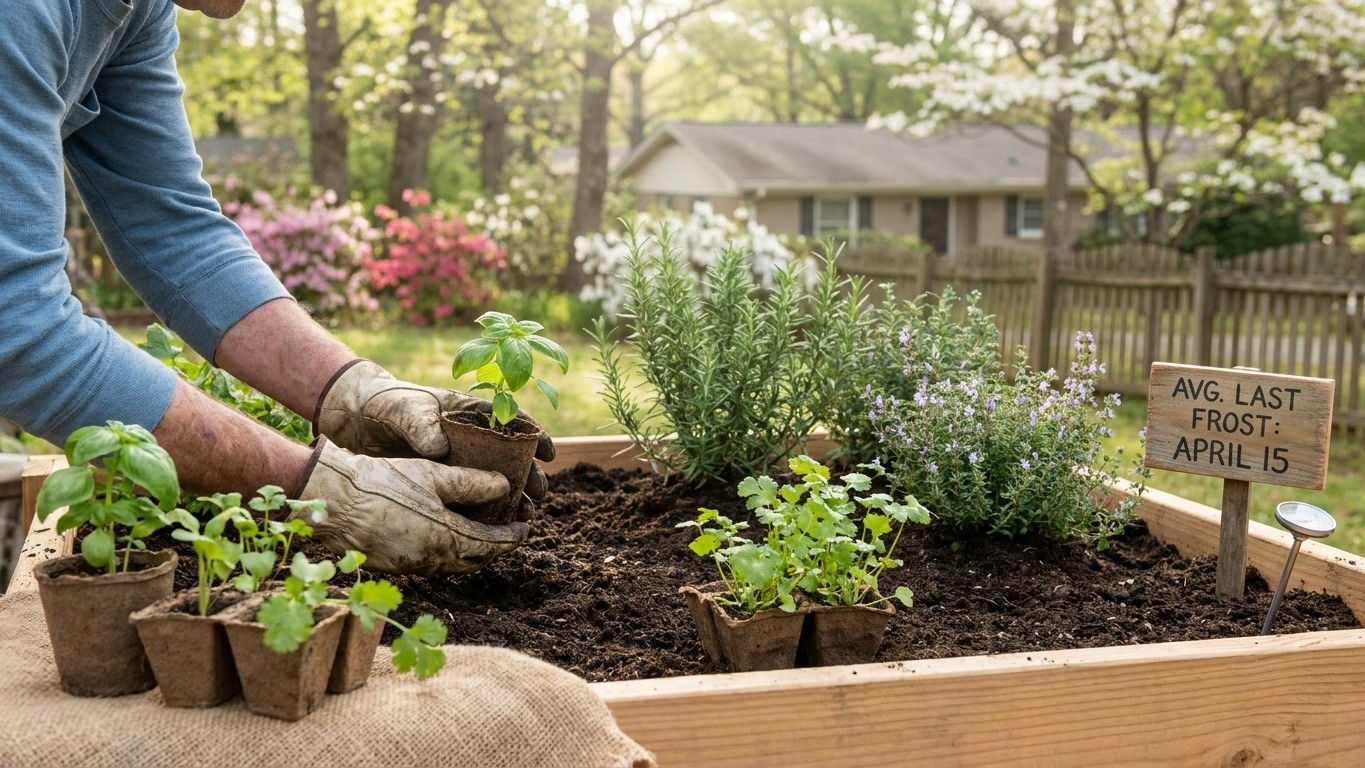

In most of Maryland, cool-season herbs like parsley, cilantro, and dill go into the ground three to four weeks before the last spring frost, while basil and other tender herbs wait until that frost date has passed entirely, somewhere between April 3 and April 16 depending on where you garden. Fall herb plantings work backward from the first frost, October 26 to November 5.
The short answer for Maryland
Those frost dates aren’t a guarantee. NOAA pulls them from 1991-2020 climate normals for the Baltimore-Washington reference station, and they mark a 30-70% probability band for a 32°F freeze, not a hard line you can circle on the calendar. April 3 is the early edge of that window; April 16 is the late edge. A gardener who plants tender herbs on April 3 is betting on the earlier side of a real range, and some years that bet loses.
Hardy herbs don’t care much about that gamble. Parsley, chives, cilantro, and dill tolerate light frost and even a hard freeze once they’ve got a couple of true leaves, so they can go in the ground from mid-March onward in most of the state, three to four weeks ahead of the last frost date. Cilantro in particular prefers to get established while the soil is still cool, since it bolts fast once temperatures climb, so an early start actually buys more usable leaf before the plant gives up and flowers.
Basil is the opposite story. It’s a heat-loving annual that stops growing, and can die outright, anywhere near 50°F, so the safe move is to wait until the frost date has fully passed, not just until it’s close. Same logic applies to other tender herbs sometimes grown here as annuals. If you’re transplanting rather than direct-seeding, you can push that window a few days earlier by hardening off indoor-started plants, but the frost date itself doesn’t move because your seedlings are ready.
Perennial herbs that survive Maryland winters, like thyme, sage, oregano, and chives, are more forgiving about spring timing since they’re not annuals racing a frost clock. They can be planted any time from early spring through early fall as long as they have six to eight weeks to root in before the ground freezes hard. The fall window matters here too: anything planted after early October is racing October 26 to November 5, and a late planting with weak roots is exactly the kind of plant that struggles through the winter described in the next section.
What will not work here

Rosemary is the herb most likely to disappoint a Maryland gardener who treats it as a permanent perennial. The coldest month here averages a daily minimum of 25.4°F, and that’s the number that actually decides winter survival, not the occasional record-cold night everyone remembers. Rosemary’s hardiness runs out right around where Maryland’s winters sit, which is why so many gardeners in the state find it thriving all summer and then turning to brown mush by February. The fix isn’t a different planting date, it’s treating rosemary as a container plant that comes indoors for winter, or as an annual you replace each spring.
Basil planted early is the second common failure, and it’s almost always a calendar mistake rather than a plant problem. Someone plants basil in late March because the weather feels warm, gets a stretch of 70°F afternoons, and then loses the whole tray to a night that dips into the 30s, which is well within the normal range before April 3. Basil doesn’t just dislike frost, it sulks and yellows at temperatures in the 40s, so even a frost-free but chilly stretch right after planting can stunt it for weeks.
Humidity does the damage summer drought gets blamed for
Maryland summers combine real heat with real humidity, and that combination is harder on Mediterranean herbs than dry heat would be. Thyme, oregano, and sage evolved in dry, airy hillside conditions, and they push back against humid air with fungal problems, root rot, and mildew, especially when they’re planted close together the way a small garden bed tempts you to plant them. Spacing that would be fine in a dry climate becomes a liability here, because damp air sits between crowded plants overnight and doesn’t clear until well into the next morning.
Watering on a fixed weekly schedule is the other quiet killer, particularly for herbs that prefer to dry out between waterings. A once-a-week soak might match a dry Western state’s rainfall pattern, but it stacks badly on top of Maryland’s own humid-summer rain events, leaving soil saturated for herbs like rosemary, sage, and lavender that would rather go dry than stay wet. The herbs that actually want consistent moisture, basil and cilantro among them, are the ones a rigid weekly schedule tends to underwater during a hot stretch, so the same watering habit fails in opposite directions depending on which herb it’s applied to.
What changes across Maryland
Maryland’s official hardiness range runs from 5b to 8a on the USDA map, which is a wide spread for a state this size, and it means there is no single planting date that’s honest for the whole state. That range is built on one measurement, the average annual extreme minimum temperature, and it tells you how cold your coldest nights get, not when your last frost falls or how long your growing season runs, though the two tend to move together.
The mountainous counties in the far west, Garrett and Allegany, sit at the cold end of that range. Elevation there pushes both the last spring frost and the first fall frost later and earlier respectively, meaning a shorter season squeezed from both ends, and it means the state’s frost-date window given earlier runs weeks behind what a Western Maryland garden actually experiences. A hardy herb planted on the early edge of the state’s window in Garrett County is planted too early for local conditions, not too late.
The Eastern Shore sits at the opposite end. Milder winters and an earlier spring push the frost dates toward the early side of the state range, and the coastal influence of the Chesapeake Bay moderates both the coldest winter nights and the last frost date compared to inland areas at a similar latitude. A gardener there working from the state’s April 3 figure is closer to their own reality than a gardener using April 16.
None of this tells you which zone applies to your own yard, and it shouldn’t. Elevation, slope direction, and distance from open water shift conditions block by block in ways a statewide range can’t capture, so the right move is checking the USDA Plant Hardiness Zone Map directly for your address rather than guessing from county name alone.
Where to check this for your own county
The University of Maryland Extension runs the state’s official cooperative extension service at extension.umd.edu, and it’s the source that turns a state-level range into a number you can actually use. A state page, this one included, can only give you the spread; a county-level recommendation from extension staff who work with local growers every season beats it every time.
Once you’re on the site, look specifically for two things. First, a planting calendar built for your county or region rather than the state as a whole, since Extension offices typically break Maryland into its climatic sub-regions instead of publishing one blanket date for Garrett County and Worcester County alike. Second, look for variety trial results or recommended cultivars for herbs, since Extension horticulturists test which basil, thyme, or oregano varieties actually perform in Maryland’s humidity and clay-heavy soils, information no national seed catalog can give you because it’s specific to regional disease pressure and rainfall patterns.
Master Gardener volunteers, trained and coordinated through the same Extension system, staff plant clinics and hotlines in most counties and can usually answer a specific timing question faster than digging through PDFs. If your county’s page feels thin, calling or emailing the local Extension office directly is a normal, expected use of the service, not an imposition, since fielding exactly these questions is part of its mission.
Where they disagree, especially by more than a week or two, the county source wins, because it accounts for elevation, soil, and microclimate details a statewide climate normal can’t see.
Checking this against your own garden
Every date here comes from historical averages, and your own garden is running its own weather this year, so a handful of direct observations will tell you more than any calendar. Soil warmth by feel is the first and most useful check: push a bare finger two inches into the bed, and if it feels cool rather than cold, most herb seeds and transplants are ready to handle it, since seed germination for herbs like basil and cilantro slows dramatically in soil that still feels genuinely cold to the touch.
Watch for the first flush of weed seedlings breaking the surface nearby, particularly fast germinators like chickweed or henbit. When they show up reliably in a bed, it’s a rough sign the soil has warmed enough for cool-season herb seeds to sprout too, since many common weeds and hardy herbs share a similar germination temperature threshold.
For anything you’ve already got growing, the appearance of true leaves, the second set that looks like the mature plant rather than the rounded first seed leaves, is the signal that a seedling has enough of a root system to handle transplanting or thinning without setting it back. Rushing a transplant before true leaves appear is a common way to lose seedlings to shock, regardless of what the calendar says about timing.
None of these signs replace the frost-date math entirely, but they catch the years when your particular spot runs warmer or colder than the regional average, which happens more often than a single printed date suggests.
If you follow the almanac, here is when to plant herbs by the moon. It is a tradition, not a proven method.