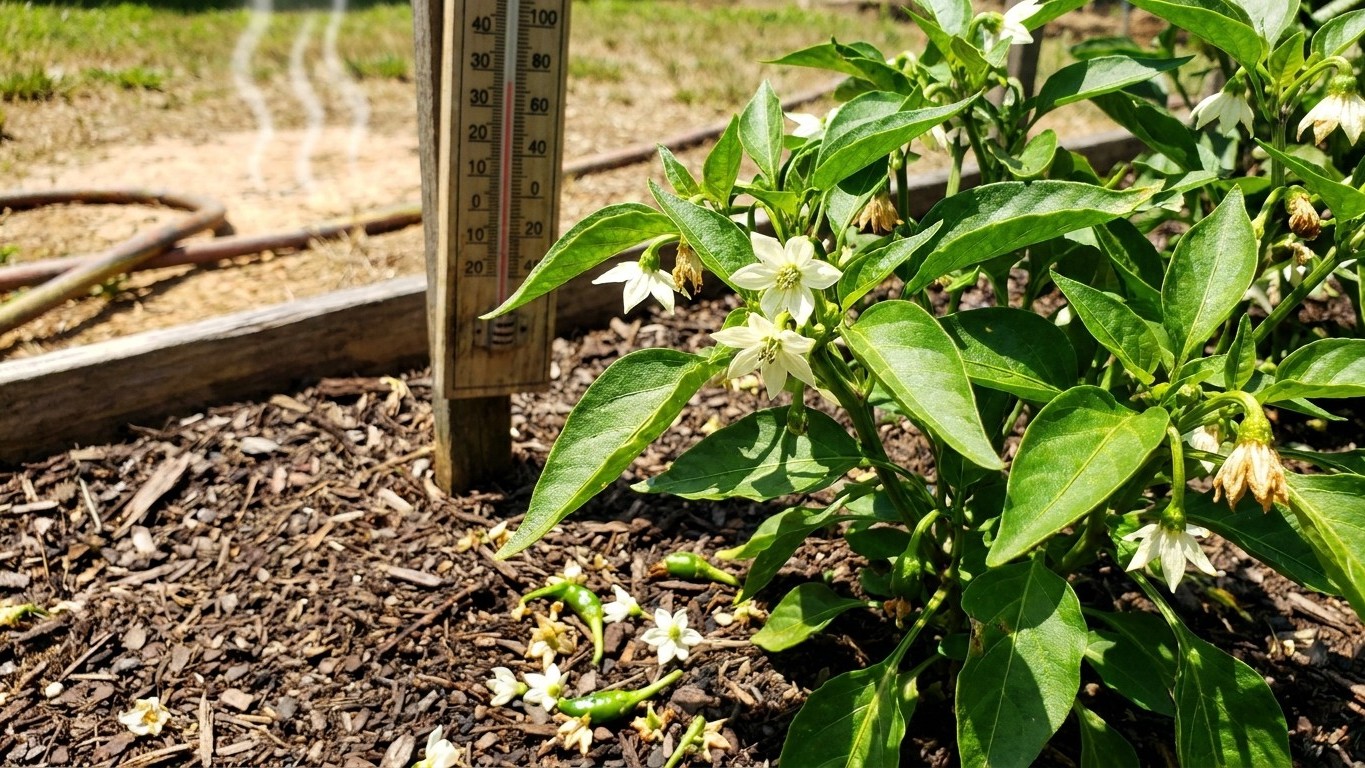

Peppers Fail to Set Fruit in Maryland mainly because the state’s summer heat pushes past the flower’s comfort zone, and because cool nights in spring or early fall can do the same thing from the other direction. Maryland averages 24.6 days a year at or above 90 F, enough heat load to stall pollen inside an open blossom. Add a night that drops below 55 F on either end of the season, and the same flower can drop without ever setting a pepper. Both ends matter here, not just the hot one.
The short answer
Baltimore’s 30-year climate record puts the state at 24.6 days a year reaching 90 F or higher, according to NOAA’s 1991-2020 Climate Normals. That’s not one brutal heat wave. It’s roughly three and a half weeks scattered across July and August, sometimes back to back, sometimes broken up by a cooler stretch. For a pepper plant, that kind of heat load is enough to shut down fruit set even while the plant looks perfectly healthy: green, leafy, covered in flowers that simply fall off instead of turning into peppers.
The heat side
Pepper flowers need viable pollen to set fruit, and pollen loses viability once daytime temperatures climb into the 90s for several days running. Utah State University Extension notes plainly that pepper fruit set fails once days push above 90 F. Maryland’s 24.6-day average means most gardeners in the state should plan for at least a few stretches each summer where blossoms drop and no new fruit forms, no matter how well the plant is watered or fed. The flowers usually come back once the heat breaks, and fruit set resumes within a week or two.
The cold side
The other failure point is less talked about but just as real: nights below 55 F. This happens most often in Maryland during a cool stretch in late spring, right after transplanting, or during an early cool snap in September. This site tracks days at or above 90 F for Maryland, but it does not carry summer night minimum temperatures, and that number can’t be guessed from latitude or from how cold the coldest month runs. A location’s summer overnight lows depend on elevation, tree cover, and how close it sits to water, not just how far north it is. Anyone growing peppers in Maryland should keep a simple outdoor thermometer or a smart sensor on the porch through the growing season and watch for nights that dip below that 55 F line, especially in the weeks right after transplanting when plants are just starting to flower.
When to start seed here
Working out a start date for pepper seed is mostly arithmetic once you know two things: your local last frost date, and how long it takes your soil to reach 60 F. Maryland’s last spring frost, based on NOAA’s 1991-2020 data at the Baltimore reference station, falls between April 3 and April 16 for the central part of the state. Utah State Extension recommends starting pepper seed 8 to 10 weeks before transplanting, and transplanting only after frost has passed and soil has warmed to 60 F.
Do the math for your county
- Start with your local last frost window. For central Maryland, that’s April 3 to April 16.
- Soil warms slower than air, so add roughly one to two weeks after that frost date before the ground reliably holds at 60 F. That pushes a realistic transplant window into mid-to-late April for most of the state.
- Count back 8 to 10 weeks from that transplant window to find your indoor seed-starting date. For a mid-to-late April transplant, that lands seed-starting somewhere in mid-to-late February.
- Adjust for your specific region. Western Maryland’s mountainous counties, Garrett and Allegany, run weeks later than the frost dates above, so push both the transplant date and the seed-starting date back accordingly. The Eastern Shore tends to run milder, which can allow an earlier transplant.
- Once transplanted, watch for the first flowers. The 35 to 45 days often cited for pepper fruit development run from flowering, not from the transplant date itself, so factor that stretch in after you see the first blossoms open.
Regional timing at a glance
| Region | Frost pattern relative to central MD | Effect on seed-starting date |
|---|---|---|
| Western Maryland (Garrett, Allegany) | Weeks later, mountainous terrain | Push seed-starting date later |
| Central Maryland (Baltimore reference) | April 3 to April 16 | Mid-to-late February start |
| Eastern Shore | Milder, earlier warm-up | Can start slightly earlier |
What goes wrong here
Temperature-driven failures
- Blossom drop in a hot spell. Flowers open, look fine, then fall off without setting fruit once several 90 F-plus days stack up. There’s no fix for the heat itself, but keeping soil moisture steady and providing afternoon shade with a light cloth over the row during the worst stretches helps some flowers hang on until the heat breaks.
- Blossom drop after a cool night. A night below 55 F, most common right after transplanting or during an early fall cool spell, can cause the same drop from the other direction. Since this varies block to block depending on elevation and cover, track your own overnight lows rather than assuming the season is “past the risk.” A frost cloth or row cover overnight during a cold snap protects open flowers.
Water and calcium-driven failure
- Sunscald. Maryland’s summer sun is strong enough, especially during those 90 F-plus stretches, to bleach or blister the skin of fruit that’s overly exposed after heavy pruning or leaf loss. Leaving more foliage on the plant, rather than stripping it back for “better airflow,” protects developing peppers from direct scald.
- Blossom-end rot. This shows up as a dark, sunken patch on the bottom of the fruit and usually traces back to uneven watering, not a lack of fertilizer. Peppers that dry out between waterings during a hot stretch, then get soaked all at once, struggle to move calcium into developing fruit. Even, consistent watering through those hot weeks matters more than adding extra calcium products.
Common questions
What temperature stops peppers from setting fruit in Maryland?
Fruit set fails at both ends: once nights drop below 55 F, or once days climb above 90 F, according to Utah State University Extension. Maryland’s 24.6 days a year at or above 90 F means the hot-end failure is a near-annual occurrence somewhere in the growing season.
How many days does Maryland get above 90 F in a typical year?
Based on the Baltimore reference station’s 1991-2020 NOAA Climate Normals, Maryland averages 24.6 days a year reaching 90 F or higher.
When should I transplant peppers outdoors in Maryland?
Transplant after your local last frost date and once soil has warmed to 60 F. For central Maryland, the last frost window runs April 3 to April 16, with soil typically reaching 60 F a week or two after that. Western Maryland runs later; the Eastern Shore tends to run milder.
Does blossom-end rot on peppers mean I need more calcium?
Usually not. Blossom-end rot in Maryland peppers is most often tied to inconsistent watering during hot stretches rather than a true calcium shortage in the soil. Keeping soil moisture steady through the season addresses most cases without any added product.