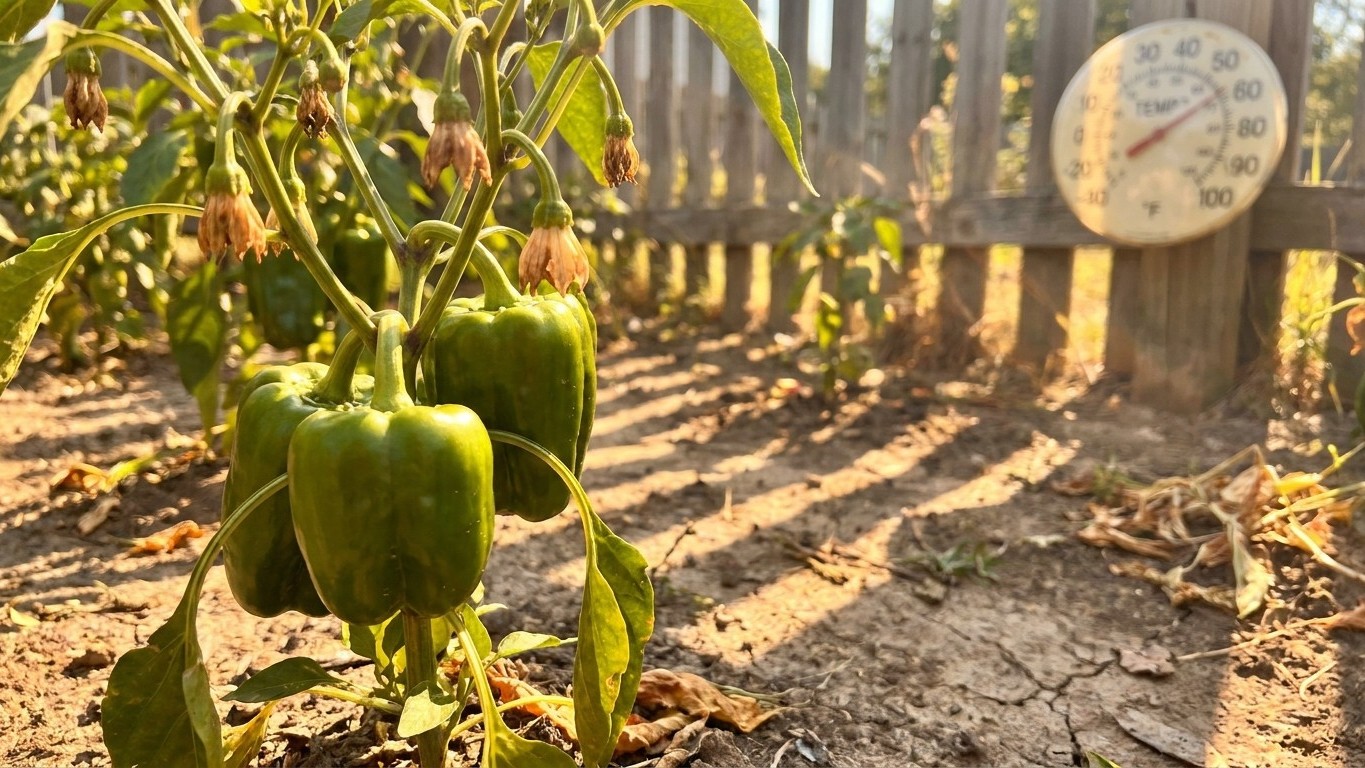

Peppers set fruit reliably across most of Maryland, but the state’s summer heat load, an average of 24.6 days a year at or above 90 F, can shut fruit set down for stretches in July and August. The other failure point is cool nights, and this site does not track summer night minima for Maryland, so that half of the equation is on you to watch locally.
The short answer

Start with the number: Baltimore’s reference station logs an average of 24.6 days a year at 90 F or hotter, based on NOAA’s 1991-2020 Climate Normals. That is not a single heat wave. It is close to a month, spread across the growing season, when daytime highs climb past the point where pepper flowers start to abort instead of setting fruit. Utah State University Extension, in its guide to peppers in the home garden, puts the upper failure threshold plainly: fruit set fails once days run above 90 F. Maryland’s summer count means most gardeners in the state should expect at least a few of these stretches, sometimes clustered in late July, sometimes scattered through August, depending on the year.
What that looks like on the plant is not dramatic. Flowers open, then drop off within a day or two, unpollinated and unset. No pest, no disease, nothing to spray for. The plant is simply protecting itself, redirecting energy away from fruit production while it manages heat stress. Growers sometimes mistake this for a nutrient problem or a watering problem and start adjusting fertilizer, which does nothing for a heat-driven drop.
The other end of the failure range is nights below 55 F. Utah State’s guidance is explicit that pepper fruit set fails at both ends, not just the hot one, and cool nights below that threshold cause the same kind of flower drop as a heat spell, just from the opposite direction. This matters more at the edges of the season, in a cool stretch in late spring or an early cold snap in fall, than in the heart of summer. For a fuller breakdown of both failure points and how they play out locally, see Why Peppers Fail to Set Fruit in Maryland.
Here is the limit of what this page can tell you: this site carries the days-above-90-F figure for Maryland, but it does not carry summer night minima. Nighttime lows vary by elevation, by how close you are to open water, by whether you are in a valley that pools cold air or on a ridge that drains it away. A garden in Garrett County and a garden on the Eastern Shore can have very different overnight temperatures on the same date, even though they share a state. Do not guess at your night lows from your latitude or from how cold your winters get. Watch your own thermometer, especially in the weeks right after transplant, and for guidance on getting that transplant timing right in the first place, see When to Start Pepper Seed in Marylandand again as nights start cooling in early fall.
When to start seed here
Timing pepper seed in Maryland is a subtraction problem, and the pieces come from two different places: your last frost date and the days-to-maturity of your chosen variety, since choosing among the Pepper Varieties That Ripen in a Maryland Season makes this calculation far more forgiving. spring frost date, and how long peppers need indoors before they are ready to go into the ground. Here is how to work it out for your own county.
- Find your last spring frost window. NOAA’s 1991-2020 Climate Normals put Maryland’s 32 F freeze probability window between April 3 and April 16 for much of the state. Western Maryland, in Garrett and Allegany counties, runs weeks later than that because of elevation. The Eastern Shore tends to run milder and can sit at the earlier end of the window.
- Add the soil temperature condition. Frost date alone is not enough. Utah State University Extension’s guidance is to transplant peppers once the soil has warmed to 60 F, and only after frost risk has passed. In a cool, wet spring, soil can lag well behind the air, so a soil thermometer pushed a few inches into the bed tells you more than the calendar does.
- Count back 8 to 10 weeks for the indoor start. That same source gives an indoor lead time of 8 to 10 weeks before transplant. If your working transplant date lands in mid-April on the early end of the frost window, an 8-to-10-week countback puts your seed-starting date in early-to-mid February. If your county runs later, closer to late April or into May in the mountains, push the seed-starting date back to match.
- Recheck against your own site each year. Frost dates are averages built from 30 years of data, not guarantees for any single spring. A late cold snap or an early warm-up can shift the actual safe date by a week or more in either direction, which is exactly why the soil temperature check in step two matters as much as the calendar date.
Do this arithmetic once for your own address, using your county’s typical last frost rather than the statewide range, and you have a seed-starting date you can repeat every year with small adjustments.
What goes wrong here
- Blossom drop from a heat spell. Flowers open and fall without setting fruit once days run above roughly 90 F, matching Maryland’s average of 24.6 such days a year. The plant is not dying and does not need treatment. Provide afternoon shade during the hottest stretches, keep soil moisture even so the plant is not managing heat stress and drought stress at once, and expect fruit set to resume once temperatures ease.
- Blossom drop from a cool night. The same failure shows up at the opposite end, when nights drop below 55 F, per Utah State University Extension. This is more common at the shoulders of the season than in midsummer. Because this site does not track summer night minima for Maryland, watch your own overnight lows directly, especially right after transplant in spring and again as nights start cooling in early fall, and hold off expecting new fruit set until nights climb back above that mark.
- Sunscald on exposed fruit. Strong, direct summer sun can scald pepper fruit that loses its leaf cover, showing up as a pale, papery patch on the side facing the sun. Avoid heavy pruning of foliage during peak summer, and if a plant has thinned out on its own from stress, consider light shade cloth over exposed fruit until leaf cover fills back in.
- Blossom-end rot. A dark, sunken patch at the blossom end of the fruit points to inconsistent water delivery interfering with calcium uptake, more than a soil calcium shortage itself. Even, regular watering, particularly during hot stretches when demand spikes, is the direct fix; mulching the root zone helps keep moisture levels steadier between waterings.
Checking this against your own county
Everything above is built from statewide and reference-station data, useful for setting expectations but not a substitute for what is happening in your own yard. Soil warms at different rates by county, microclimates shift frost timing by a week or more, and local extension staff track conditions on the ground in a way a climate normal cannot.
University of Maryland Extension, at extension.umd.edu, is the land-grant extension service for the state and the right place to confirm current frost timing, soil condition, and pest pressure for your specific county before you lock in a transplant date. Their county offices can also speak to conditions in Western Maryland’s higher elevations or the Eastern Shore’s milder pattern in more detail than a statewide range can capture.
Common questions
Can I still get peppers to set fruit during a Maryland heat wave?
Fruit set typically pauses rather than fails permanently once days push past roughly 90 F. Keep the plant watered evenly and give afternoon shade if you can; fruit set generally resumes once temperatures ease back down.
Is soil temperature or air temperature more important for transplanting?
Both matter, but soil temperature is the condition Utah State University Extension names directly: wait until soil reaches 60 F, and only after frost risk has passed, even if the air already feels warm enough.
Does the 35-to-45-day fruiting window start at sowing?
No. That range runs from flowering, not from when seed goes in the ground or when transplants go outside. Track it from the first open blossoms on the plant, not from your seed-starting date.
Why does my western Maryland garden lag the rest of the state?
Elevation. Garrett and Allegany counties sit well above the rest of Maryland and run their last spring frost weeks later than the April 3 to April 16 window that applies to much of the state, which pushes both transplant dates and indoor seed-starting dates later as well.