
December in Maryland sits weeks past the first fall frost window of October 26 to November 5 and months before the last spring frost window of April 3 to April 16, so the honest answer is that almost nothing new goes into open soil. What still works: garlic and shallots if the ground hasn’t locked up, cold frames holding hardy greens, dormant bare-root planting, and forcing rhubarb or chicory indoors. The rest of the month belongs to pruning, planning, and protecting what’s already stored.
What goes in the ground in December

The calendar isn’t what shuts down planting in Maryland this month, the soil is. By December the state has already passed its first fall frost window of October 26 to November 5, and it won’t see the last spring frost window of April 3 to April 16 for another four months. That gap is the whole story: soil temperature at root depth has dropped below the range where roots build new tissue, so anything tender goes in the ground only to rot or heave out during a freeze-thaw cycle.
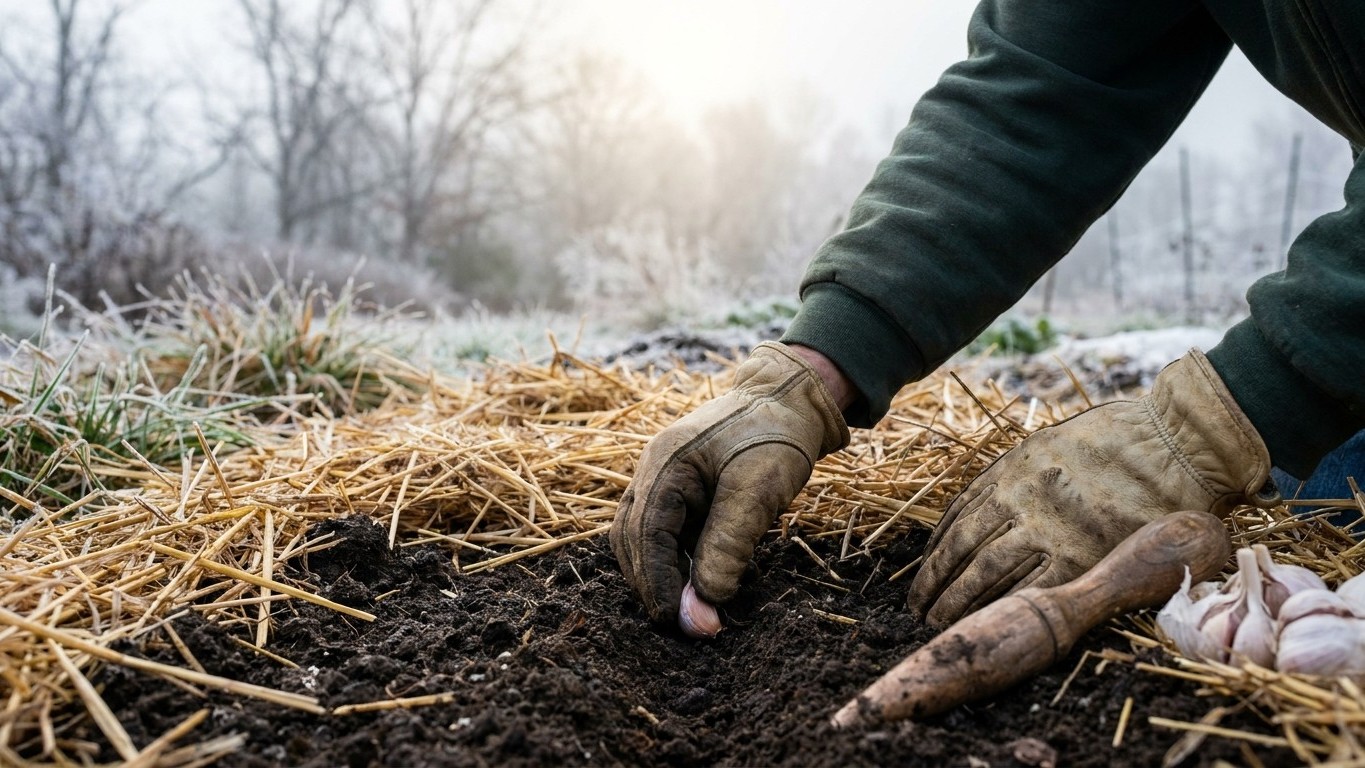
That said, a few things still make sense wherever the ground remains workable, meaning it’s not frozen solid or waterlogged. Garlic and shallots are the classic exception: if fall planting got delayed, cloves can still go in through early December in the milder parts of the state, particularly the Eastern Shore, as long as you can still push a trowel into the bed. Cover the row with straw once planted, both to insulate and to mark the spot before snow hides it.
Bare-root fruit trees, roses, and dormant shrubs are the other legitimate December planting, provided the ground isn’t frozen and the plant is fully dormant, no green tissue showing. Settle the roots, water once to close air pockets, then mulch heavily and leave the pruning for later.
Cold frames and low tunnels extend the season for what’s already growing rather than starting anything new: spinach, mâche, and claytonia planted back in fall will keep producing under cover through much of the winter. And two crops make sense started indoors this month specifically because they don’t need soil at all: rhubarb crowns dug and brought into a dark, cool space will force tender stalks in a few weeks, and Belgian endive roots do the same trick, producing pale, tight chicons when kept in total darkness. Western Maryland’s higher elevations will already have frozen ground weeks before the Eastern Shore does, so what’s workable on the coast may already be locked up in Garrett or Allegany counties.
What to start under cover
Seed-starting math in December runs backward from the last spring frost window of April 3 to April 16, not forward from today’s date. Onions and leeks grown from seed are typically started roughly 10 to 12 weeks ahead of transplanting, which is itself timed a few weeks before that last frost window. Do the arithmetic and the earliest onion and leek seed can reasonably go under lights in late December, mostly for gardeners in the western counties who want the extra head start their shorter, cooler season demands. For most of the state, this is still early, and patience costs nothing here.
Most everything else, tomatoes, peppers, brassicas for spring transplant, waits until January or February. Starting now almost guarantees the first failure mode of indoor seed-starting: plants that outgrow their pots long before it’s safe to set them outside, turning leggy and rootbound under indoor light that never quite matches the sun. A six-week-old tomato seedling sitting in a four-inch pot in February is not ahead of schedule, it’s stunted.
The opposite mistake shows up later in the season, when gardeners who waited too long discover their transplants haven’t sized up before the ground is ready, and the harvest window closes before it opens. December is really a planning month for this reason: check germination rates on leftover seed packets, order anything you’re missing, and set a start date on the calendar keyed to April 3 through April 16 rather than to a fixed day. That single habit, counting backward from the frost window instead of forward from today, is what separates a productive spring bed from a scramble.
What is ready to pick
Outdoors, the harvest in December is thin, and there’s no point pretending otherwise. But thin isn’t nothing. Kale, collards, and Brussels sprouts left standing from fall planting actually improve after a hard frost, converting starches to sugars, so a cold snap makes them sweeter rather than ruining them. Leeks handle freezing soil well too; dig them as needed rather than all at once, since they store better in the ground than in a refrigerator drawer.
Cold frames are doing real work this month if they were planted in fall: spinach, lettuce, and mâche under cover will keep cropping in small amounts through the cold, especially on the milder Eastern Shore. Indoors, sprouts and microgreens are the easiest fresh green a household can produce in December, ready in five to fourteen days depending on the seed, with no soil temperature to worry about at all.
The other harvest this month is really an inspection. Stored squash, potatoes, and onions need a walk-through at least every couple of weeks. Squash showing a soft spot or a sweet, fermenting smell is going soft from the inside and should be used immediately, not left to spread rot to its neighbors. Potatoes that have sprouted or gone green from light exposure should be pulled and either used right away (green skin trimmed away, it’s a natural response called greening) or composted if soft. Onions that have gone papery-soft at the neck are breaking down and won’t hold much longer. A five-minute check now saves a whole bin later.
The jobs that matter this month
December carries a full list of work, none of it optional if you want a strong spring. Dormant pruning tops the list: apple and pear trees, along with brambles like raspberries and blackberries, are pruned while fully dormant and leafless, when you can see the branch structure clearly and the plant won’t bleed sap or waste energy healing cuts. Wait until the coldest snap has passed if temperatures are extreme, but don’t push pruning past late winter or you’ll be cutting into swelling buds.
Seed catalogs move fast this month. Popular varieties, especially anything featured in a catalog’s front pages, sell out by midwinter, so ordering now beats discovering your first-choice tomato is unavailable in February. Pair that with planning next year’s rotation on paper: which beds grew heavy feeders like tomatoes and squash, which grew light feeders or nitrogen-fixing legumes, and where disease pressure showed up so you can move related crops elsewhere.
Soil, compost, and tools
Empty beds are the easiest time to test soil and correct pH, since amendments like lime need months to work into the soil before spring planting. Turn the compost pile if it hasn’t frozen solid, adding fallen leaves in thin layers rather than one thick mat that mats down and goes anaerobic. Clean and sharpen pruners, loppers, and hoes now, while there’s time, rather than fighting dull, rusted tools on the first warm day of spring when everyone wants to be planting instead of filing an edge.
Fences, raised bed corners, and trellis hardware are easier to repair without a crop in the way. And newly planted garlic beds benefit from a mulch check after any heavy rain or freeze-thaw cycle, since heaving can push cloves partway out of the ground; press them back down and add mulch rather than leaving them exposed to desiccate.
What not to do in December
The most common December mistake in Maryland is trusting a warm afternoon over the calendar. A 55-degree day in the middle of winter doesn’t mean the soil has warmed to seed-safe temperatures, it means the air did, briefly. Air warms and cools in hours; soil at root depth takes weeks to follow. Planting anything tender on the strength of one mild day is a bet against the season, and the season usually wins.
The same mild spell tempts gardeners to pull mulch off cold frames or perennial beds early, thinking the cold has passed. It hasn’t. Maryland is still four months from the last spring frost window of April 3 to April 16, and a single hard freeze after uncovering can undo protection that survived weeks of real winter. Leave insulation in place until you’re closer to that window, not until one nice afternoon convinces you otherwise.
Nitrogen is the other trap. Feeding dormant perennials, fruit trees, or garlic beds with a nitrogen-heavy fertilizer this month pushes soft, tender new growth right when the plant should be resting, and that new growth is exactly what a hard freeze kills first. Hold nitrogen until active spring growth resumes; if a soil test in December shows a deficiency, correct it with slower-acting amendments instead, and save the nitrogen boost for when plants can actually use it.
Last, don’t let stored crops go unchecked because harvest season feels over. A single soft potato or squash left in a bin can spread rot to everything around it within a couple of weeks, turning a full winter’s storage into a loss over a job that takes five minutes.
Checking this against your own county
Everything above is a statewide starting point, and Maryland’s geography is too varied for one December to fit every county the same way. The mountainous counties of Western Maryland, Garrett and Allegany, run weeks behind the rest of the state on both frost windows, meaning ground there often freezes solid well before the Eastern Shore’s soil does. The Eastern Shore and the milder coastal counties, by contrast, can keep beds workable longer into December and cold frames producing further into winter. Elevation alone can shift a frost date by a week or more within a single county.
For a planting calendar built around your specific zip code, along with local frost data and county-level guidance, the University of Maryland Extension is the reference to check before finalizing anything on this page.
Common questions
Can I still plant garlic in Maryland in December?
Yes, as long as the ground is workable, meaning it isn’t frozen solid or waterlogged. This is more realistic in milder areas like the Eastern Shore than in Western Maryland, where the ground often freezes earlier.
Is it too late to start seeds indoors in December?
For most crops, yes, it’s early rather than late; tomatoes and peppers started now will outgrow their pots long before it’s safe to transplant. Only leek and onion seed, started 10 to 12 weeks ahead of the April 3 to April 16 frost window, makes sense this early, and mainly for western counties with a shorter season.
What vegetables can I still harvest in December in Maryland?
Kale, collards, and Brussels sprouts left in the ground actually sweeten after frost, and leeks can be dug as needed through frozen soil. Cold frames may still be producing spinach, lettuce, or mâche if they were planted in fall.
Why does Maryland’s hardiness zone matter for December planting decisions?
Maryland spans USDA Hardiness Zones 5b to 8a, a range built on average annual extreme minimum temperatures. That range explains why a plant that survives winter easily on the Eastern Shore may not make it through a Western Maryland winter without extra protection.