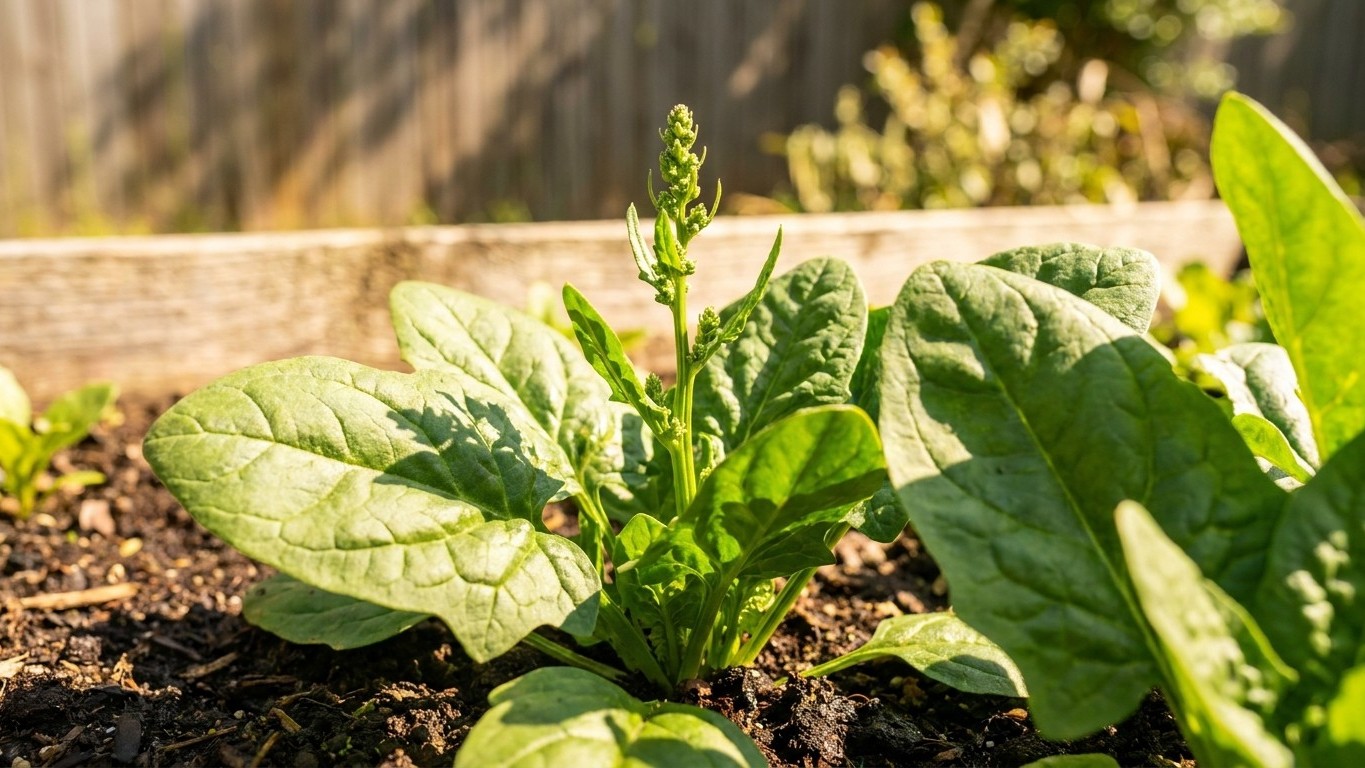

Yes, spinach will bolt early almost anywhere in Maryland, and it has little to do with how mild or muggy the summer feels. The trigger is day length working together with heat, and both push against this crop here. Growers get one solid window in spring and another in fall, but the long, bright, soil-baking middle of the year is effectively closed to spinach. Knowing why day length matters as much as temperature changes how you time every sowing date in this state.
The short answer
On the longest day of the year, Maryland gets 14 hours and 45 minutes of daylight. That number matters more than most gardeners assume. Spinach bolts under long days combined with warm temperatures, so once the days stretch past a certain point, the plant starts moving toward flowering no matter how the thermometer reads. A cool, cloudy summer does not buy extra weeks here, because the day length itself is doing part of the work. This is the opposite of what happens with onions on a long-day schedule, where lengthening days build the bulb. For spinach, lengthening days build a flower stalk instead, and once that starts, the leaves turn bitter and the harvest is effectively over.
Heat piles on top of that mechanism rather than replacing it. Spinach grows best where temperatures stay under 75 degrees Fahrenheit, and Maryland averages 24.6 days a year at 90 degrees or above, measured at the Baltimore reference station. That figure is not the average summer temperature, it is the heat load, the count of days pushing the plant well past its comfort zone. Most of those 90-degree days cluster in June, July, and August, exactly the stretch when daylight is also at its longest. So the two pressures land at the same time of year, which is why the failure feels sudden. One week the spinach looks fine, the next it has thrown up a central stalk and gone bitter.
The honest answer, then, is that both mechanisms are working against spinach in Maryland, not just one. Day length sets the outer limit on how late into early summer a spring planting can hold, and heat finishes the job by making any surviving plants unpalatable even before they flower. Gardeners who treat this as purely a heat problem, and try to out-shade or out-water their way through June, are fighting only half the battle. The daylight clock keeps running regardless of what the mulch or the shade cloth does.
How long the spring window really is
Working out the real spring window means starting from a fixed point and moving forward, not guessing at a calendar date. Here is how that plays out using Maryland’s own numbers.
- Start from the last frost. NOAA’s 1991-2020 climate normals put Maryland’s last spring frost between April 3 and April 16, with mountainous Garrett and Allegany counties running weeks later and the Eastern Shore trending milder.
- Back up two to three weeks for sowing. That puts a realistic spring sowing date somewhere from mid-March into early April for most of the state, shifted later in the western counties.
- Count the cool weeks that follow. Spinach germinates and grows well in cool soil right after sowing, and that stretch of good growth typically holds for several weeks while spring temperatures stay under the 75-degree ceiling.
- Watch for the ceiling, not the calendar. Once daytime highs start settling above 75 degrees for good, which in Maryland tends to happen as spring gives way to early summer, growth quality drops and the plant’s bolting clock, already running on day length, accelerates.
Add it up and most of Maryland gets somewhere in the range of six to eight usable weeks between a mid-to-late-March sowing and the point where heat and day length together end good production. That window is not fixed to a specific date because the last frost itself moves by nearly two weeks depending on where in the state you garden, and the transition into consistently warm days does not arrive on the same schedule everywhere either. The practical takeaway is to sow as early as the soil can be worked after the last frost risk passes, rather than waiting for a specific date on a seed packet, since every week lost at the start is a week lost off an already short window.
The autumn crop, and when the soil lets you sow
Fall spinach in Maryland runs into two separate obstacles, and they arrive in the opposite order from what most gardeners expect. The season does not end with the first obstacle, it starts with one.
Soil still too warm to germinate
Utah State University Extension notes that spinach seed germination drops off once soil temperatures climb above 80 degrees Fahrenheit. Maryland’s summer soil holds heat well past the point where the air starts to feel like fall, especially in the humid corridor around Baltimore and the Eastern Shore. With 24.6 days a year averaging 90 degrees or hotter concentrated in June through August, the ground itself stays too warm for reliable germination well into late summer. Sowing spinach too early in that window is often the reason a fall crop simply never comes up, regardless of how the seed packet or the air temperature looks.
The frost that ends the season
Maryland’s first fall frost arrives between October 26 and November 5, again with the western mountains running later and milder pockets running earlier into that range only rarely. Utah State University Extension recommends sowing a fall crop 50 to 75 days before the date you want to harvest, since no days-to-maturity figure is published for the crop itself. Counting back from an October 26 target puts the sowing window between roughly mid-August and early September, which conveniently lines up with the point in the year when soil temperatures are finally dropping out of that germination-blocking zone above 80 degrees.
| Region | Typical last spring frost | Typical first fall frost |
|---|---|---|
| Western Maryland (Garrett, Allegany) | Later than the state range, into mid-to-late April | Earlier than the state range, into mid-October |
| Central Maryland (Baltimore area) | April 3 to April 16 | October 26 to November 5 |
| Eastern Shore | Earlier and milder than the central range | Later than the state range, into early-to-mid November |
Utah State University Extension names four spinach varieties, Bloomsdale, Melody, Teton, and Olympia, though it publishes no data on days to maturity, bolt resistance, or leaf type for any of them. Rather than guess at differences the source does not provide, treat the variety choice as separate from the timing question. The calendar math above, working backward from frost dates and forward from soil temperature, applies regardless of which of those four names ends up in the ground.
Common questions
Does a cooler-than-normal summer let Maryland spinach avoid bolting?
No. Bolting is triggered by long days as well as by heat, and Maryland’s 14 hours and 45 minutes of daylight on the longest day is enough on its own to push spinach toward flowering, regardless of how mild the temperatures happen to run.
Why does spinach seed sometimes fail to come up in late summer even when it isn’t frosty yet?
The obstacle in late summer is heat in the soil, not cold in the air. Germination drops once soil temperatures climb above 80 degrees Fahrenheit, and Maryland’s ground often stays that warm well into the season.
Is the growing window the same across all of Maryland?
No. Western Maryland’s mountains push the last frost later and the first frost earlier, shortening both the spring and fall windows, while the Eastern Shore’s milder pattern shifts the fall frost later and can stretch the autumn crop by comparison.
Should I pick a specific spinach variety to fight bolting in Maryland?
Utah State University Extension lists Bloomsdale, Melody, Teton, and Olympia as spinach varieties but does not publish comparative data on bolt resistance for any of them, so variety choice should not replace careful attention to sowing dates and soil temperature.