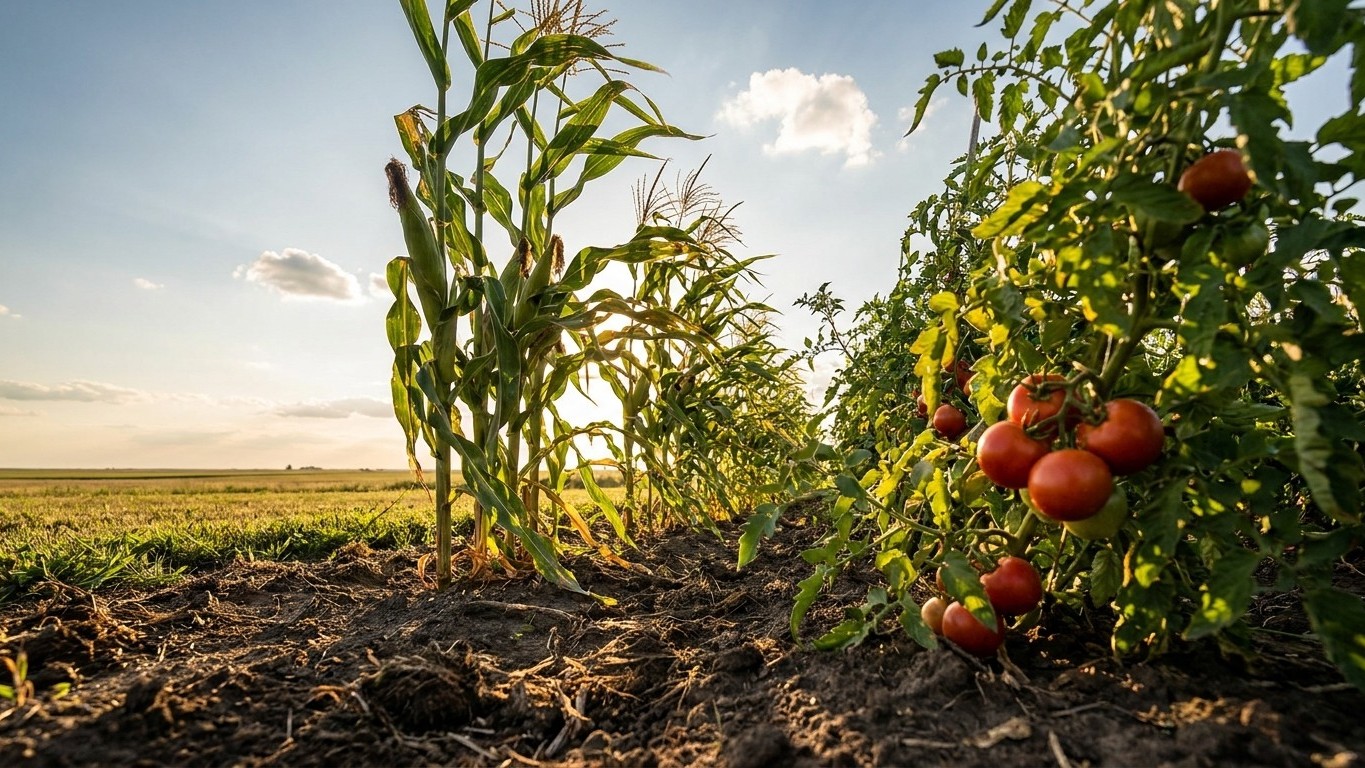

Sweet corn in Maryland is ready 60 to 90 days after planting, and planting cannot start until the soil reaches 60 F, which happens after the last frost, not on it. Once an ear is ripe, the clock turns against you. Sugar starts leaving the kernel the moment it is picked, and heat speeds that up. How much time you get between garden and kitchen depends heavily on the type of corn you sowed. For the full growing picture, see Growing Sweet Corn in Maryland.
The short answer
Start with the soil, because that is where gardeners most often jump the gun. Maryland’s last spring frost falls between April 3 and April 16, based on NOAA NCEI Climate Normals (the 32 F freeze probabilities in the 30 to 70 percent band). Soil at 60 F arrives later than that. Often a good deal later. A bed can be frost-free for weeks and still sit too cold to wake a corn seed. Western Maryland (Garrett and Allegany counties) is mountainous and runs weeks later than those dates, while the Eastern Shore runs milder.
Soil warms on its own schedule
Utah State University Extension puts the rule in two parts: sweet corn needs soil above 60 F, and 60 to 90 days from planting. Clemson Cooperative Extension adds a finer split: “Do not plant before the soil temperature at the 4-inch depth is at least 50 ºF. Wait to plant extra-sweet varieties until soil temperatures reach 65 °F.”
Keep the depth in that sentence. A thermometer pushed 4 inches into the bed reads cooler than the surface, and the surface is what a warm afternoon fools you with. The two thresholds are not interchangeable either. Ordinary sweet corn tolerates the lower number, but extra-sweet seed sown at 50 F tends to rot rather than sprout. That is why a gardener can succeed one year and fail the next just by switching varieties. No calendar date for 60 F soil is published here, so the thermometer is the authority. More on timing is in When to Sow Sweet Corn in Maryland.
Ripe, then fading
Ripeness is read from three signs together: dry brown silks, husks that are still moist and green, and milky juice when you puncture a kernel. One sign alone misleads. Brown silks on a dry ear can still hide immature kernels. This is a second clock, separate from the first. Planting to harvest (60 to 90 days) tells you whether a variety fits the season. Silk emergence to harvest (about 17 to 24 days) tells you which week to pick.
After picking, the fade begins. Clemson’s factsheet is blunt: “Sweet corn loses sugar from the kernel rapidly at high temperatures… Sweet corn can be stored under optimal conditions for about five days, but will lose sweetness with each day of storage.” Five days is a ceiling under the best conditions, not a promise. Baltimore, the reference station for NOAA’s climate normals, averages 24.6 days a year at 90 F or hotter, and a warm kitchen counter is no better than a hot field. Genotype matters too. The su type loses sugar fastest, se holds it longer, and sh2 holds it longest. That is the practical reason to pick one over another, and it is the real basis of the old advice about racing from the garden to the pot.
Does a late variety fit here?
Count the frost-free stretch first. From the end of the last-frost window (April 16) to the start of the first-fall-frost window (October 26), there are roughly 193 days. At the long end, April 3 to November 5, it is about 216. The first fall frost, again from NOAA NCEI normals, falls between October 26 and November 5. Mountain counties differ, and their dates are not published here. Soil warming takes a bite out of the front of that stretch, so the real question is how much slack remains after planting.
A 60-day variety
An early variety fits with room to spare. Sown into 60 F soil, it needs only 60 days, so even with soil warming late and a cold fall arriving early, the margin is wide. That margin buys a second or third planting. The catch is timing, not the calendar: later plantings meet different insect pressure, and the pest article, What Eats Corn in Maryland, and When, covers what shows up as summer wears on. Staggered sowings also raise the cross-tasselling issue covered below.
A 90-day one
Yes, a 90-day variety fits in most of Maryland, and the arithmetic is simple. Take the shortest frost-free stretch, about 193 days, and subtract 90. That leaves about 100 days of slack to pay for cold soil in spring and an early frost in fall. The late variety stops fitting only when it goes in late. Counting back 90 days from October 26 lands on roughly July 28, and from November 5 on roughly August 7. A 90-day corn sown after that is gambling with the first frost.
The doubtful case is the mountains. Garrett and Allegany run weeks off the dates above, and the figures here do not give a local frost-free window for them. If you garden there, check local frost records before committing to a long-season variety, and lean toward the shorter end of the 60 to 90 range.
What goes wrong here
Climate causes most of the failures, but not all. Here are the ones that show up, with the fix for each.
- Soil sown too cold. Gardeners treat the last frost date as the green light, but soil at 60 F comes later. Seed in cold ground sits, rots, or comes up thin, and extra-sweet seed is the least forgiving. Remedy: push a thermometer 4 inches into the bed. Wait for at least 50 F for ordinary sweet corn and 65 F for extra-sweet, and treat the general 60 F rule as your working target.
- A variety too late for the season. A 90-day corn sown in late July or August runs into the first fall frost window. The same variety in the mountains can run out of season sooner. Remedy: count back from October 26, the early edge of the frost window, and choose a 60-day type for late sowings or cooler counties.
- Sweetness lost to cross-tasselling. This one has nothing to do with climate. If su, se and sh2 types tassel at the same time, sweetness is lost. The source publishes no separation distance, so do not trust any number of feet you read elsewhere. Remedy: keep the types from tasselling together. Grow one type per planting, space sowings so each type tassels on its own schedule, and plant in blocks of three or more rows (a shape of garden, not a date).
- Waiting too long to pick. A ripe ear left on the stalk or on the counter loses sugar. Remedy: use all three signs, dry brown silks, green moist husks, and milky juice, then pick when the ear is ready and eat it soon.
Common questions
Is 60 F soil the same as the last frost date?
No. The last frost falls between April 3 and April 16, and soil reaches 60 F after that. Use a thermometer at the 4-inch depth, not the calendar.
How long does sweet corn keep after picking?
Clemson says it can be stored under optimal conditions for about five days, but it “will lose sweetness with each day of storage.” Five days is a maximum, and su types fade fastest, se slower, sh2 slowest.
Can I grow a 90-day sweet corn in Maryland?
In most of the state, yes, if it goes in at the right time. Counting back 90 days from the early edge of the first-fall-frost window gives roughly late July as the cutoff. Western Maryland needs a local check, because its dates are not published here.
How do I know which week to pick?
Count about 17 to 24 days from silk emergence, then confirm with all three signs together: dry brown silks, moist green husks, and milky juice from a punctured kernel. That count is separate from the 60 to 90 days that measure the whole season.