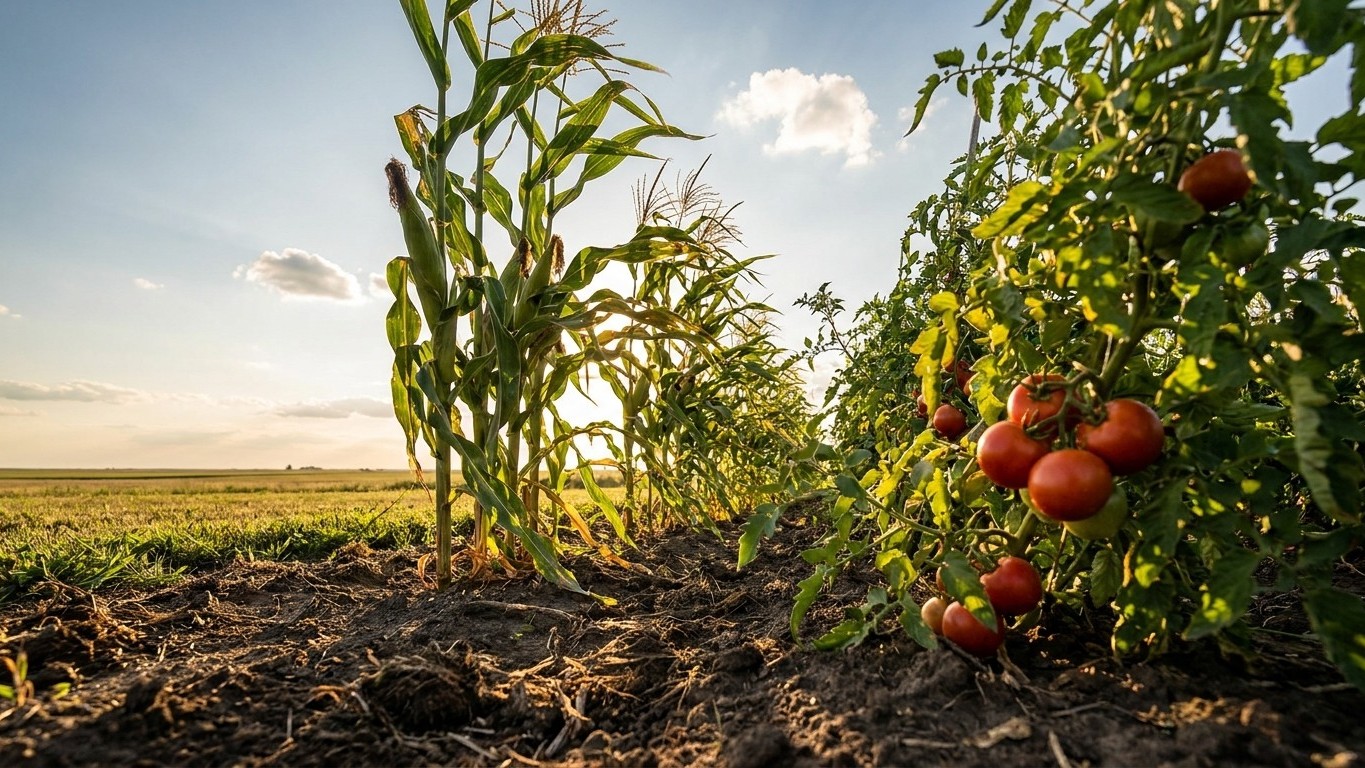

Sweet corn in Maryland is ready to eat on two separate clocks. The first starts when the soil warms, not when the last frost passes, and a crop planted then has plenty of room before fall frost. The second starts when the silks appear and sets the week you pick. This page covers the eating side: when the ears are ready, and what decides whether they taste sweet. Pests are left out, because the sources behind it publish no figures on them.
The short answer
Soil reaches 60 F later than the last frost, and the two should never be treated as the same day. The NOAA NCEI 1991-2020 Climate Normals, at the Baltimore-area reference station, put the last spring freeze between April 3 and April 16 (the 30 to 70 percent probability band for 32 F). Ground at planting depth lags the air by weeks after that. No calendar date for 60 F soil is published in these sources, so this page won’t invent one. A thermometer decides.
The 60 to 90 days that sweet corn needs from planting do fit before autumn. The same NOAA data put the first fall freeze between October 26 and November 5. Between the two ranges sit roughly 190 to 215 days. Cold soil in spring eats into that, but not enough to threaten a 60-day crop, and not usually a 90-day one either (more on that below).
Soil first, calendar second
Utah State University Extension says sweet corn needs soil above 60 F. Clemson Cooperative Extension gives a floor and a second threshold: “Do not plant before the soil temperature at the 4-inch depth is at least 50 ºF. Wait to plant extra-sweet varieties until soil temperatures reach 65 °F.”
Keep the depth. A surface reading is warmer than the soil where the seed sits, and it will send you out too early. The two numbers also aren’t interchangeable. Ordinary sweet corn tolerates the lower one. An extra-sweet (sh2) seed sown into 50 F soil tends to rot instead of germinating. That’s why a gardener can succeed one year and fail the next after nothing changed but the seed packet. For the planting side of this question, see When to Sow Sweet Corn in Maryland.
Two clocks, two questions
Sixty to ninety days from planting tells you whether a variety fits the season. Seventeen to twenty-four days from silk emergence tells you which week to pick. Don’t merge them into one number. The first is a purchase decision made in spring, the second a daily check in summer.
For the picking week, look for three signs together: silks that have dried and turned brown, a husk that is still moist and green, and milky juice when you puncture a kernel. One sign alone misleads.
Once picked, the sugar starts leaving. Clemson’s factsheet puts it plainly: “Sweet corn loses sugar from the kernel rapidly at high temperatures… Sweet corn can be stored under optimal conditions for about five days, but will lose sweetness with each day of storage.” Read “about five days” as a ceiling under ideal conditions, not a promise. Genotype matters here. The su type loses sugar fastest, se holds it longer, and sh2 holds it longest. Baltimore averages 24.6 days a year at 90 F or higher, so a picked ear sitting on a warm porch is losing sugar quickly. That is the real reason behind the old advice to run from the garden to the pot.
Does a late variety fit here?
A 60-day variety
Comfortably. Wait for soil to reach the threshold for the type you chose (50 F at the 4-inch depth for ordinary sweet corn, 65 F for extra-sweet), plant, and count 60 days. Even if a cold, wet spring pushes planting back by weeks, harvest lands far ahead of the October 26 edge of the first-frost range.
That slack is useful. It allows a second planting, or staggered sowings, so the whole patch doesn’t ripen in the same few days. Staggering also matters for sweetness, as the last section explains. The sources name no specific variety, so this page doesn’t either. Check the days-to-maturity figure on the packet, and ask whether it counts from planting or from emergence.
A 90-day variety
It fits in the Baltimore reference zone, with less margin than the early one. Take the cautious end of the fall range, October 26, and count back 90 days. You land in the height of summer, not in spring. So a planting made after soil warms in spring has months to spare. The trouble starts only with a very late sowing, a replanting after a failed stand, or a second round put in “just to see.”
The extra-sweet condition adds a wrinkle. A 90-day sh2 type needs 65 F soil, which arrives later than 50 F. In a cold spring, the wait for that warmth is what shortens the margin, not the fall frost itself.
Western Maryland (Garrett and Allegany counties) is a different case. It is mountainous, and its spring runs weeks later than the figures above. The verified frost dates here describe the central reference station, not the mountains, and no mountain fall-frost figure is published. For that part of the state, the honest answer is that a 90-day corn is not established as a fit. A shorter variety is the safer choice, and Will Sweet Corn Ripen in Maryland? works through the question. The Eastern Shore runs milder, so the central numbers are conservative there. For the full picture, start from Growing Sweet Corn in Maryland.
What goes wrong here
Three failures account for most disappointing sweet corn in this state. Two come from the calendar and one has nothing to do with climate.
- Soil sown too cold. The last frost has passed, the air feels warm, and the seed goes in. But soil at the 4-inch depth trails the air, and extra-sweet seed in 50 F ground rots instead of sprouting. The remedy is a soil thermometer pushed in to 4 inches. Wait for at least 50 F for ordinary sweet corn, 65 F for extra-sweet, and treat Utah State’s figure of above 60 F as the working target for a general planting. Never use the last-frost date (April 3 to April 16) as a stand-in for any of those readings.
- A variety too late for the season. This is rare in central Maryland on a spring planting, but it happens with late replanting and in the mountains. A 90-day corn sown so late that its days run past the October 26 to November 5 range is racing frost it can’t beat. The remedy is to count forward from planting, using the packet’s days to maturity, and compare the result with the first fall frost. If the count lands inside the frost range, switch to a shorter variety or skip the planting. In Garrett and Allegany, repeat that math with local figures, since the ones here don’t cover them.
- Sweetness lost to cross-tasselling. No weather causes this. Utah State University Extension says sweetness is lost if su, se and sh2 types tassel at the same time. The source publishes no separating distance, so none is given here. The advice rests on timing: don’t let different types tassel together. Plant one type per sowing, or stagger different types so their tasselling doesn’t overlap. Plant in blocks of three or more rows, not a single long line, which is a shape of garden and not a date. The same rule covers a neighbor’s patch if it is close enough to matter, though the sources give no figure for that either.
Common questions
Is 60 F soil the same as the last frost date?
No. The last spring freeze at the reference station falls between April 3 and April 16, according to NOAA NCEI’s 1991-2020 normals. Soil at planting depth warms well after that, and this page publishes no date for it. Measure at 4 inches instead of guessing from the calendar.
How long does picked sweet corn keep?
Clemson says it “can be stored under optimal conditions for about five days, but will lose sweetness with each day of storage.” Treat five days as the outer limit, not a guarantee. Heat speeds the loss, and su types lose sugar fastest, se more slowly, sh2 slowest.
Can I grow su, se and sh2 in the same garden?
Only if they don’t tassel at the same time. When they do, sweetness is lost. The source publishes no isolation distance, so the safe approach is separate sowings timed apart, in blocks of three or more rows.
How do I know an ear is ready?
Look for dry brown silks, a husk that is still moist and green, and milky juice from a punctured kernel, all three together. The expected window is 17 to 24 days from silk emergence. That count starts at the silks, not at planting, so it is a separate clock from the 60 to 90 days that decide whether a variety fits the season.