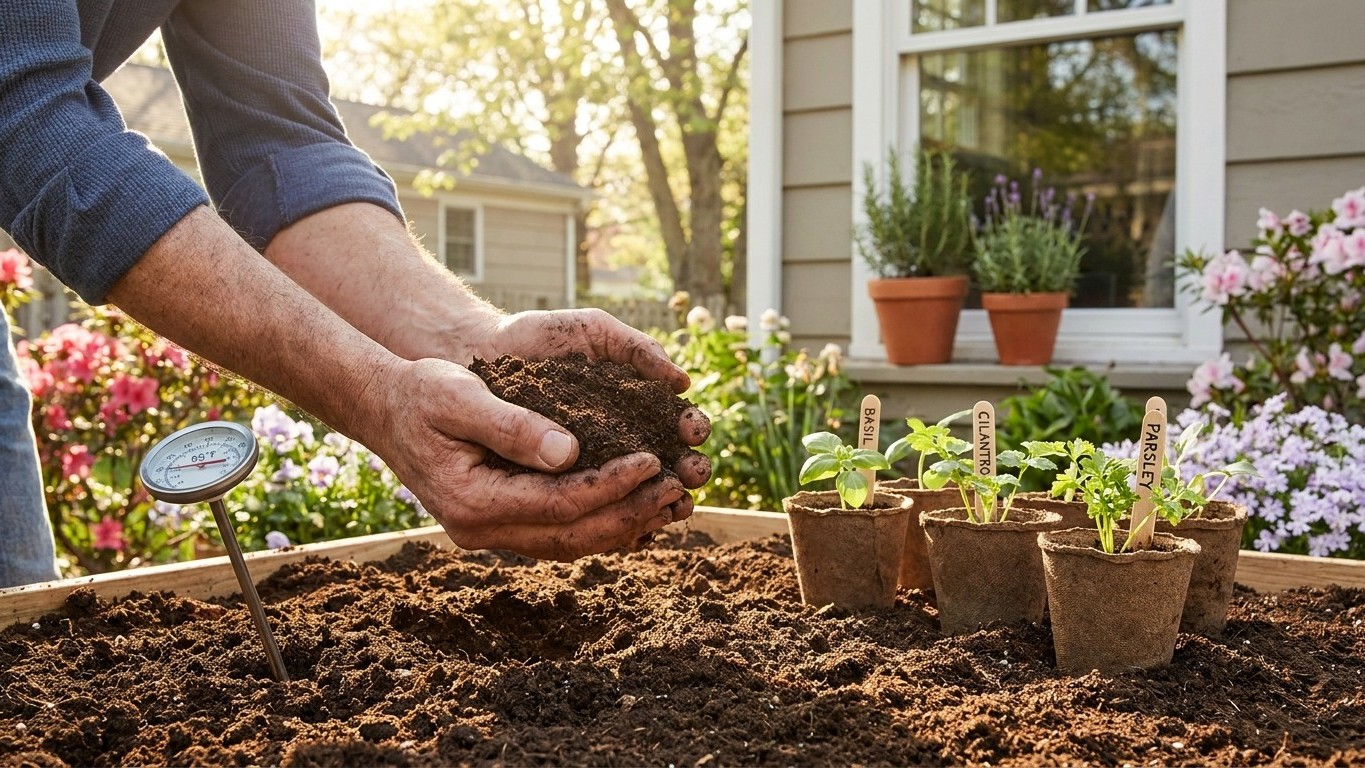

In most of Massachusetts, the safe window for putting tender herbs like basil in the ground runs from mid-April to early November, though soil warmth, not the calendar, decides the actual start. Cold-hardy herbs such as thyme, sage, and chives behave differently, since some overwinter outdoors while others need to come inside once the mercury drops.
When the soil is warm enough in Massachusetts
The last spring frost at Boston’s Logan Airport station falls between April 1 and April 8, according to NOAA’s 1991-2020 Climate Normals, which track the 30 to 70 percent probability band for a 32°F freeze. That’s the frost date. It is not the planting date, and treating the two as the same thing is where a lot of herb gardens get off to a rocky start.
Frost is a proxy for something else: soil temperature. Basil, cilantro, and other warm-season herbs germinate poorly and sulk visibly in cold ground, even on a day when the air feels pleasant. Soil at 4 inches deep typically lags behind air temperature by a couple of weeks in spring, since the ground releases the winter’s stored cold slowly. A gardener who plants basil the week frost risk clears is often planting into soil still in the low 50s, where the seedlings sit and do little until real warmth arrives.
The frost date itself deserves a caveat too. It’s a probability, not a promise. The 30 to 70 percent band from NOAA means frost risk is already meaningfully present before April 1 and still lingering after April 8, not that the switch flips cleanly on those two dates. And the Logan station sits on Boston Harbor, the mildest, most moderated spot in the state. Inland suburbs, the Connecticut River Valley, and especially the Berkshires see frost linger later into spring and arrive earlier in fall. A gardener in Pittsfield or Greenfield should treat the Logan window as an optimistic estimate, not a local forecast.
For cold-hardy perennial herbs, the frost date matters less. Chives, oregano, mint, and established thyme plants tolerate a late frost with minor leaf damage at worst, so gardeners growing those types can get a jump on the calendar. Rosemary is the exception among the “hardy” group: it reads as hardy in warmer climates but struggles with New England winters outdoors, a detail that matters more in the season-length discussion below.
Practically, that means two starting lines exist on the same piece of ground. Hardy perennial herbs can go in as soon as the soil can be worked, sometimes in late March. Tender annual herbs wait until the soil itself, not just the air, has caught up, typically a week or two after the local frost-free date clears.
How long the season lasts here
The first fall frost at the same Logan reference station arrives between November 3 and November 14. Paired with the spring window of April 1 to April 8, that gives a frost-free stretch running roughly 209 to 227 days, depending on which edge of each probability band you use. Either way, it lands around seven months, which is a genuinely long growing season by New England standards, and it’s the coastal, urban-influenced version of that season. Inland gardens should expect it trimmed by a couple of weeks on both ends.
What that length allows is more interesting than the raw number. Seven months is enough time to grow a full cycle of a fast annual herb like cilantro or dill, let it bolt in summer heat, then start a second round from seed for a fall harvest. It’s also long enough that basil, planted once soil warms in late May, has all the time it needs to reach full size and keep producing through September without racing a September frost.
What a longer window changes
A short season forces a gardener into one shot: sow once, harvest once, done. Massachusetts’ window is generous enough that succession sowing genuinely pays off for quick annuals, especially cilantro, which bolts fast in summer heat regardless of how carefully it’s watered. Sowing a small patch every few weeks from May through August keeps a steady supply coming instead of one glut followed by nothing. The site’s succession sowing guide walks through timing that out crop by crop.
The season length also affects whether transplanting from nursery starts is worth the root disturbance. With seven months on the clock, there’s enough runway to direct-seed slower herbs like parsley, which resents having its taproot disturbed, rather than buying starts and risking transplant shock. In a territory with a four-month season, that calculation would tilt the other way, since every week lost to transplant recovery matters more.
Heat and water in Massachusetts
No verified count of days above 90°F is on record for this page, and summer rainfall figures aren’t part of the confirmed data set here either, so neither gets invented. For herbs specifically, that gap matters less than it would for, say, tomatoes, because the number that actually organizes a Massachusetts herb bed isn’t a summer heat count. It’s winter.
The mean daily minimum temperature in the coldest month, tracked by NOAA’s 1991-2020 Climate Normals for the Boston reference station, sits at 23.1°F. That’s not the record low; it’s the average low across the coldest month’s worst nights, which is the figure that actually determines whether a woody perennial herb survives winter in the ground or needs to come indoors.
Layered on top of that, the USDA Plant Hardiness Zone Map (2023 edition, built on 1991-2020 averages) places Massachusetts across zones 5a to 7b. That’s a wide range for one state, and it’s a territory-wide spread rather than a single number, which is exactly why the map itself, checked against a specific address, matters more than any statewide summary. Coastal areas and the immediate Boston metro trend toward the warmer end of that range; the Berkshires and the higher inland valleys sit at the colder end.
Why winter decides the herb bed, not summer
That 23.1°F average minimum is cold enough to kill rosemary left in the ground over winter in most of the state, even though rosemary is often sold and treated as a hardy perennial in milder climates. Thyme, sage, oregano, chives, and mint generally handle that cold fine once established, which is why they show up as permanent fixtures in Massachusetts herb gardens while rosemary, and often bay laurel, get grown as annuals or moved into pots and brought indoors before the first hard freeze.
That single distinction, ground-hardy versus pot-and-protect, reorganizes the whole bed. It’s less about picking herbs that like New England summers, which most culinary herbs tolerate reasonably well, and more about sorting herbs into what stays outside all winter and what needs a windowsill from November through April.
Which herbs suit Massachusetts
None of this points to a specific variety, and that’s a deliberate choice, not an oversight. Naming a cultivar without knowing which one has actually been trialled against local disease pressure and frost timing would be a guess dressed up as advice. The UMass Extension service tracks which specific varieties perform well in Massachusetts conditions year to year, and that trial data is the only variety recommendation actually worth trusting here.
Reasoning by type, though, holds up well against this territory’s numbers. The frost-free window, generous but not endless, favors basil, cilantro, and dill types bred for reliable germination in cooler soil rather than ones that need a long, hot ramp-up. The winter cold, defined by that 23.1°F average minimum, means woody Mediterranean types like rosemary and bay do better treated as container plants that spend winter indoors, while thyme, sage, oregano, chives, and mint can be planted once and left as permanent fixtures.
What humidity does to the choice
New England summers bring stretches of humid, still air, and for herbs that shows up as a disease question before it shows up as a heat question. Basil in particular is vulnerable to downy mildew in muggy conditions with poor airflow, and dense plantings without space between plants make it worse. Spacing plants generously and choosing a spot with morning sun and some breeze matters more here than picking a heat-tolerant type, since the real threat most summers is dampness lingering on leaves overnight, not scorching daytime temperatures.
A few culinary herbs common in home gardens, including yarrow and certain mints, carry long-standing medicinal reputations. This page doesn’t evaluate those claims one way or the other; it’s a growing guide, not a health resource, and that line matters. Anyone drawn to an herb’s traditional reputation should look elsewhere for that evaluation and treat what grows here as a culinary and garden plant, full stop.