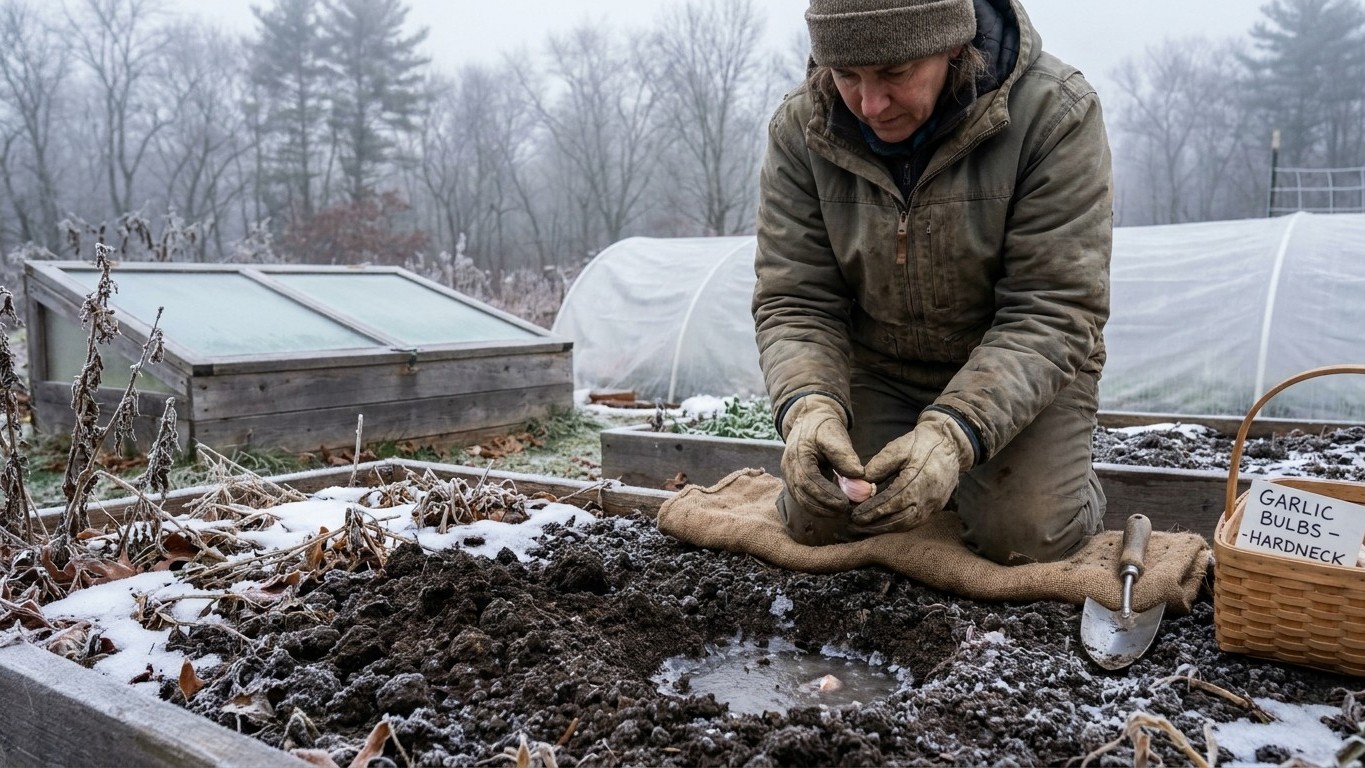

By December, Massachusetts gardeners have almost nothing to plant in open ground. The state’s first fall frost already arrived weeks earlier (November 3 to November 14, per NOAA), so soil is frozen or close to it across most of the state. Garlic and shallots can still go in if the ground remains workable early in the month, cold frames and low tunnels keep earlier plantings alive, and bare-root or dormant stock can be set out. Beyond that, the real work moves indoors and under cover.
What goes in the ground in December

The decision about what goes into open soil never comes down to the date on the calendar. It comes down to soil temperature and where that falls relative to the frost window. NOAA’s 1991-2020 climate normals put the first fall freeze at the Boston reference station between November 3 and November 14. By December, that threshold is behind us, and soil temperature at planting depth has usually dropped well below the range most root systems need to establish. That single fact decides almost everything else in this section.
So the honest answer is that direct-sowing or transplanting tender or even moderately hardy crops into unprotected ground is not a realistic option this month. But calling December a dead month for planting overstates the case. A handful of tasks still belong in the open ground, and several more happen under simple protection.
What still works this month
| Option | Where | Note |
|---|---|---|
| Garlic and shallot cloves | Open ground, if not yet frozen solid | Push the planting window as late as the soil allows; mulch heavily right after |
| Bare-root fruit trees, shrubs, canes | Open ground, dormant season | Only if the site is unfrozen enough to dig a proper hole |
| Hardy greens started earlier | Cold frames, low tunnels | Not new plantings, but protection lets existing spinach, kale, and mâche keep growing slowly |
| Rhubarb and chicory roots | Indoors, in dark, warm conditions | Forced for tender winter stalks and chicons, not planted outdoors at all |
Notice what is missing from that list: peas, alliums grown from sets rather than cloves, and anything remotely tender. None of it belongs in Massachusetts soil this month, and pushing it in anyway wastes both seed and effort.
What to start under cover
Seed starting indoors works backward from the frost window, not forward from the date on the seed packet. The last spring frost across the state’s reference station runs from April 1 to April 8, meaning the safe transplant date for tender crops sits roughly four months out. Count back from there the number of weeks a given seedling needs to reach transplant size, and December lands well before that countdown should begin for almost every summer crop.
Peppers and tomatoes, for instance, typically need eight to ten weeks indoors before they go out, which places their sowing date in February, not December. Start them now and by April they are rootbound, leggy, and stressed before they ever see the garden. That is the first failure mode: starting too early produces weak transplants, not a head start.
The second failure mode runs the other way. Slow growers like onions and leeks, which need ten to twelve weeks under lights before they can handle cool spring soil, have their own countdown that starts in mid-winter. Push their sowing date too late and they never bulk up enough to perform.
What actually belongs on the December list
This month is better used for cold-stratifying native and perennial seed that needs eight to twelve weeks of chilling before it will germinate at all. Seed can go into moist flats and sit in an unheated garage or a refrigerator so it is ready to sow once the stratification period ends. Herbs on a bright windowsill, continuous batches of sprouts and microgreens, and germination testing on leftover seed packets round out a realistic under-cover list. Save the tomato and pepper trays for later.
What is ready to pick
Almost nothing comes out of an unprotected Massachusetts garden in December. Ground that is frozen or blanketed in snow holds root crops in stasis rather than offering a harvest. But a few things still make it to the kitchen, and they are worth knowing about before writing the month off entirely.
Kale, leeks, and other hardy overwinter crops planted earlier in the season often survive under snow cover, their flavor actually improved by repeated cold exposure. Cold frames and low tunnels extend this further, keeping spinach, mâche, and other cold-tolerant greens harvestable in small amounts through the coldest weeks. Indoors, sprouts and microgreens supply fresh greens on a rotating cycle regardless of what is happening outside.
The bigger job this month is checking what is already in storage. Squash, potatoes, and onions put up earlier in the season need a hands-on inspection: soft spots on squash, sprouting eyes on potatoes, and any onion that has gone soft at the neck all signal it needs to be used or discarded before it spreads rot to the rest of the bin. A five-minute check every couple of weeks saves far more of the harvest than letting it sit untouched until spring.
The jobs that matter this month
December earns its keep through maintenance and planning rather than planting, and the list of real deadlines is longer than it looks. Dormant pruning of apple, pear, and other fruit trees, along with cane fruits like raspberries, works best now precisely because the plants are leafless and dormant. Disease and pest pressure that would otherwise spread through open wounds during the growing season is far lower in winter, and the bare branch structure makes it easy to see exactly which limbs need to come out.
Seed ordering belongs on this month’s calendar too. Popular varieties, especially regionally adapted ones sold through smaller seed companies, sell out well before spring planting season, and waiting until February to order often means settling for a second-choice variety. Pairing that order with a written rotation plan for next season, so beds that grew heavy feeders like tomatoes or brassicas move to lighter feeders or legumes, prevents the soil depletion that shows up as smaller yields down the road.
Soil itself deserves attention whenever the ground is workable: a simple pH and nutrient test now gives enough lead time to source and apply lime or amendments before the spring planting rush. Compost piles keep breaking down through winter if turned periodically to maintain airflow, even at a slower pace than summer. Tools cleaned and sharpened now, beds and fencing repaired while nothing is growing, and one more pass through stored crops for rot round out a genuinely full month of work, even without a single seed going into open ground.
What not to do in December
The most common mistake this month is treating a mild afternoon as a sign the ground has warmed. Air temperature and soil temperature are not the same thing, and Massachusetts soil in December stays cold or frozen at planting depth even during a stretch of unusually warm weather. Planting into it, or working it with a shovel or tiller while it is still wet and cold, compacts the structure and can do damage that lingers into spring.
A close second is uncovering cold frames or low tunnels too eagerly after a warm spell. Plants acclimated to the stable, protected environment inside a frame get shocked by a sudden drop back to freezing once the cover comes off, often losing tender new growth that took weeks to produce. The safer approach is to vent covers briefly on genuinely mild days rather than removing them outright, then close everything back up well before evening cold sets in.
Feeding nitrogen at the wrong point in the season causes its own problems. Any fertilizer applied late enough to push soft, tender growth right before a hard freeze leaves that new growth vulnerable to cold damage, undoing whatever benefit the feeding was meant to provide. December calls for patience on fertilizer, not one more application before spring.
Finally, mulch applied for winter protection without any thought to rodents creates cover for voles and mice to tunnel in and girdle bark or roots undetected. A quick check that mulch isn’t piled directly against trunks, and that traps or barriers are in place where rodent pressure has been a problem before, prevents a hidden loss that often isn’t discovered until spring.
Checking this against your own county
Every date and range in this article comes from a single reference station, and Massachusetts is not a single climate. Elevation change alone can shift a frost date by weeks between the Berkshires and the coast, and the difference between Cape Cod’s moderating ocean influence and an inland valley’s cold-air pooling can be just as large. Treat the state-wide picture here as a starting point, not an instruction specific to your yard.
| Region type | Typical pattern vs. the coastal reference station |
|---|---|
| Coastal and Greater Boston | Mildest frost timing in the state, closest to the published range |
| Inland valleys and suburbs | Frost arrives earlier in fall, lingers later in spring |
| Berkshires and higher elevations | Widest gap from the coastal reference, shortest frost-free stretch |
For a planting calendar built around local conditions, the UMass Amherst Extension is the right next stop.
Common questions
Can garlic still go in during December in Massachusetts?
Yes, as long as the ground remains workable. Once soil freezes solid, planting stops until spring, so garlic and shallots pushed in late benefit from a heavy mulch layer to buffer the roots through the rest of winter.
Is it too late to start seeds indoors this month?
For tomatoes, peppers, and other tender summer crops, yes, it’s too early, not too late. Their eight-to-ten-week countdown from the April 1-8 frost window puts their sowing date in February, so starting in December only produces leggy, stressed seedlings by transplant time.
Do overwintered vegetables actually survive Massachusetts winters?
Cold-hardy crops like kale and leeks routinely survive under snow cover, and cold exposure often improves their flavor. Protection with a cold frame or low tunnel extends the range of what stays harvestable through the coldest stretch.
What is the single most important December task for fruit trees?
Dormant pruning. With no leaves and lower disease pressure, this is the season when structural cuts are safest and easiest to judge, and skipping it here means correcting problems under much harder conditions once growth resumes.