
By November, most of Massachusetts has already crossed its first fall frost, so the honest answer for open ground is: garlic and shallots if the soil is still workable, and not much else. What changes the picture is elevation and distance from the coast, not the date on the calendar. Everything below explains why, and what still has a place in the garden this month.
What goes in the ground in November

The mechanism here is simple: first fall frost at Logan Airport, the state’s mildest recording station, lands between November 3 and November 14 in a typical year. Inland towns and the Berkshires see that freeze earlier, sometimes by two or three weeks. So for most of the state, November opens after the ground has already had its first hard chill. That single fact rules out anything tender before we even talk about specific crops.
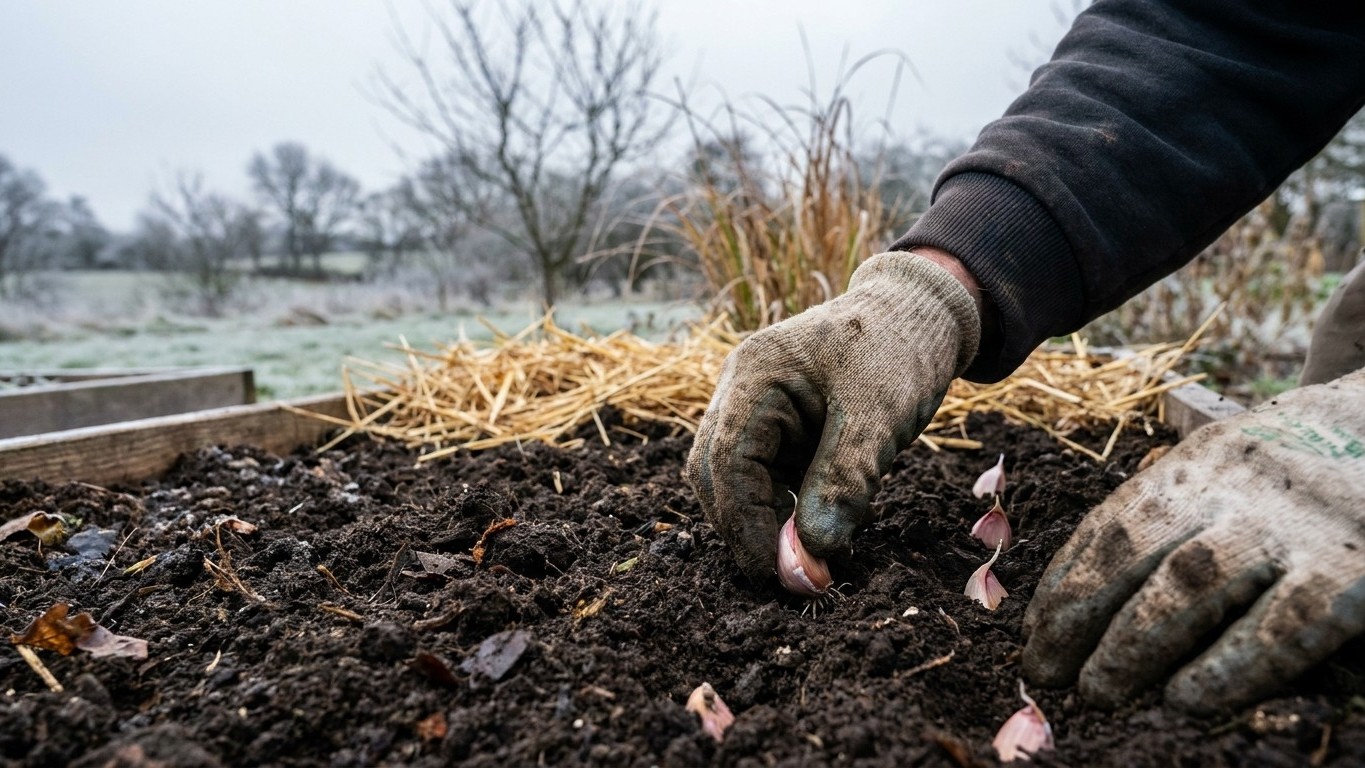
What survives that reality is short. Garlic and shallots are the one direct-sown planting that still makes sense early in the month, as long as the soil hasn’t locked up. Push cloves root-down about two inches deep, mulch heavily with straw once the ground starts to firm, and let winter do the vernalizing work for a summer harvest. Past that window, the soil becomes too cold and too wet to work without compacting it, and pushing anything into it does more harm than good.
What still has a place
Bare-root fruit trees, roses, and shrubs can still go in while the ground remains diggable, since dormant roots don’t need warm soil to establish, only contact with it before a true freeze locks them out. Cold frames and low tunnels extend the life of greens sown back in late summer, holding spinach, mache, and claytonia through cold snaps that would kill them in the open. Indoors, this is the month to force rhubarb crowns or chicory roots in a dark, cool space for a harvest that has nothing to do with the calendar outside. None of this is a consolation prize. It’s simply what the season allows.
What to start under cover
Counting backward from a frost date only works when that frost date is still ahead of you. In November, the last spring frost at the reference station runs from April 1 to April 8, which puts most of the state five months or more from safe transplant weather. That’s too far out to start slow-growing vegetable transplants now. Onions and leeks started this early would sit under lights for months, turning rootbound and leggy long before they had anywhere to go. That’s the first failure mode worth naming: starting too early doesn’t gain time, it just produces weaker plants.
What does make sense this month runs on a much shorter clock. Microgreens and sprouts don’t care what the calendar says outside; a tray of pea shoots or radish micros is ready in seven to fourteen days regardless of season, and restarting a new tray every week or two keeps a steady supply moving to the kitchen through the darkest stretch of the year. Cold-frame greens sown back in late summer can still be topped up with a fast crop of mache or corn salad if there’s room and the frame stays above freezing during the day.
The other project worth starting now is winter sowing: perennial and native seeds that need a cold, moist stratification period can go into vented containers left outdoors through winter, using the season’s own freeze-thaw cycle to break dormancy naturally. That’s the second failure mode to watch for in reverse: waiting too long into winter to set those containers out means the seed misses enough cold days to break dormancy properly by spring.
What is ready to pick
Outdoors, the honest answer for most of the state is very little. Anything still standing in an open bed by November has usually already taken a frost hit, and tender crops are done for the season. What keeps producing is what was planted specifically to survive this stretch: kale and leeks bred for cold tolerance actually sweeten after a freeze, as the plant converts starches to sugars in response to the cold, and both can be pulled from under a light snow cover well into the month. Brussels sprouts left on the stalk do the same thing, and a hard frost often improves their flavor rather than ruining it.
Cold frames and low tunnels are the other source of anything genuinely fresh outdoors, holding spinach and mache in a harvestable state on all but the coldest days. Indoors, sprouts and microgreens fill the gap entirely, giving a household fresh greens on a schedule that has nothing to do with frost dates.
The other job this month is checking what’s already in storage. Squash, potatoes, and onions put up earlier in the fall need a hands-on inspection now: any squash with a soft spot or a sweet smell should be used immediately rather than left to spread rot to its neighbors, potatoes with green shoulders or sprouting eyes should be sorted out, and onions that have gone soft at the neck are on their way out and won’t hold much longer. A few minutes spent checking a storage bin now saves an entire crate later.
The jobs that matter this month
This is where November earns its keep, even with almost nothing new going into the ground. Dormant pruning of fruit trees and cane berries can begin once leaves have dropped and the plant has gone fully dormant, and doing it now rather than waiting until late winter means fewer wounds sitting open through the wettest, most disease-prone stretch of the year. Cut out dead, crossing, and diseased wood first, then shape for structure.
Seed ordering belongs on this month’s list too, and it matters more than it sounds. Popular varieties, particularly heirloom tomatoes and specialty peppers, sell out from suppliers well before spring planting season arrives, and ordering now means getting the actual variety planned rather than a substitute. Pair that with planning next season’s crop rotation on paper while the layout of the past season is still fresh in mind; deciding now which beds grew nightshades or brassicas last time avoids repeating a rotation mistake that invites soil-borne disease.
Soil, tools, and storage
A soil test taken now, while the ground is still workable in most yards, gives results back in time to amend before spring rather than scrambling after the fact. Turning a compost pile one more time before the coldest weather sets in keeps the decomposition process active longer into the season. Cleaning and sharpening tools before they go into winter storage, oiling wooden handles and metal blades, means they’re ready to work instead of rusted shut come spring. Fencing and raised bed frames are also worth a walk-around now, since a loose board or a sagging wire is far easier to fix in November than to discover broken under a foot of snow.
What not to do in November
The most common mistake this month is trusting a warm afternoon over the calendar. A run of 60-degree days can feel like an invitation to tuck in a few more warm-season starts, but soil temperature lags well behind air temperature, and cold soil will stall or rot roots even when the air feels mild. If it’s November, treat any lingering warm-season crop as living on borrowed time, not as a sign the season has reopened.
The second mistake runs the opposite direction: uncovering cold frames or pulling mulch off newly planted garlic after a mild spell, assuming the cold snap has passed. It hasn’t. A frame or a mulch layer put down for winter protection needs to stay in place through the season, not get adjusted every time the weather takes a brief turn for the pleasant. Removing protection early exposes tender growth to the next freeze with no buffer left.
The third is feeding nitrogen at the wrong point in the season. A dose of high-nitrogen fertilizer this late pushes soft new growth right before a hard freeze, and that new growth is exactly what gets damaged worst by cold. If beds need feeding at all this time of year, a balanced or phosphorus-leaning amendment worked into the soil supports root development over winter instead of forcing top growth that the season is about to punish.
Checking this against your own county
Everything above is built on Logan Airport data, the mildest and most urban weather station Massachusetts has, and even the frost window itself spans eleven days rather than landing on a single date. Inland valleys, hilltop yards, and anywhere in the Berkshires will see that first frost earlier, sometimes well before November opens. A state-wide hardiness range of zone 5a to 7b, per the USDA Plant Hardiness Zone Map, tells the same story: no single month applies evenly from Cape Cod to the western hills. Before acting on any of this, check current conditions and localized guidance through the UMass Amherst Extension, which tracks frost and planting timing specific to Massachusetts counties.
Common questions
Can I still plant garlic in Massachusetts in November?
Yes, as long as the soil is still workable and hasn’t frozen solid. Garlic actually needs a period of cold to form proper bulbs, so a November planting, mulched well after the ground firms up, is standard practice across the state.
Is it too late to start vegetable seeds indoors this month?
For anything meant to transplant outdoors in spring, yes, since the last spring frost at the reference station doesn’t arrive until April 1 to April 8. Starting slow growers like onions or leeks now only produces leggy, rootbound plants long before the soil is ready for them.
Why do my kale and Brussels sprouts taste better after a frost?
Cold-hardy brassicas convert starches to sugars as a response to freezing temperatures, which is a survival mechanism that happens to improve flavor. It’s one of the few genuine upsides of gardening this late in the season.
How do I know if stored squash or onions are going bad?
Check for soft spots, a sweet or fermented smell, or sprouting eyes on potatoes and softening at the neck on onions. Any affected item should be pulled and used right away, since rot spreads quickly to neighboring produce in storage.
Gardeners who plant by the Moon can check the November 2026 moon planting calendar, a tradition rather than a proven method.
Related guides
Elsewhere? See what to plant in November in every state and province.