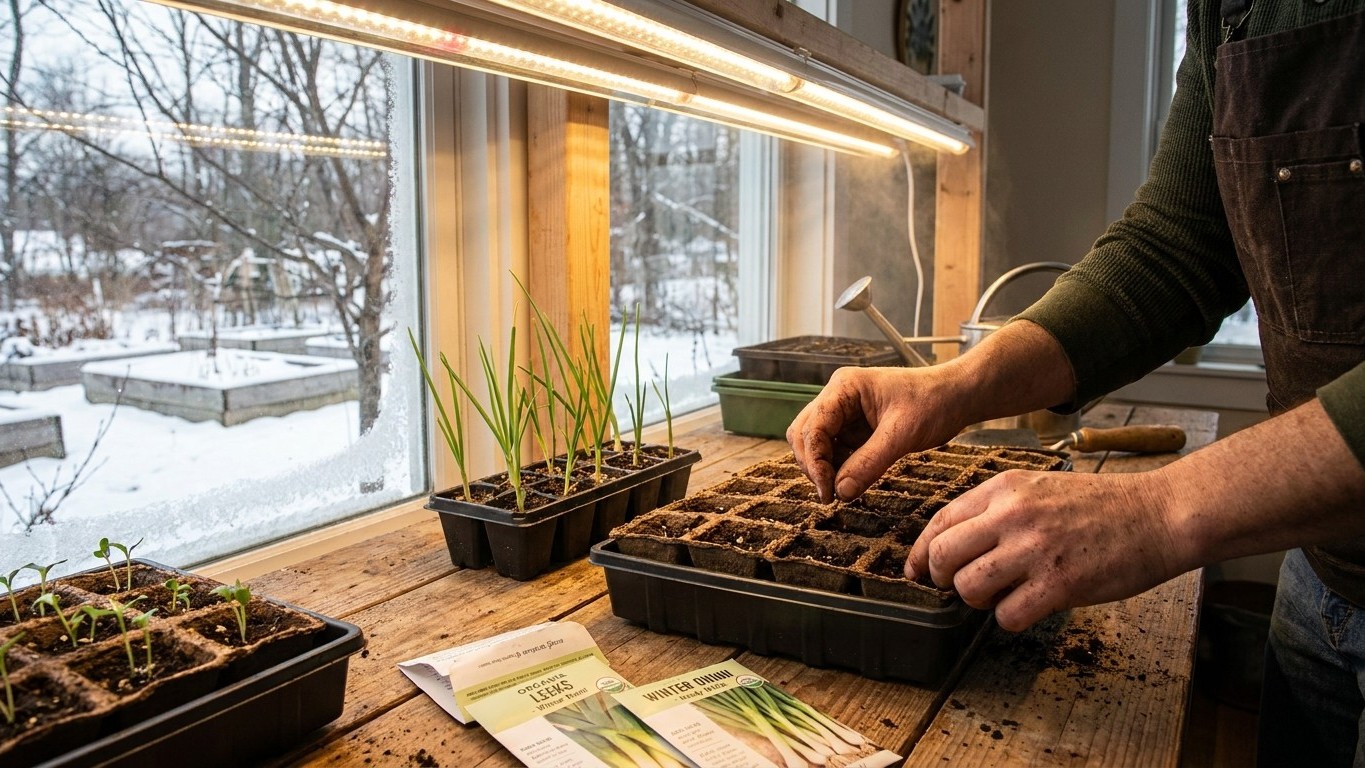

Nothing goes into open garden soil in Massachusetts this month. The last spring frost at Boston’s Logan Airport falls between April 1 and April 8, and that’s the mildest spot in the state. February’s real work happens indoors and under cover: starting onions and leeks from seed, pruning dormant fruit trees, ordering seed catalogs before the best varieties sell out.
What goes in the ground in February

Massachusetts sits in USDA Hardiness Zone 5a-7b, a range built entirely on average annual extreme minimum winter temperature, and in February that range means one thing everywhere in the state: the ground is either frozen solid, saturated with meltwater, or both. The NOAA NCEI 1991-2020 Climate Normals put the last spring freeze at Logan Airport somewhere between April 1 and April 8. That’s the warmest, most sheltered station in Massachusetts, sitting on the harbor in urban Boston. Inland suburbs, the Connecticut River Valley, and especially the Berkshires run weeks behind that window. So if Boston isn’t safe to plant until early April, the rest of the state is later still.
That makes February an honest zero for direct-sown or transplanted crops in the open garden, statewide. There’s no hardy green, no pea, no allium that changes that math this early in the year. What’s worth doing instead falls into a handful of categories.
Cold frames and unheated hoop houses are the one place where soil sometimes stays workable enough to matter. If a cold frame was set up in fall with spinach, mache, or claytonia already established, February is when those plants slowly wake up on sunny days, even while snow sits outside the frame. Nothing new gets sown into that frame yet, but the plants already in it start producing again as day length increases.
Bare-root fruit trees, brambles, and grapevines ordered for spring delivery sometimes arrive in February from nurseries in warmer regions. If the ground is truly unworkable, the fix is heeling them in: a temporary trench, roots covered with loose soil or mulch, kept moist, until the ground opens up enough for a real planting hole. Forcing rhubarb or chicory indoors is another legitimate February project, using roots dug and stored the previous fall, brought into a dark, cool basement to push blanched, tender growth weeks before anything outdoors would produce it.
What to start under cover
Seed starting in February works backward from the last frost window, not forward from a date on a calendar. With Logan’s last freeze falling April 1 to April 8, and inland areas running later, a gardener counts back from whichever date applies to their own yard.
Onions and leeks need roughly 10 to 12 weeks of indoor growth before they’re ready to go outside as transplants. Counted back from early April, that lands seed-starting for onions in mid-to-late January, which means late February is really the tail end of the window for leeks and a workable moment to still get onions started if it hasn’t happened yet. Peppers and eggplant need about 8 to 10 weeks under lights before transplanting, which puts their start date squarely in February for most of the state.
The two ways this goes wrong both come from ignoring that backward math. Start too early, and by the time the ground and air are actually warm enough outside, the seedlings have outgrown their trays. Onions become rootbound and stop putting energy into bulb formation. Peppers get leggy, stretching toward whatever light they can find, and stall out once transplanted because their root systems never had room to develop properly.
Start too late, and the opposite problem shows up. A pepper sown in April instead of February simply runs out of growing season before Massachusetts hits its first fall frost, which arrives between November 3 and November 14 at Logan and earlier inland. Between those two mistakes, most home gardeners are better off starting slightly early and potting up into larger containers as needed, rather than starting late and hoping a short season Massachusetts summer makes up the difference. It rarely does, especially for long-season peppers and eggplant.
What is ready to pick
Little to nothing comes out of the open garden in Massachusetts during February, and there’s no point dressing that up. But a well-stocked kitchen garden from the fall before still has something to offer.
Kale, especially the curly and Lacinato types, often survives under snow cover and can be harvested a leaf at a time whenever the snow melts back enough to reach the plant. The cold actually improves the flavor, converting starches to sugars as a frost-tolerance mechanism. Leeks left in the ground, particularly if mulched heavily in fall, do the same thing: dig around the base, and there’s often a usable leek still standing even in January and February. Parsnips behave the same way, and many gardeners intentionally leave a row unharvested through fall specifically so it can be dug in late winter, when the roots taste noticeably sweeter.
Cold frames earn their keep here. Spinach, mache, claytonia, and other cold-hardy greens planted the previous September or October keep producing small harvests through February whenever there’s enough daylight to trigger new growth. Indoors, sprouts and microgreens fill the gap entirely independent of outdoor weather: a tray of pea shoots or sunflower microgreens on a windowsill takes seven to ten days from seed to harvest, regardless of what’s happening outside.
February is also the month to walk through the root cellar or basement storage and check on squash, potatoes, and onions. Winter squash that’s starting to soften near the stem, potatoes sending out pale sprouts, or onions gone soft at the neck all need to be used first, before the rot spreads to the rest of the batch. One bad squash left in a bin can take down its neighbors within a couple of weeks.
The jobs that matter this month
February carries real deadlines for a garden that won’t see a seed sown outdoors for weeks yet, and skipping them costs the whole season.
Pruning and dormant work
Dormant pruning of apple and pear trees, blueberry bushes, and bramble canes should happen before buds swell, typically through late winter while the plant is still fully asleep. Pruning cuts made now heal faster than cuts made after growth resumes, and they carry far less risk of spreading disease, since most fungal and bacterial pathogens aren’t active in cold temperatures. This is also the window to clean and sharpen pruners, loppers, and shovels, since dull blades tear plant tissue instead of cutting cleanly, leaving wounds that heal slowly and invite disease.
Planning and soil
Seed catalogs move fast in late winter, and popular varieties, particularly disease-resistant tomatoes and heirloom types, sell out by early spring. Ordering now avoids settling for a second-choice variety in April. This is also the moment to sketch out crop rotation for the coming season, especially for anything in the nightshade or brassica families, which build up soil-borne disease if planted in the same bed year after year. A soil test through the UMass Extension soil testing lab takes a couple of weeks to turn around results, so submitting a sample in February means amendments can be worked in well before planting starts. Turning the compost pile, even a frozen one, keeps the decomposition process moving once temperatures rise, and repairing raised beds, trellises, and fencing is far easier now, while the ground is firm and there’s nothing growing to avoid stepping on.
What not to do in February
The most common mistake in a Massachusetts February is trusting a warm afternoon. A 55-degree day in mid-February feels like spring, but soil temperature lags well behind air temperature, especially under snow cover or in shaded beds. Direct-sowing anything, even cold-tolerant seeds like spinach or peas, into soil that’s still near freezing a few inches down simply means the seed sits there and rots before it germinates. Soil needs sustained warmth, not one warm afternoon, to support germination.
Uncovering cold frames, row covers, or winter mulch too early after a mild stretch is another version of the same error. A few warm days followed by a hard freeze, which is common in Massachusetts through March, can kill plants that had just been exposed and hardened off prematurely. The mulch and covers exist specifically to buffer against that freeze-thaw swing, and pulling them back too soon defeats the purpose entirely.
Fertilizing with nitrogen this month is also a mistake, and it’s one gardeners make with good intentions. Dormant trees, shrubs, and perennials aren’t actively growing, so nitrogen applied now either leaches away with snowmelt and spring rain before roots can use it, or worse, it pushes a flush of tender new growth right before a freeze can kill it back. Nitrogen is far more useful applied once real growth resumes in spring, not while everything is still asleep.
Checking this against your own county
A statewide frost window is a starting point, not a personal instruction. The April 1 to April 8 last-frost figure comes from a single station at Logan Airport, a waterfront, urban location that runs milder than almost anywhere else in Massachusetts. Elevation in the Berkshires, distance from the coast, and even which side of a valley a garden sits on can shift these windows by two to three weeks in either direction. A gardener in Pittsfield or Great Barrington should expect a later spring and an earlier fall than someone gardening near Boston Harbor.
The UMass Amherst Extension publishes county-level guidance and a planting calendar that accounts for these regional differences far than any statewide date range can.
Common questions
Can I plant garlic in Massachusetts in February?
Garlic is a fall-planted crop in Massachusetts, typically going into the ground in October so it can establish roots before winter. By February, garlic already in the ground is dormant and doesn’t need attention beyond making sure mulch hasn’t blown away. New garlic isn’t planted this month.
Is it too early to start tomato seeds indoors in February?
For most of Massachusetts, yes, unless the last frost falls very early in a particular county. Tomatoes generally need 6 to 8 weeks of indoor growth before transplanting, and with the last frost at Logan Airport not arriving until April 1 to April 8, most gardeners are better off waiting until early-to-mid March to start tomato seed.
What can I harvest from a cold frame in February in Massachusetts?
Cold-hardy greens planted the previous fall, including spinach, mache, and claytonia, often survive and produce light harvests inside a cold frame through February, especially as daylight hours start increasing later in the month.
Why do frost dates differ so much across Massachusetts?
The published NOAA NCEI frost window comes from a single Boston-area station that sits on the harbor, which moderates temperature extremes. Inland areas, higher elevations, and the Berkshires lose that coastal buffering effect and see both later spring frosts and earlier fall frosts as a result.