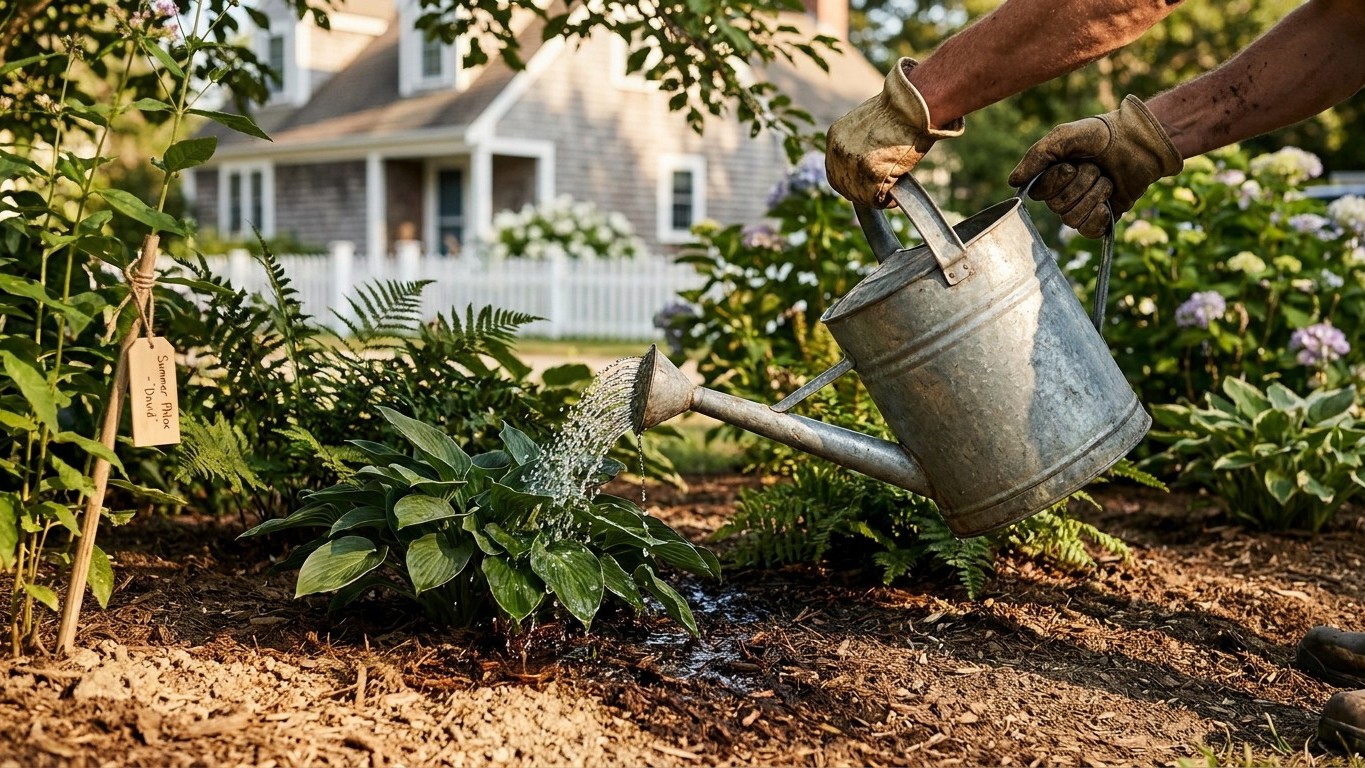

Massachusetts doesn’t hand gardeners a single dry season to plan around, and that’s exactly what makes watering here tricky. The state sees only 10.2 days a year above 90F on average, yet summer rainfall shows up unevenly, some weeks generous, others nearly dry, which means the calendar can’t tell you when to water. The soil and the thermometer have to.
What the climate asks of you

Start with the number that rules out shortcuts: Massachusetts averages just 10.2 days a year at 90F or hotter, measured at the Boston reference station (NOAA NCEI Climate Normals, 1991-2020). That’s a modest heat load compared to the Mid-Atlantic or the Deep South, and it means a Massachusetts garden isn’t fighting the kind of relentless evaporation that forces daily watering in hotter states. But modest heat doesn’t mean reliable rain. Summer precipitation across New England tends to arrive in bursts, a thunderstorm here, a dry stretch there, rather than as a steady weekly drip a gardener can count on.
That unevenness is the real challenge. The rule of thumb that a garden bed wants roughly an inch of water a week doesn’t change because you live in Worcester instead of Phoenix. What changes is whether the sky delivers that inch on schedule. In a good week, rain covers most or all of it. In a dry week, and Massachusetts gets plenty of those between June and August, the gardener has to make up the difference by hand or by hose, and there’s no way to know in advance which kind of week you’re in until you check the soil, which is why Watering Through a Dry Spell in Massachusetts requires paying attention to the ground rather than the calendar.
Soil changes the math
Soil texture varies a lot across the state, and it decides how far that inch of water actually goes. The sandy, well-drained soils common on Cape Cod and in parts of Plymouth County let water pass through fast, so a rainy week there can still leave the top few inches dry within a couple of days. The heavier clay-loam soils found in parts of the Connecticut River Valley and inland counties hold moisture much longer, sometimes for a week or more after a good soak. Two gardens fifty miles apart, both under the same sky, can need completely different watering schedules because of what’s under their feet, and gardeners relying on pots rather than ground beds face their own version of this problem, which is why Watering Pots and Containers in Massachusetts calls for a different rhythm altogether.
The frost-free window matters here too. Last spring frost typically falls between April 1 and April 8, and first fall frost between November 3 and November 14, based on 32F freeze-probability data from the Logan Airport station (NOAA NCEI 1991-2020 Normals). That’s a growing season of roughly seven months along the coast, though inland suburbs and the Berkshires, sitting in USDA zones toward the colder end of the state’s 5a-7b range, see both frosts earlier and later than that waterfront figure suggests. A longer season means more weeks where watering decisions matter, not fewer.
How much, how often
Deep and infrequent beats shallow and frequent, every time. A quick daily sprinkle wets only the top inch or so of soil, and roots follow the water, staying shallow and exposed right where the sun bakes hardest. A deep soak that reaches six to eight inches down pulls roots deeper, where the ground stays cooler and holds moisture longer between waterings. The gardeners who water a little every evening because it feels responsible are often doing more harm than the ones who water twice a week and mean it.
The soil itself tells you when it’s time, and checking takes ten seconds. Push a finger or a trowel two inches into the ground near the base of a plant. If it’s dry at that depth, water. If it’s still damp, wait another day and check again. This one habit replaces every watering schedule printed on a seed packet, because it responds to what’s actually happening in your yard that week, not to a generic calendar.
Timing and technique matter almost as much as volume. Here’s a sequence worth following through a Massachusetts summer:
- Water in the early morning, ideally before 9 a.m., so moisture soaks in before the day’s heat pulls it back out through evaporation.
- Aim the water at the base of the plant, not the leaves, since wet foliage overnight invites fungal disease in the state’s humid summer air.
- On sandy ground, common on the Cape and in southeastern counties, water more often but in shorter sessions, since the soil holds little moisture at a time and dries out fast.
- On heavy clay, typical of parts of the Connecticut River Valley, water less often but let it soak in slowly, and never water or work the soil while it’s still wet from the last session, since clay compacts easily and drowns roots that can’t get oxygen.
- During the driest stretches of July and August, when the month’s rainfall often falls short of what a garden needs, plan on supplemental watering roughly twice a week rather than waiting for the sky to catch up.
The throughline is that Massachusetts summers don’t offer a dry season predictable enough to plan around in advance, which means the finger-in-the-soil test does more work here than it would in a place with a clear, single dry month.
Restrictions and rules
Watering restrictions are common across Massachusetts, especially in towns that draw from groundwater or smaller reservoirs, and they tend to tighten during dry stretches rather than following a fixed yearly calendar. Some municipalities limit outdoor watering to certain days of the week based on odd or even street addresses, others restrict watering to early morning or evening hours only, and a number of water districts issue mandatory bans during declared drought conditions. These rules differ from one town to the next and change from one summer to the next, so nothing here should be treated as a fixed statewide standard.
Because summer rainfall in Massachusetts doesn’t arrive on a reliable schedule, restrictions are a real possibility almost anywhere in the state during a dry summer, not just in the sandier, faster-draining areas. The only way to know what applies to your address this season is to check with your local water department or municipal website before setting up a timer or irrigation system. Many towns post current watering days and hours directly on their public works or water department pages, and some update them mid-season if drought conditions develop.
The UMass Amherst Extension also tracks regional conditions and can point homeowners toward current guidance for their part of the state, which is a useful starting point if your town’s own site doesn’t spell things out clearly.
Using less
Cutting water use in a Massachusetts garden mostly comes down to slowing down evaporation and matching supply to what plants actually need, rather than any single dramatic fix. A few techniques do most of the work:
- Mulch, two to three inches of it around beds and shrubs, slows evaporation enough that watering intervals can often stretch by a day or two, especially useful on the state’s sandier soils where bare ground dries out fast.
- Drip irrigation or soaker hoses deliver water straight to the root zone instead of spraying it into the air, cutting the amount lost to evaporation and wind drift compared to an overhead sprinkler.
- Grouping plants by water need keeps thirsty vegetables and annuals separate from drought-tolerant natives and perennials, so you’re not overwatering the tough plants just to satisfy the thirsty ones nearby.
- Organic matter worked into the soil, compost especially, improves both the sandy soils common near the coast and the heavier clay found inland, helping sand hold water longer and helping clay drain a little better.
- Rain barrels, where local rules allow them, capture roof runoff for later use. An inch of rain falling on a thousand square feet of roof yields roughly 600 gallons, so a single good summer storm can fill a barrel fast. The catch in Massachusetts is timing: because summer rain arrives unevenly rather than in a steady weekly pattern, a barrel can sit full after one storm and run dry during the next two or three rainless weeks, which is exactly when a garden needs it most.
None of these replace a watering can or a hose entirely, but together they can meaningfully cut how often you need to reach for either one.
Common questions
How often should I water my garden in Massachusetts during summer?
There’s no fixed number of days that works statewide, since it depends on your soil and that week’s rainfall. Check the soil two inches down before deciding, and expect sandy soils near the coast to need water more often than clay-loam soils inland.
Are watering restrictions common in Massachusetts?
Yes, many towns impose day-of-week or time-of-day limits, and some issue outright bans during drought. Rules vary by municipality and can change mid-summer, so check your local water department rather than assuming a statewide standard.
Does Massachusetts get hot enough to need daily watering?
Not typically. The state averages only 10.2 days a year above 90F, a modest heat load, but uneven summer rainfall still creates dry stretches where a garden needs help even without extreme heat.
Do rain barrels work well in Massachusetts?
They can, since a single storm delivering an inch of rain over a 1,000-square-foot roof yields about 600 gallons. The tradeoff is that Massachusetts summer rain doesn’t fall on a steady schedule, so a barrel can run dry during multi-week gaps between storms.