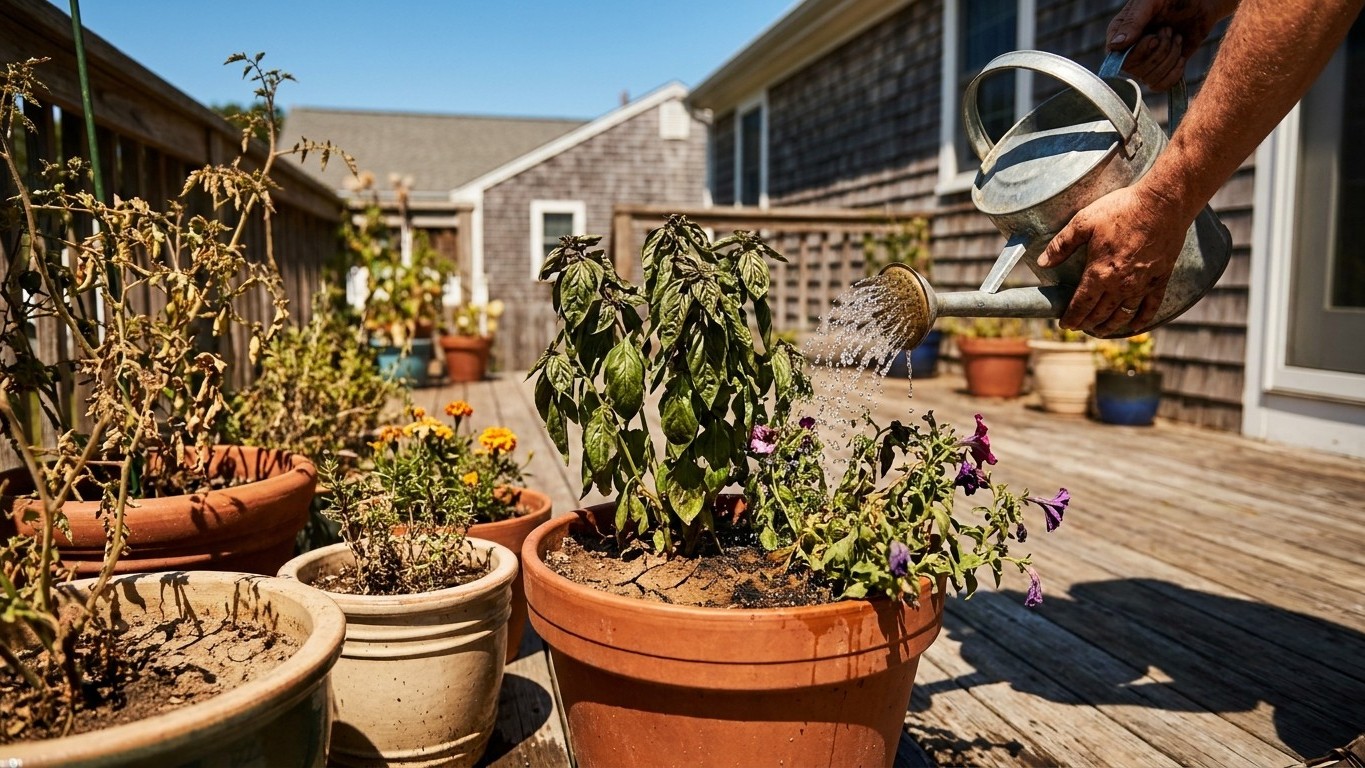

Massachusetts summers deliver just over three inches of rain in the driest month, while the mercury climbs past 90F about ten times a year. That gap between what falls and what evaporates is the whole story of watering here: not enough sky-water in August, and enough heat to burn through a container’s moisture reserve before lunch.
What changes here

Two numbers do the heavy lifting for anyone watering pots or beds in Massachusetts. August, the driest summer month at the reference station, averages 3.23 inches of rain. The state also sees about 10.2 days a year at or above 90F. Put together, that means the month when plants most need consistent moisture is also the month the sky provides the least of it, and the heat load is high enough to strip that moisture back out of the soil fast.
Run the arithmetic and the picture gets sharper. A vegetable bed or a perennial border generally wants close to an inch of water a week. Spread August’s 3.23 inches evenly across the month, and a single week gets roughly 0.73 inch from rainfall alone. That leaves a shortfall of about 0.27 inch a week that has to come from a hose, a watering can, or drip irrigation, assuming the rain falls evenly, which it rarely does. A summer thunderstorm can drop half an inch in twenty minutes and then nothing for ten days, so the monthly average hides real dry stretches.
Containers feel this shortfall faster than ground beds. A pot has no reservoir of surrounding soil to draw from, so on a 90F day it can lose visible moisture within hours, especially if it sits on pavement or a south-facing deck that radiates heat back up into the root ball. June and July run slightly wetter than August, at 3.89 and 3.27 inches respectively, which is worth knowing if a gardener assumes early summer needs the same attention as late summer. It usually doesn’t, at least not by the calendar averages.
None of this replaces watching the actual plant and the actual soil. These are normals recorded at one reference station over three decades, not a forecast for a specific yard, and a coastal garden on the Cape behaves differently than one in the Berkshires. A rain gauge stuck in the ground near the tomatoes tells a gardener more about their own microclimate than any regional average ever will.
How to water when it matters
The method that works in Massachusetts isn’t exotic, but it has to be applied with the state’s rain pattern in mind rather than a generic gardening rule pulled from a different climate. Deep, infrequent watering pushes roots downward, where the soil stays cooler and moister even after a 90F afternoon. Frequent shallow watering does the opposite: it trains roots to stay near the surface, right where an August heat spike does the most damage. Morning watering matters too, because it gives leaves time to dry before evening, and wet foliage sitting overnight is an open invitation to fungal disease, especially in the humid stretches between rain events.
Checking soil moisture at root depth, not just at the surface, is the habit that separates a thriving bed from a stressed one. The top half-inch of soil can look bone dry an hour after watering while the root zone below stays saturated, or the reverse: a crusted, sun-baked surface can hide moist soil just below. A finger pushed two inches down, or a trowel pulled up for a quick look, settles the question in seconds.
Soil texture changes the rhythm of all of this. Sandy soil, common in parts of southeastern Massachusetts and the Cape, drains fast and holds little reserve, so it needs shorter, more frequent soakings to keep pace with an August heat run. Heavier clay soil, more typical inland, holds a week’s worth of water but punishes impatience: watering it again before it has dried invites root rot rather than growth.
- Check the soil two inches down before watering at all; if it’s still moist, wait another day.
- Water at the base of the plant, not overhead, so leaves stay dry going into the evening.
- Water in the early morning, giving the day’s heat time to dry any incidental splash on foliage.
- Aim for roughly one inch of water a week combined from rain and hose, using August’s 3.23-inch monthly average as the baseline to check against a personal rain gauge.
- On sandy soil, split that inch into two or three shorter sessions; on clay, one deep soaking usually covers the week.
That one-inch figure is a starting point, not a rule carved in stone. A raised bed with fast-draining mix needs more; a shaded container against a north wall needs less. The only way to know for sure is to check the soil itself.
What goes wrong
The daily sprinkle
A quick pass with the hose every evening feels responsible, but it wets only the top inch or two of soil. Roots follow the water, staying shallow and exposed right where a 90F afternoon bakes them hardest. A gardener who waters daily is often watering more often than needed and still not solving the actual moisture problem below.
Watering leaves at night
Overhead watering in the evening leaves foliage wet through the cool, humid hours until morning, which is exactly the window fungal spores need to take hold. Powdery mildew and blight both spread faster on leaves that stay damp overnight, a common complaint in Massachusetts gardens during the muggier stretches of July.
Trusting the rain
A summer downpour can look thorough while wetting only the top half-inch of soil, especially on compacted or clay-heavy ground where water runs off before it soaks in. Skipping the watering can because “it rained” without checking with a finger is one of the more common and avoidable mistakes here, particularly given how unevenly summer rain falls across the state.
Skipping the mulch
Bare soil in direct sun on a 90F day gives back a good share of whatever water was just applied, straight into the air through evaporation. A two- to three-inch layer of mulch slows that loss and keeps root-zone moisture available longer between waterings, which matters more in a state where the driest month barely clears three inches of rain.
Local help
The UMass Extension service is the state’s land-grant resource for soil testing, plant diagnostics, and region-specific growing guidance. Local water providers and municipal districts set their own outdoor watering restrictions, and those rules shift by season and by town, so check with the local water department directly before setting an automatic irrigation schedule.
Common questions
How much rain does Massachusetts get in a typical summer?
About 10.4 inches across June, July and August combined, with August running driest at 3.23 inches.
How many hot days should a Massachusetts gardener plan for?
Around 10.2 days a year reach 90F or higher, based on the 1991-2020 climate normals for the reference station.
Is it better to water containers or garden beds more often in August?
Containers, since they hold far less soil volume and dry out faster on hot pavement or decking than an in-ground bed does.
Do watering restrictions apply the same way across the state?
No. Restrictions are set locally by water districts and can change seasonally, so check directly with a town’s water provider for current rules.