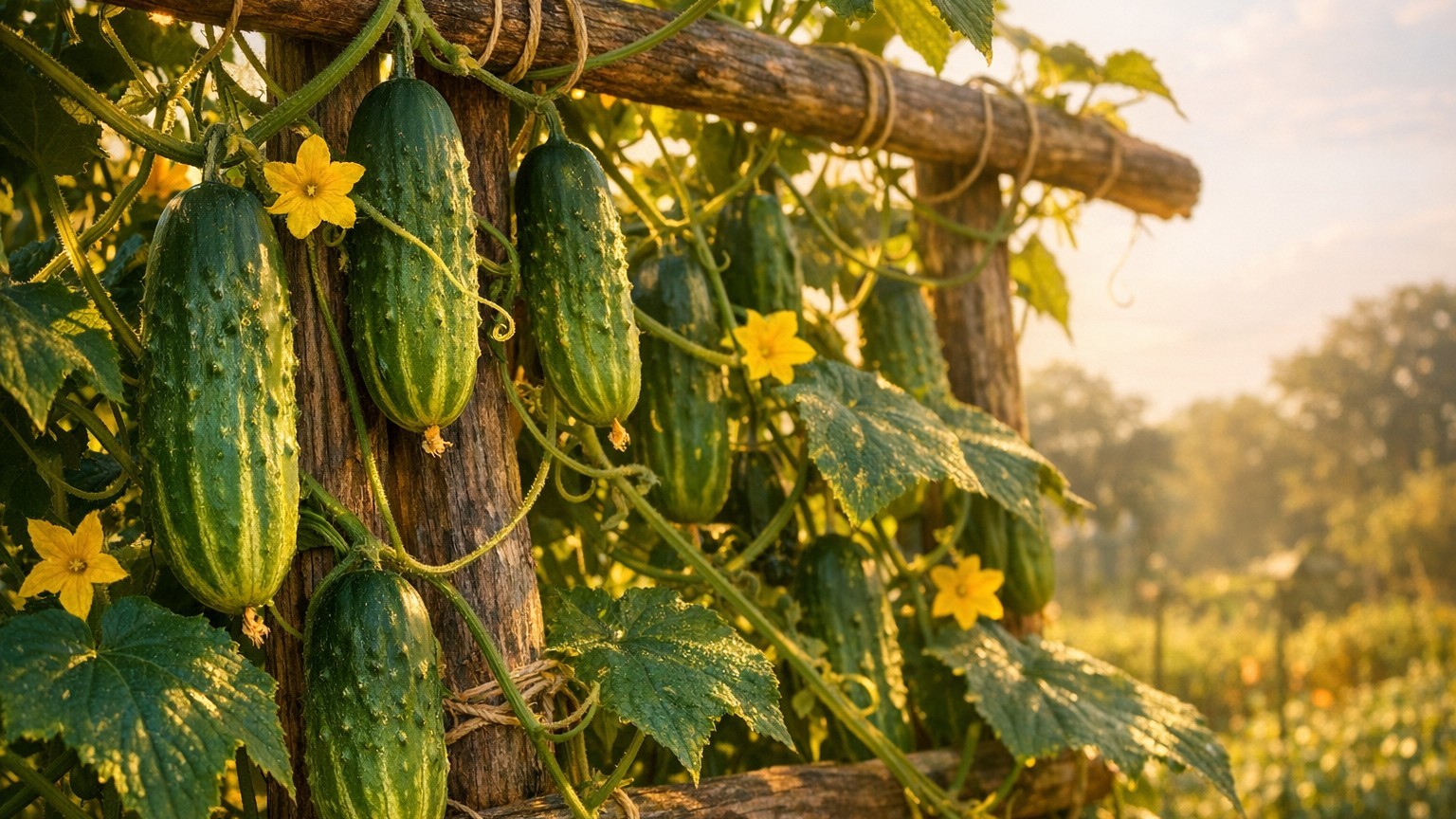

Michigan gardeners get the most reliable harvest from quick-maturing pickling and bush-type cucumbers, plus parthenocarpic varieties for high tunnels or containers. Long-season vining slicers are the riskier bet, especially outside the warmest counties. The reason comes down to how many frost-free days a given part of the state actually gets.
The short answer for Michigan
Start with the calendar, because that’s what decides which cucumber type has a real shot. Around the Detroit area, last spring frost lands near April 30, and the first fall frost in zone 6a arrives between October 6 and October 21, per MSU Extension. That gives a frost-free window in the neighborhood of five months in the state’s warmest zone. Move north or up in elevation, and that window shrinks fast, since much of the Lower Peninsula doesn’t see its last frost until early to mid May, and colder zones lose weeks off both ends.
That’s the number that should drive variety choice more than anything else. Fast-maturing types, the pickling cucumbers and compact bush cultivars bred to size up quickly, fit a five-month window with room to spare, including a margin for a slow, wet spring or an early cold snap. Long-vining slicers that need a long, steady stretch of warmth to fill out are the ones that get caught by an early October frost, particularly outside the Detroit corridor.
Heat load matters less than you’d think
Michigan’s heat load is moderate, not extreme: the reference station averages just 10.3 days a year at or above 90°F, per NOAA climate normals. Cucumbers don’t need a scorching summer to produce, they need consistent warmth without long cold interruptions, so a modest number of 90-degree days isn’t the limiting factor here. It just means the state isn’t the place to gamble on varieties bred for desert-heat regions expecting weeks of triple-digit stress.
For small yards, patios or raised beds, bush-type cucumbers are worth a look since they stay compact without sacrificing much on productivity. For anyone growing under a high tunnel or wanting fruit without relying on bee activity in a cool, damp spring, parthenocarpic varieties (ones that set fruit without pollination) are a category worth asking about at a local nursery or through the extension service. None of this replaces a look at what’s actually been trialled in your county, which is covered further down.
What will not work here

The clearest failure pattern in Michigan is a long-maturing vining slicer planted in a short-season zone. If the frost-free window in your part of the state is closer to four months than five, a variety that needs the full stretch of steady summer warmth to fill out large fruit is racing a clock it usually loses. That mismatch shows up as vines still flowering heavily in September with no time left to finish the fruit before frost.
Watering habits sink almost as many cucumber patches as frost does. Summer rainfall across June, July and August averages about 10 inches at the reference station, with August running driest at 3.26 inches. That sounds like enough, until you account for how it arrives. Michigan summer rain tends to come as thunderstorms rather than steady soaking rain, and a hard, brief downpour mostly runs off instead of soaking into the root zone, especially on sandy soil. A gardener who waters once a week because “it rained a lot this summer” is often shortchanging the plant on the weeks between storms, and cucumbers are sensitive to inconsistent moisture, responding with bitter fruit or blossom drop.
Humidity and crowding
Michigan’s Great Lakes-influenced humidity, combined with rainfall arriving in bursts, means foliage often stays wet longer after a storm than the rainfall total alone would suggest. That’s a problem for cucumbers planted too close together or trained flat on the ground, since damp leaves in tight spacing are exactly the setup that lets fungal disease move fast through a bed. Vertical trellising or wider spacing gives foliage a chance to dry out between storms, which matters more in a humid state than in a dry one with the same rainfall number.
None of this means Michigan is a hard place to grow cucumbers. It means the two most common mistakes, an oversized long-season variety and a “rained enough this month” watering habit, are also the two easiest to fix before the season starts.
What changes across Michigan
Michigan is not one climate. The USDA Plant Hardiness Zone Map (2023, built on 1991-2020 minimum temperature normals) places the state across a wide 4a to 6b range. That spread is built on average annual extreme minimum winter temperature, so it’s a winter-hardiness measure, not a direct growing-season length figure, but the two track closely enough in practice: the coldest zones in the northern Lower Peninsula and the Upper Peninsula also tend to carry the shortest frost-free windows.
A gardener in a zone 6a or 6b pocket, closer to Lake Michigan’s moderating shoreline or in the southeast near Detroit, is working with a season close to the five-month figure cited above. A gardener in a colder 4a or 4b zone further north or at higher elevation should expect meaningfully fewer frost-free weeks, a later safe planting date, and an earlier fall cutoff. That’s the gardener who benefits most from leaning hard into fast-maturing pickling or bush types and skipping the long-season slicers altogether.
There’s no single planting date or single “best variety” that covers a state this wide, and any page, including this one, that gives one flat answer for all of Michigan is oversimplifying. The honest version is a range: check where your county sits on the zone map before locking in a variety list, since the difference between 4a and 6b is close to two full USDA zones, which typically means several weeks of season length.
Where to check this for your own county
Everything above is a state-level pattern, useful for narrowing down cucumber types, but not a substitute for what’s actually recommended where you garden. Michigan State University Extension runs the state’s land-grant extension service, and it’s the right next stop.
Two things are worth pulling up there specifically. First, the local planting calendar for your county or region, since MSU Extension publishes frost-date guidance that’s more granular than a single statewide range, and that’s the number that should set your actual sowing date rather than a generic “early to mid May” statewide window. Second, look for variety trial results or recommendations from MSU’s horticulture program, which reflect what’s actually been tested to hold up under Michigan’s specific rainfall pattern and disease pressure, rather than a generic national list.
A county-level recommendation beats a state-level one every time, because it accounts for local frost timing, local soil, and often local disease pressure that a statewide page like this one can’t capture. Consider this article the starting framework, the “what type, and why” for Michigan broadly, and the extension office’s answer as the actual final word on “which variety, and when to plant it” for your specific ZIP code.
Checking this against your own garden
Dates and zone maps get you close, but your own plot has the final say, and cucumbers are good at showing their preferences if you know what to watch for. Soil warmth is the first check: cucumbers stall or rot in cold soil, so before transplanting or direct-seeding, dig a couple of inches down and feel the soil rather than trusting the calendar alone. If it still feels cool and heavy rather than warm and workable, wait, even if the date on paper says it’s time.
The first flush of flowers tells you something too. Cucumbers produce male flowers before female ones, so an early wave of blossoms with no fruit forming isn’t a problem, it’s normal sequencing. What matters is how quickly female flowers (the ones with a tiny swollen cucumber shape behind the bloom) follow. A long gap can point to stress, often from uneven watering or a cool stretch of weather specific to your yard rather than the region as a whole.
Watch the first true leaves as well, the ones that emerge after the initial rounded seed leaves. Slow, pale, or stunted true leaves usually mean the soil hasn’t warmed enough or moisture has been inconsistent, both things your own microclimate controls more than any state average does. A shaded corner, a slope that drains fast, or a spot that catches extra reflected heat off a fence can all shift these signals earlier or later than a neighbor’s garden a mile away, which is exactly why the plant’s own behavior outranks every date on a calendar.