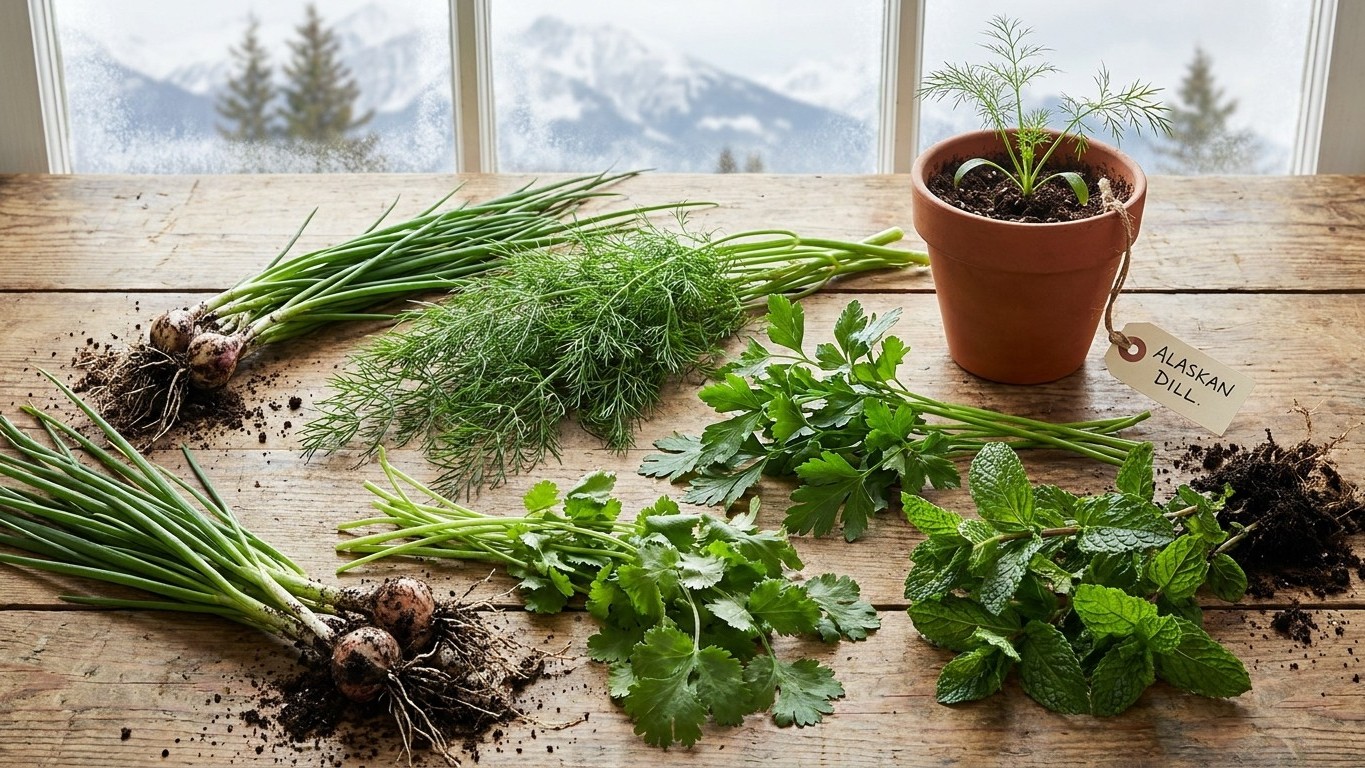

Minnesota gardeners get the best results from herbs that fit two limits: a frost-free window that can run as short as 165 days in cooler spots, and winter minimums cold enough to kill most woody perennials outright. Chives, thyme, oregano, and dill top the list. Rosemary and bay laurel don’t survive outside at all.
The short answer for Minnesota
Sort your herb choices by what they need to do, not by what looks good on a seed rack. Minnesota’s frost-free season runs from a last spring frost of April 17 to April 30, to a first fall frost of October 11 to October 23, based on the 1991-2020 NOAA climate normals for the Twin Cities. That gives a working season of roughly 165 to 190 days depending on which end of each band applies to your spot, and it’s the number every herb choice should be measured against.
Perennial herbs that survive a Minnesota winter without being dug up or hauled indoors are the safest long-term investment. Chives, most culinary thyme varieties, oregano, and mint all tolerate the coldest-month average minimum of 8.8°F that defines a typical Minnesota winter here. Sage usually makes it through with a layer of mulch over the crown. These are plant-once, harvest-for-years herbs, and in a state where the hardiness zone runs 3a to 5a, that reliability matters more than it does in milder regions.
Annual herbs are the second tier, and they’re not a downgrade, just a different commitment. Basil, cilantro, dill, and parsley grow fast enough to produce a full harvest inside even the shorter end of Minnesota’s frost-free window. Basil in particular wants warm soil, so it should go in well after the last frost date, not on it. Cilantro and dill are quick enough that a gardener can get two plantings in during a single Minnesota summer, one in late spring and one in midsummer for a fall crop.
Herbs that need to be treated as houseplants for part of the year make up the third category. Rosemary and bay laurel are the two most common examples: both are frequently sold at Minnesota garden centers, and both will die at the state’s average winter minimum if left outdoors. Growers who want them either pot them and bring them in before the first fall frost, or accept replanting each spring as an annual expense.
The short version: build a Minnesota herb garden around perennials for the backbone, annuals for the volume, and a short indoor-overwinter list for anything Mediterranean.
What will not work here

Some herbs fail in Minnesota for a straightforward reason: the winter minimum is colder than they can take. Rosemary is rated hardy to roughly USDA zone 8 in most references, and Minnesota’s coldest-month average minimum of 8.8°F sits nowhere near that threshold. Even a mild winter here will kill an unprotected rosemary plant. Bay laurel has the same problem, and both are routinely sold in Minnesota nurseries as annuals or container plants precisely because they can’t survive the ground here.
French tarragon sits in a gray zone. It’s often listed as hardy to zone 4, which puts it right at the edge of what southern Minnesota offers and outside of what the state’s northern 3a stretch can support. A gardener in the Twin Cities area might get a tarragon plant through several winters with heavy mulch; a gardener near the Canadian border is fighting a losing streak. This is a case where the state-level hardiness range of 3a-5a genuinely predicts failure for part of the state and marginal success for the rest, rather than a clean yes or no.
Slow-maturing herbs that need a long, uninterrupted hot stretch don’t get enough runway even in the milder south of the state. Lemongrass is the clearest example: it wants a sustained hot season measured in months, not the roughly six-month frost-free window Minnesota offers even at its longest. Gardeners who try it outdoors from seed rarely get a usable harvest before the first fall frost cuts the season short.
Timing mistakes cause almost as much failure as species selection. Basil seed or transplants set out before the soil has warmed, meaning anywhere close to that April 17 to April 30 last-frost window, will sit stalled or rot rather than grow. The plant isn’t dead from frost damage in every case; it’s simply too cold for the roots to function, and by the time a gardener notices stunted growth, weeks of the short season are already gone.
Finally, treating a Minnesota herb bed like a Zone 7 or 8 garden, expecting rosemary hedges or a permanent bay tree, is the single most common and most avoidable disappointment reported by home gardeners moving to the state from milder climates.
What changes across Minnesota
Minnesota is not one growing region wearing a single label. The USDA Plant Hardiness Zone Map places the state across a 3a-5a range, and that two-zone spread is wide enough to change which perennial herbs survive winter depending on where in the state a garden sits. A herb that reliably overwinters in the 5a stretch of southern Minnesota can die outright in the 3a stretch further north, even with identical care.
Frost timing moves in step with that zone spread. The Twin Cities figures, a last spring frost of April 17 to April 30 and a first fall frost of October 11 to October 23, represent the mild end of the state. Northern Minnesota runs two to three weeks tighter at both ends of the season, according to the same NOAA climate normals dataset. That means a northern gardener working from the Twin Cities dates alone would plant too early in spring and risk harvesting too late in fall, losing herbs to frost that a southern grower wouldn’t see for another two or three weeks.
In the northern part of the state, or at higher local elevation, treat every date as a middle estimate and pull both ends of the calendar inward. Push spring transplanting of tender herbs like basil back by two to three weeks past what a southern Minnesota gardening guide recommends, and plan to harvest or bring in tender pots two to three weeks earlier in fall.
Local factors, elevation, distance from Lake Superior, whether a yard sits in a low frost pocket or on a warmer slope, shift the practical zone by half a step or more even within the same county. The right move is checking the current USDA Plant Hardiness Zone Map for the specific address, not assuming a home matches the state’s midpoint.
Where to check this for your own county
State-level information smooths over exactly the kind of local variation described above. The more useful next step is the University of Minnesota Extension, at extension.umn.edu, which is the land-grant university extension service for the state and the source that publishes county-level growing information rather than statewide averages.
Two things are worth looking for there specifically. The first is a county or regional planting calendar, if one exists for the area, since it will reflect the tighter frost windows of the north or the milder ones of the south far than a statewide date range can. The second is any variety trial data for herbs grown in that county’s Master Gardener program or county extension office reports; these trials often note which thyme, oregano, or basil varieties performed best under that county’s specific combination of soil, rainfall, and season length, information a general state guide has no way to include.
A county-specific recommendation will always outperform a state-level one, for the simple reason that it’s built from conditions closer to the actual garden. State-level information is useful for understanding the broad limits Minnesota’s climate sets on herb choices, but not a substitute for the local data a county extension office can provide. Anyone serious about pinning down exact planting dates, or about which named variety of a given herb has actually performed well nearby, gets more value from a call or visit to the local extension office than from any statewide chart, including this one.
Checking this against your own garden
Every date and figure is a regional average, and a gardener’s own observations in their specific yard outrank all of them once the growing season is underway.
Soil warmth by feel is the first and most reliable check before direct-sowing anything. Pushing a finger a couple of inches into the bed in spring and feeling cool, damp soil rather than cold soil is a better signal for sowing dill or cilantro seed than any calendar date, since a shaded or low-lying bed can lag weeks behind a sunny, well-drained one even in the same yard.
The first flush of flowers on an annual herb like basil or cilantro is a warning sign worth watching for, not a milestone to celebrate. Both plants bolt, meaning they rush to flower and set seed, in response to heat stress or crowding, and once that starts the leaf quality drops fast. Catching the first buds early lets a gardener pinch them off to extend the harvest, and it also tells them something about their own microclimate: a bed that bolts earlier than a neighbor’s is running hotter or drier than average for the area.
The appearance of the first true leaves, the second set that emerges after the initial seed leaves on a young seedling, is the clearest sign that germination actually succeeded rather than just started. Seed leaves can appear even from a seed that’s about to fail; true leaves mean the plant has established real roots and is drawing nutrients on its own. Watching for that stage before thinning or transplanting avoids the common mistake of disturbing seedlings that haven’t actually taken hold yet.