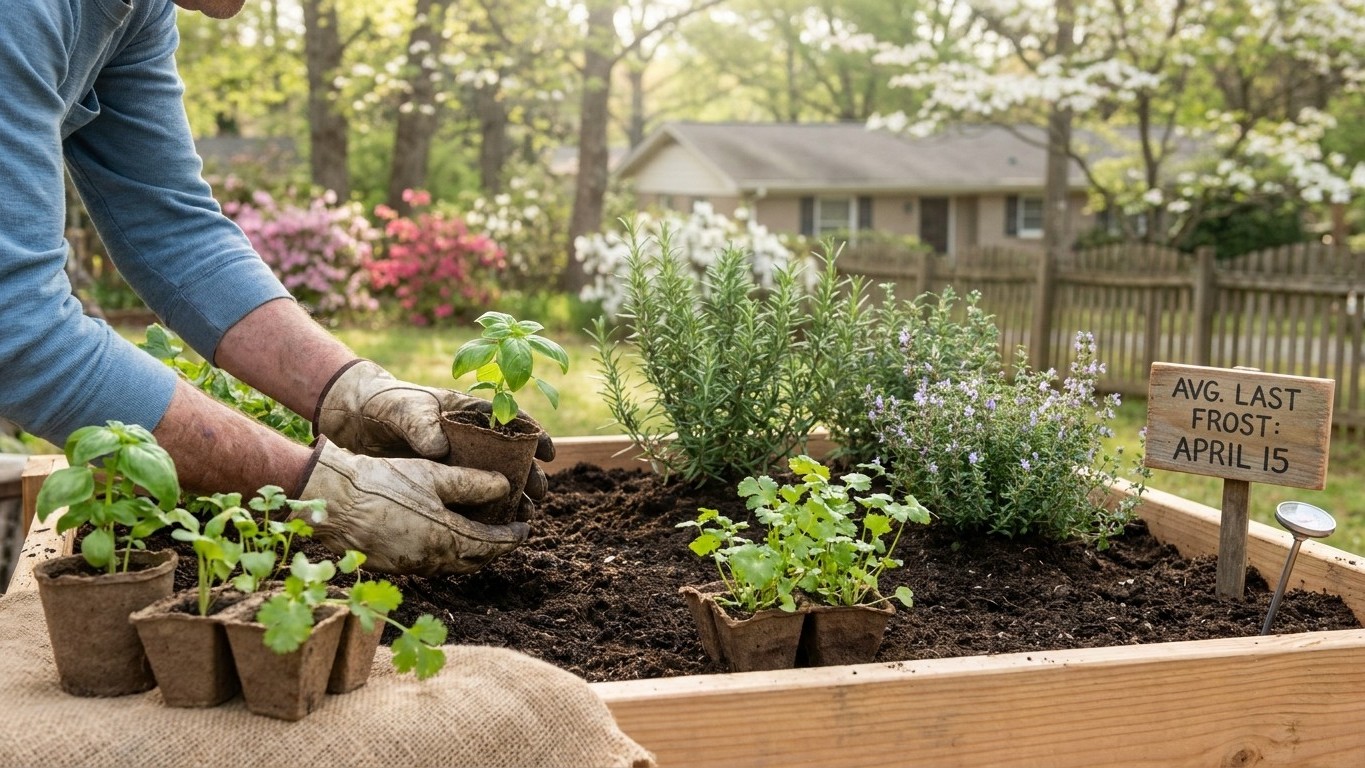

The safe outdoor window for tender herbs in Minnesota runs from mid-to-late April through mid-to-late October, but that range hides a two-to-three-week swing depending on where in the state you garden. The dates below come straight from NOAA’s frost probability data for the Twin Cities, the mildest part of Minnesota, everywhere else starts later and ends earlier.
The short answer for Minnesota
Minnesota’s last spring frost falls somewhere between April 17 and April 30, and the first fall frost lands between October 11 and October 23. Those are NOAA’s 1991-2020 climate normals for the Minneapolis reference station, built on the 30-70% probability band for a 32°F freeze. Read that plainly: on April 17, there’s roughly a 70% chance of freezing weather still ahead; by April 30, that risk has dropped to about 30%. Nothing here is a guarantee, it’s a betting line, not a promise.
Do the arithmetic and you get Minnesota’s real frost-free season, and it’s not a fixed number. Take the tightest case, last frost on April 30 and first frost on October 11, and you’re working with about 164 frost-free days. Take the most generous case, April 17 to October 23, and you get closer to 189 days. That 25-day swing is the difference between a garden that comfortably ripens a full basil harvest and one that’s racing the calendar by Labor Day.
For direct-seeded herbs that tolerate a light frost, dill, cilantro, chives, parsley, that window can open earlier than the official last-frost date, since these germinate in cool soil and shrug off a light nip. For frost-tender herbs started as transplants, basil above all, the safe move is waiting until the back half of the frost-probability window has passed, not the front edge of it. Basil set out on April 20 in a year that turns cold on April 27 won’t just stall, it will often die outright from chilling injury even without a hard freeze.
On the fall side, the same logic runs in reverse. October 11 is the earliest realistic date for a killing frost anywhere in the Twin Cities area, so tender herbs need to be harvested, potted up, or protected before that date arrives, not after. Waiting for the calendar to confirm a frost has already happened is waiting too long in roughly one year out of three.
What will not work here
Perennial Mediterranean herbs are the first casualty of a Minnesota winter, and the number that explains why isn’t the record low, it’s the mean daily minimum of the coldest month: 8.8°F. That’s not an occasional cold snap, that’s the average low night after night in January. Rosemary, bay laurel, and lemongrass are rated for winter survival well above that figure in their native ranges, and no amount of mulching turns an outdoor Minnesota bed into a climate those plants tolerate. If you want rosemary or bay year-round here, it lives in a pot that comes indoors, full stop, it does not overwinter in open ground.
The USDA hardiness zone for Minnesota spans 3a to 5a, a range built on average annual extreme minimum temperature. Even at the mild end of that range, zone 5a bottoms out well below what most so-called “hardy” perennial herbs from warmer catalogs are rated to survive. Anything sold as hardy to zone 7 or 8 is a container plant here, not a garden bed plant, no matter what the tag promises.
Short season, slow herbs
The 164-to-189-day frost-free window also rules out herbs that need a genuinely long, hot growing season to bulk up before flowering or going dormant. Slow-maturing perennial herbs that need a full season just to establish roots before their first winter arrive at a disadvantage in the tighter end of that range, especially in years when a late spring frost eats into the front of the season. Direct-seeding a slow herb in early May and expecting a mature plant by an October 11 frost is optimistic math in a short-season year.
Humidity is the other quiet killer. Minnesota summers bring stretches of muggy, still air, and herbs planted at seed-packet spacing meant for drier climates trap moisture between leaves. Basil and other tender-leafed herbs planted too close together in that kind of air are far more prone to fungal leaf spot and downy mildew than the same plants given extra elbow room. Tight spacing that works fine in a dry western state becomes a liability here.
What changes across Minnesota
A state that spans hardiness zones 3a through 5a does not have one planting calendar, it has several, and the spread is wide enough that a date that works in the Twin Cities can be flatly wrong two hundred miles north. The frost dates above are anchored to Minneapolis, the mildest corner of the state. Northern Minnesota runs two to three weeks tighter at both ends of the season, meaning a later last frost in spring and an earlier first frost in fall.
Stack those two shifts together and a gardener in International Falls or near the Iron Range isn’t just losing a week off one end of the season, they’re potentially losing close to a month of total frost-free growing time compared to someone gardening in the southern Twin Cities suburbs. For frost-tender herbs like basil, that’s the difference between two full harvests before frost and barely one.
There’s no shortcut that substitutes for knowing which end of that 3a-to-5a range applies to a specific yard. Elevation, distance from Lake Superior’s moderating effect, and simple latitude all shift the local frost dates in ways a statewide average can’t capture. A gardener in the Arrowhead region and one in Rochester are, for planting purposes, gardening in different states even though both mail their taxes to St. Paul. The right move isn’t guessing which side of the range you fall on from a state-level article, it’s checking the USDA hardiness zone map directly for the specific ZIP code in question, since the map is built for exactly that level of precision and a statewide summary isn’t.
Where to check this for your own county
Every date and temperature figure in this article describes Minnesota in general, anchored to the Minneapolis reference station. That’s useful for a statewide overview and not good enough for an actual planting decision in Duluth, Rochester, or a farm outside Fargo’s Minnesota-side counties. The next step is the University of Minnesota Extension, the land-grant service that exists specifically to translate statewide climate data into county-level growing advice.
Two things are worth looking for once there. First, a county-specific or regional planting calendar, which will adjust the frost dates in this article for local microclimate rather than relying on the Twin Cities normals used here. Second, a list of herb varieties that have actually been trialled by extension staff or master gardener volunteers in that county, since not every variety sold at a regional garden center performs the same across a state this size, wetter southeastern counties and drier western ones can favor different cultivars of the same herb.
A county recommendation beats a state one every time, because it’s built on local soil, local microclimate, and local trial results rather than a single reference weather station three hours away. Treat the frost dates and hardiness range here as the frame, and treat the county extension office as the fine print that actually applies to your yard.
Some gardeners also time this by the Moon: when to plant herbs by the moon, as almanac tradition rather than fact.
Checking this against your own garden
No frost-date table beats what’s actually happening in a specific bed, and three simple checks tell you more than any calendar can. First, soil warmth by feel: push a bare hand a couple of inches into the planting bed in mid-morning. Cold, clammy soil that feels uncomfortable after a few seconds means the ground hasn’t caught up to the calendar yet, no matter what date it is. Warm, dry-to-the-touch soil that feels pleasant means the bed itself is ready even if a late frost is still technically possible overnight.
Second, watch established perennial herbs already in the ground, chives, mint, oregano, if they’re already pushing new green growth from the base, that’s a strong local signal the coldest nights are behind you for the season, since perennial roots respond to soil temperature more reliably than any printed date. A bed that’s still bare while a neighbor’s chives are six inches tall is telling you something about shade, drainage, or exposure that a statewide table can’t.
Third, track the first true leaves on anything already seeded. Seedlings show a first pair of round cotyledon leaves, followed later by the plant’s actual true leaves, and that second stage is the real signal that a seedling is established enough to handle a bit of stress from transplanting or a marginal cold night. A seedling still at the cotyledon stage during a forecast cold snap is far more vulnerable than one already showing true leaves, regardless of what the calendar says the date should mean.