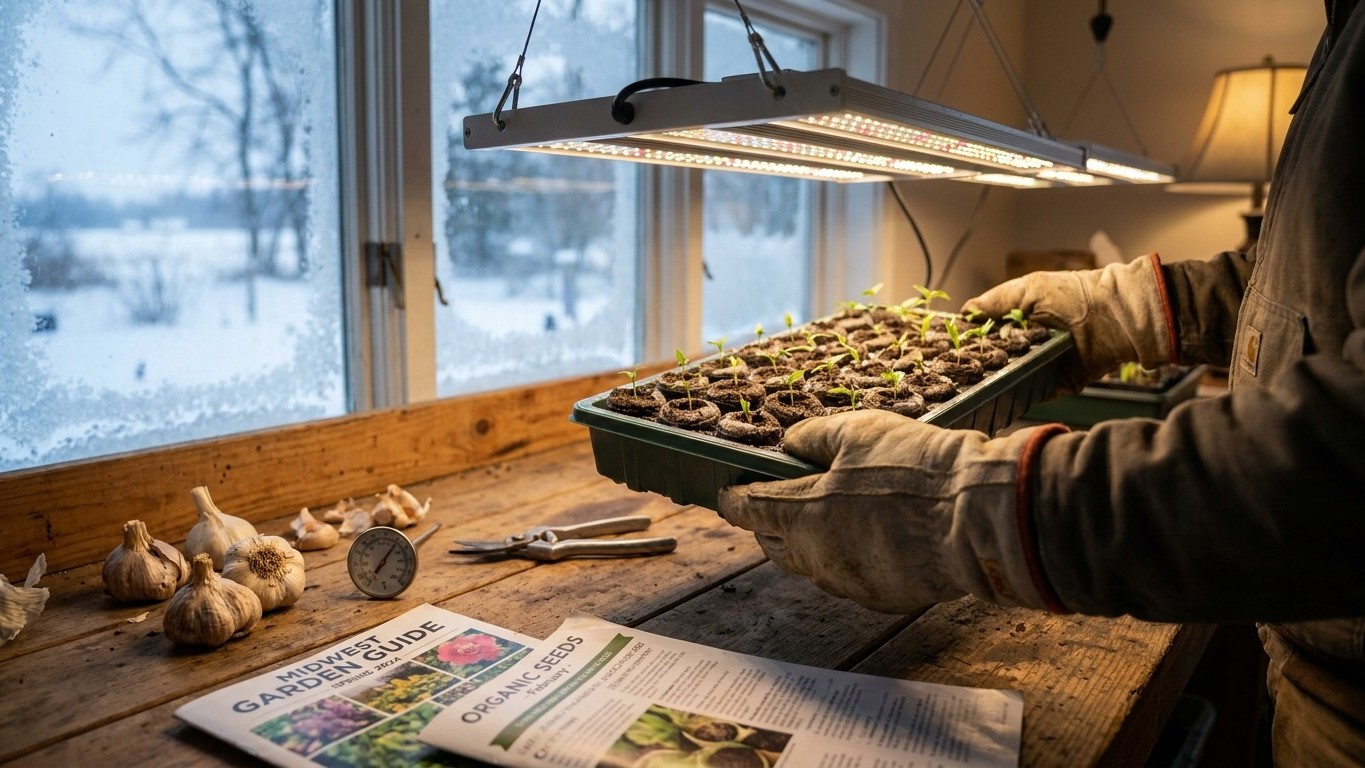

Nothing goes into open ground in Minnesota in February. The soil is frozen solid across the entire state, from the Iowa border to the Canadian line, and USDA places the state in zones 3a to 5a, cold enough that even hardy garlic sits dormant under frost-heaved soil. The real work this month happens indoors: seed starting under lights, dormant pruning, and planning the season before catalogs sell out.
What goes in the ground in February

The decision here is not the calendar, it is soil temperature and the frost window, and in Minnesota that window has not even started to open. NOAA’s 1991-2020 climate normals put the last spring frost at April 17 to April 30 for the Twin Cities area, the mildest part of the state. That is two to three months out from February. Northern Minnesota runs another two to three weeks tighter on top of that. Ground frozen to this depth cannot be worked, dug, or planted, full stop.
So the honest answer is that no new direct-sowing or transplanting happens outdoors this month, anywhere in the state. What does not need doing is disturbing garlic and shallots planted the previous fall. They are dormant in the ground already, doing their slow root work under the frost line, and the only action required is leaving them alone.
Cold frames and low tunnels are not a workaround here the way they might be farther south. In zone 3a-4a soil, the ground under a cold frame is still frozen most winters, so a frame is useful for protecting greens that were already established before freeze-up, not for starting anything new.
Bare-root fruit trees, shrubs, and brambles that arrive by mail this month should not go into the ground. Heel them into a bucket of damp sand or sawdust in an unheated garage or root cellar, keep them cold but not frozen solid, and hold them until the soil actually thaws, usually well into April or May depending on the spring.
One genuine planting job does belong to February: forcing. Dig dormant rhubarb crowns or chicory roots, bring them into a dark, moderately warm space, and you can coax an early harvest of blanched rhubarb stalks or Belgian endive while the garden outside is still locked under snow.
What to start under cover
Seed starting indoors is counted backward from the frost window, not forward from a date on a calendar. That arithmetic matters more in Minnesota than almost anywhere, because the gap between “safe to start indoors” and “safe to plant outdoors” is unusually long.
Onions grown from seed need roughly ten to twelve weeks of indoor growth before they go outside, and they can handle being transplanted a couple of weeks before the last frost since young onion sets tolerate cool soil. Counting back from an April 17 last-frost date puts the seed-starting window in late January to early February for the southern part of the state. Peppers need about eight weeks indoors, but they are far less frost-tolerant, so they should not go outside until after the frost window closes entirely, which pushes their indoor start to early or mid-February. Slow growers like celery and artichokes, if attempted at all in a short-season climate, need ten weeks or more and belong even earlier.
| Crop | Weeks needed indoors | Approximate indoor start |
|---|---|---|
| Onions (from seed) | 10 to 12 weeks | Late January to early February |
| Peppers | 8 weeks | Early to mid-February |
| Celery | 10+ weeks | Early February |
The two ways this goes wrong are mirror images of each other. Start too early and you get leggy, rootbound seedlings sitting in tiny pots for weeks longer than they should, stressed and stunted before they ever reach the garden. Start too late for a slow crop like onions or celery, and the plants never build the root or leaf mass they need before the short Minnesota growing season runs out. Neither mistake is fixable once the transplant date arrives.
What is ready to pick
Almost nothing comes out of a Minnesota garden outdoors in February, and there is no honest way to dress that up. The ground is frozen, snow cover is typically still in place, and anything left in open soil is either dead or waiting under insulation.
What still feeds a household this month comes from three places. Overwintered kale and leeks, if they were mulched heavily before freeze-up and are buried under a good snowpack, can sometimes still be dug in a mild stretch, though in the coldest parts of the state they may not be reachable until the ground softens. Cold-frame greens planted the previous fall, things like spinach, mache, and claytonia, can keep producing small pickings through winter if the frame has held up and snow has not crushed it. Indoors, sprouts and microgreens are the most reliable fresh green a Minnesota gardener gets this time of year, ready in a week to ten days from a jar or a tray on the counter.
The other job this month is inspection, not harvest. Go through the root cellar or basement stash of squash, potatoes, and onions and pull anything showing soft spots, sprouting eyes, or a sweet fermented smell before it spreads to the rest of the bin. Winter squash that is starting to develop a soft “neck” near the stem should be used first. One rotting potato in a bin of fifty can take down the whole lot within a couple of weeks if it is not caught.
The jobs that matter this month
This is the month where the real deadlines live, even with nothing planted outside.
Dormant pruning of fruit trees, raspberry canes, and grapevines should happen now, while the plants are fully dormant and before sap starts moving. Cutting a apple tree or a bramble patch in late winter, while wood is still frozen hard and free of leaves, causes far less stress than pruning after growth resumes, and it is easier to see the branch structure without foliage in the way.
Seed ordering has a real deadline too, one gardeners tend to underestimate. Short-season varieties bred to mature fast enough for Minnesota’s compressed summer are popular for obvious reasons, and the best of them sell out from seed companies well before spring. Ordering in February, rather than waiting until the ground thaws, is often the difference between getting the variety you want and settling for whatever is left.
Soil testing can be done now by mailing a sample to a lab, even with the surface frozen, since indoor labs work from a jar of soil, not from digging in real time. Getting results back in February leaves time to order lime, sulfur, or amendments and have them ready before the ground is workable. Compost piles should be checked and turned if they have not frozen into a solid block. Tools deserve attention too: cleaning rust off blades, sharpening pruners and hoes, and repairing raised bed frames or fencing sitting under a workbench are exactly the tasks that get skipped once spring planting starts and there is no time left for maintenance.
What not to do in February
The most common mistake this month is starting warm-season seeds too early out of restlessness. Tomatoes, squash, and melons started in early February, weeks or months before the last frost of April 17 to 30 even arrives, sit indoors far too long and turn into leggy, rootbound transplants that struggle to recover once they finally go in the ground.
A January or February thaw is another trap. A run of warm days can fool a gardener into pulling back mulch from strawberry beds or perennial crowns, thinking spring has arrived. It has not. A hard freeze almost always follows a midwinter thaw in Minnesota, and newly exposed crowns take real damage from that swing. Leave winter mulch in place until the thaw is sustained, not just a brief warm spell.
Pruning spring-flowering shrubs like lilac or forsythia now is also a mistake, since their flower buds are already set on last year’s wood. Cutting them back in February removes the very buds that would have bloomed, and the plant will simply skip flowering for a season. Prune those after they finish blooming instead.
Fertilizing anything dormant, lawn included, wastes the nitrogen and risks it running off with snowmelt into storm drains before any plant root is active enough to use it. Hold feeding until real growth resumes.
Checking this against your own county
A statewide answer for February is a starting point, not an instruction for a specific yard. Minnesota’s last spring frost runs April 17 to April 30 in the milder south, but northern counties run two to three weeks tighter at both ends of the season, and elevation or proximity to Lake Superior can shift local timing further still. A garden in Duluth is not on the same clock as one in Rochester.
For a county-level read on frost timing and planting windows, the University of Minnesota Extension publishes region-specific guidance worth checking against anything general written here.
Common questions
Can I plant peas outdoors in Minnesota in February?
No. Peas tolerate cold soil better than most crops, but Minnesota’s ground is still frozen in February across the entire state. Peas go in once soil is workable, typically closer to the last frost window of April 17 to 30 in the south, later farther north.
Is it too early to start tomato seeds indoors in February?
For most of Minnesota, yes. Tomatoes need six to eight weeks indoors before transplanting after the last frost (April 17 to 30 in the mildest areas), which points to a start date in March rather than February. Starting in early February usually means leggy, overgrown plants by transplant time.
What USDA hardiness zone is Minnesota in?
Minnesota spans USDA Plant Hardiness Zones 3a to 5a, based on the 2023 map built from 1991-2020 average extreme minimum winter temperatures. That range covers the whole state; northern counties sit at the colder end (3a) and the southeast trends milder (5a).
Can stored vegetables from the garden still be eaten in February?
Yes, if they have been checked regularly. Squash, potatoes, and onions stored properly since fall can hold well into late winter, but they need periodic inspection for soft spots, sprouting, or rot, since one bad piece can spread quickly through a storage bin.