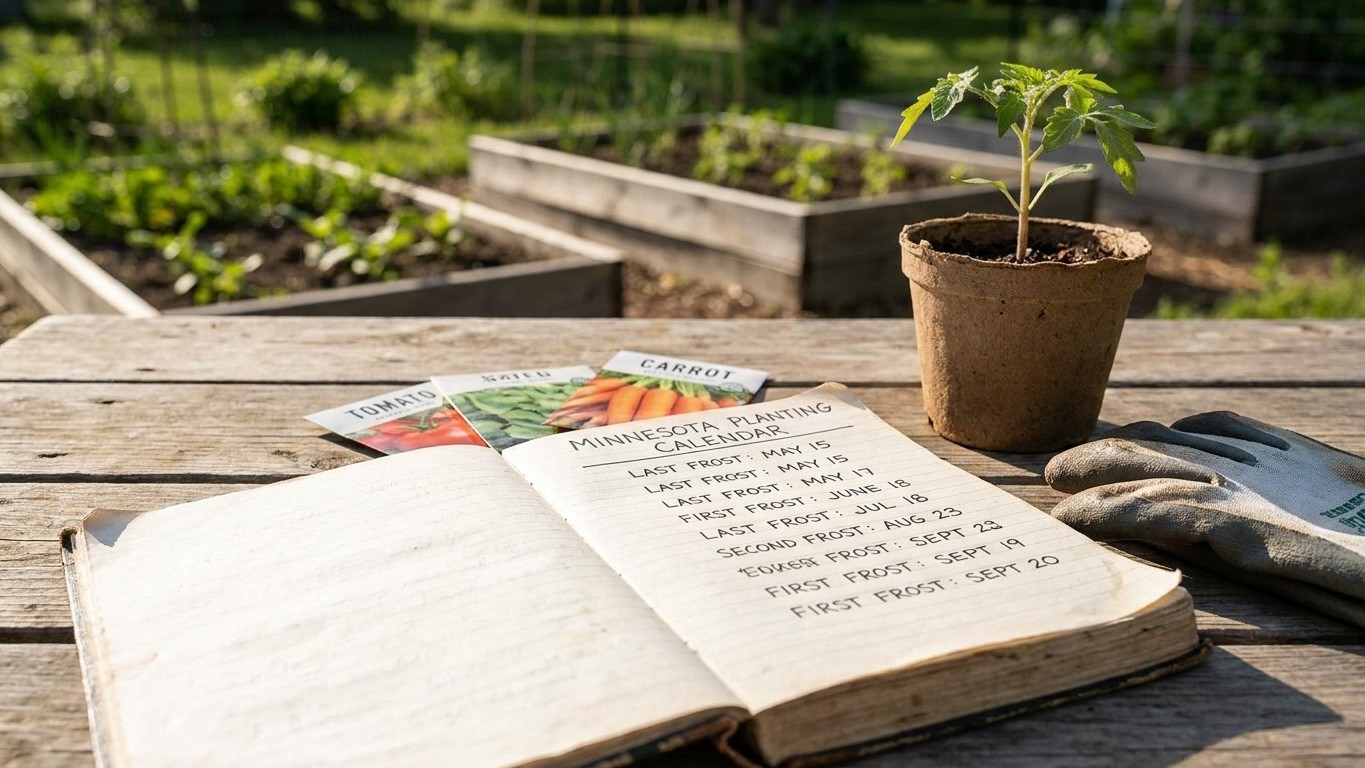

Minnesota’s last spring frost falls between April 17 and April 30, and the first fall frost lands between October 11 and October 23, according to NOAA’s 1991-2020 climate normals for Minneapolis. Those two windows set the boundaries for nearly everything you plant this year. Check the University of Minnesota Extension’s county-level frost data before you move any warm-season transplant outdoors, since a garden even a few miles from the Twin Cities can run on a different clock.
The frost window in Minnesota

Two to three weeks — that’s the gap between a Minneapolis frost date and the same date near Duluth or International Falls, and it’s why a single statewide planting calendar quietly fails half the state. Minneapolis gives you a growing season stretching roughly 165 to 190 days; push north and both ends squeeze in, spring frost lingering into mid-May, fall frost arriving that much earlier. Minnesota isn’t one climate wearing one calendar. Know which end of the state you’re gardening before you trust any frost date.
Subtract the two ranges and you get a growing season that runs roughly 165 days in a short year to about 190 days in a long one, measured at Minneapolis. That is the arithmetic, shown as a range because the underlying dates are ranges. Do not round it to a single number: a garden that gets the short end of both windows loses nearly a month of growing time compared to one that gets the long end of both.
North and south run different clocks
NOAA’s caution on this data is blunt: northern Minnesota runs two to three weeks tighter on both ends than the Minneapolis figures above. A last frost that clears by late April in the Twin Cities can linger into mid-May near Duluth or International Falls, and the first fall frost arrives that much sooner too. If you garden north of the metro, treat the Minneapolis dates as an optimistic guide and lean on the University of Minnesota Extension’s local data instead.
Compare that to gardeners working from the Missouri Planting Calendar, where a more southerly frost-free window opens weeks earlier in spring and closes weeks later in fall. Minnesota’s shorter season is exactly why days-to-maturity numbers on a seed packet matter more here than almost anywhere else in the Midwest, and it’s also why knowing exactly What to Plant in Minnesota in February can give you a head start before the ground even thaws, just as knowing What to Plant in Minnesota in December helps you plan ahead for the season to come, knowing What to Plant in Minnesota in September helps you wind the season down at the other end, and knowing What to Plant in Minnesota in June helps you make the most of peak growing season, and knowing What to Plant in Minnesota in October helps you make the most of the first frost window as the season winds down, and knowing What to Plant in Minnesota in May helps you make the most of the peak planting window, and knowing What to Plant in Minnesota in March helps you keep that early momentum going as the ground finally thaws, knowing What to Plant in Minnesota in July lets you make the most of the peak growing months, and knowing What to Plant in Minnesota in January lets you get organized while winter still has its grip, just as knowing What to Plant in Minnesota in April helps you time the frost-free transplants right, knowing What to Plant in Minnesota in November helps you close out the season on the other end, and checking What to Plant in Minnesota in August keeps the mid-season transitions from catching you off guard.
Cool-season crops
Cool-season vegetables tolerate a light frost and actually prefer to finish their early growth in cold soil, so they go in ahead of the last frost date, not after it. Peas and spinach can be direct sown as soon as the soil can be worked in spring, well before the April 17 to April 30 window closes at Minneapolis. Lettuce follows the same logic: it germinates poorly in hot soil and bolts in summer heat, so an early start beats a late one.
Brassica transplants, kale, cabbage, broccoli, and Brussels sprouts, are usually started indoors and hardened off before they go into the ground, going out while there is still a real chance of frost on the calendar. Hardening off matters more here than the exact date does: a transplant that has spent a week outside in a sheltered spot shrugs off a light freeze that would knock back one moved straight from a warm windowsill.
Root crops and the soil-workable rule
Carrots, beets, radishes, and turnips are direct sown early too, since their germination is driven by soil temperature and moisture rather than air temperature. The practical rule most Minnesota gardeners use is simpler than a calendar date: if the soil crumbles in your hand instead of forming a mud ball, it is workable, and that trumps whatever a printed date says.
- Peas and spinach: sow as soon as soil can be worked, ahead of the frost window
- Lettuce: early direct sow or transplant, tolerates a light freeze
- Brassica transplants: harden off before setting out ahead of last frost
- Carrots, beets, radishes: direct sow early, driven by soil condition not date
Warm-season crops

Tomatoes, peppers, squash, beans, and corn are the crops that actually care about the frost date, because a 32°F freeze kills them outright. But soil temperature matters as much as the frost date itself: cold, wet soil rots seed and stalls root growth even after the air has warmed past freezing. That is why the safe set-out window for transplants sits a bit later than the raw frost date alone would suggest.
What the catalog numbers mean for Minnesota
Days-to-maturity figures on a tomato packet are counted from the transplant date, not the seed date, and they shift by a week or two depending on the season’s weather. Cross that catalog number against the Minneapolis frost window and you get a real margin, not a guess. Given a last frost of April 17 to April 30 and a first fall frost of October 11 to October 23, transplants set out early May to mid May have somewhere between 165 and 190 days of frost-free season to work with before the fall freeze returns.
Short-season slicers like Sakura (55 days, indeterminate), Edox (55 days, indeterminate), Valentine (55 days, indeterminate), and Glacier (55 days, determinate) all clear that math with roughly 95 days of margin before the earliest expected fall frost. Longer-season paste and beefsteak types like San Marzano II (78 days) and Celebrity Plus (78 days) still finish with about 72 days to spare, which is comfortable but leaves less room for a cool, slow summer.
| Variety | Days to maturity | Type | First ripe | Margin before fall frost |
|---|---|---|---|---|
| Sakura | 55 | Indeterminate | Early July | 95 days |
| Sun Gold | 57 | Indeterminate | Early July | 93 days |
| Supersweet 100 | 60 | Indeterminate | Mid July | 90 days |
| Cherokee Purple | 72 | Indeterminate | Late July | 78 days |
| Big Beef Plus | 72 | Indeterminate | Late July | 78 days |
| Amalfi | 68 | Determinate | Late July | 82 days |
| Celebrity Plus | 78 | Determinate | Late July | 72 days |
| San Marzano II | 78 | Indeterminate | Late July | 72 days |
Peppers run on a similar clock to tomatoes but germinate and grow more slowly in cool soil, so most gardeners start seed indoors roughly six to eight weeks before the planned set-out date. Squash, beans, and corn are usually direct sown instead of transplanted, and all three sulk or rot in soil that has not warmed up, which is the practical reason to wait past the raw frost date rather than rushing them in the moment it passes.
The fall planting window
Working backward from the first fall frost gives you a second planting season that a lot of gardens skip entirely. NOAA’s Minneapolis normals put that first frost between October 11 and October 23, so count back from the early end of that range, not the late end, since a late-summer sowing has less room for error than a spring one does. Add a bit of extra time on top of the catalog’s days-to-maturity figure, because growth slows as daylight shortens through September, even before any frost touches the plant.
Crops that improve after a light freeze
Kale, Brussels sprouts, carrots, and parsnips are the crops worth planning a fall harvest around, because a light frost converts starches to sugars in the leaves and roots and genuinely improves the flavor rather than just being tolerated. None of these need to be pulled the moment frost is forecast, and leaving carrots or parsnips in the ground through the first couple of frosts is a common, low-risk way to stretch harvest into late fall.
Quick crops like radishes, spinach, and lettuce work well as a second planting too, since their short time to maturity fits inside even the tighter end of the fall window. A determinate tomato like Celebrity Plus, with its 78-day catalog figure and roughly 72 days of margin from a May set-out, is really a spring-and-summer crop, not a candidate for a second planting this far north, and that margin figure is worth checking against any variety before you try to squeeze in a second round.
Gardeners in warmer states get a longer runway here. The Alabama Planting Calendar shows a fall frost arriving much later in the year, which is why succession planting is a bigger part of the season there than it typically is in Minnesota.
Reading a planting calendar properly
A state-wide frost date is an average pulled from decades of weather records at one measurement station, not a promise about your yard. NOAA’s own framing of the Minneapolis figures as a 30 to 70 percent probability band already admits this: there is meaningful frost risk on both sides of the printed range, not just inside it.
What actually shifts the date in your yard
Elevation, distance from open water, and how built-up your immediate surroundings are all move the effective frost date around, sometimes by more than the county-to-county variation NOAA’s data already shows. A low spot where cold air pools will frost before a slope fifty yards away. A yard close to a large lake often runs a few degrees milder in spring and fall than one further inland, while a downtown or urban-heat-island location can lag the surrounding countryside’s frost dates in both directions.
The only real fix is to watch your own garden across a season or two: note the date of your last hard frost each spring, keep a thermometer in the spot where you actually plant, and treat the printed calendar as the starting guess you adjust from, not the final word.
Local help
For county-level frost dates, soil testing, and cultivar trial results specific to your part of the state, the University of Minnesota Extension is the resource to use before you finalize a planting date. Their county offices also run soil test programs, which matter more in a state with Minnesota’s range of soil types than a single statewide guideline ever could. Anyone building out a broader garden plan can also start from our Minnesota guides for other state-specific growing topics.
Common questions
Is it too early to plant tomatoes outside in April in Minnesota?
Yes, in almost every part of the state. NOAA’s Minneapolis normals put the last spring frost between April 17 and April 30, and northern Minnesota runs two to three weeks later than that, so April transplanting risks a hard freeze that will kill tomatoes outright.
What’s the fastest tomato I can grow if my season runs short?
Look at 55-day varieties like Sakura, Edox, Valentine, or Glacier, which reach maturity fast enough to leave roughly 95 days of margin before the earliest fall frost at Minneapolis. That margin shrinks in northern counties, so a fast variety matters even more the further north you garden.
Does the frost date really change that much across the state?
Yes. The Minneapolis figures above are the mildest in Minnesota, and NOAA’s data notes that northern parts of the state run two to three weeks tighter on both the spring and fall end, which shortens the whole growing season by roughly a month compared to the Twin Cities.
How accurate is a printed last-frost date, really?
It’s a probability, not a promise. NOAA’s range comes from a 30 to 70 percent freeze probability band, meaning there is still a real chance of frost before or after the printed window, which is why cautious gardeners wait until the later end of the range for tender transplants.
What if I miss the fall planting window for a second round of crops?
Quick crops like radishes, spinach, and lettuce still fit inside a shortened fall window because their time to maturity is short to begin with. Root crops like carrots and parsnips can also stay in the ground through the first frosts without harm, which buys extra time even if a planting date was missed.
Some gardeners layer an older custom on top of frost dates: planting by the moon, which we explain as almanac tradition, not fact.
Related guides
- Wisconsin Planting Calendar: When to Sow and Plant, Frost Dates Included
- Iowa Planting Calendar: When to Sow and Plant, Frost Dates Included
- Missouri Planting Calendar: When to Sow and Plant, Frost Dates Included