
By November, Minnesota has already crossed its first fall frost window (October 11 to October 23), so this is not a planting month for anything tender. What still works is narrow and specific: garlic and shallots pushed into ground that hasn’t frozen solid, bare-root dormant stock, cold frames holding what’s already established, and a short list of indoor and forcing projects. Everything else waits for spring.
What goes in the ground in November

The calendar says November, but the soil doesn’t care what the calendar says. What decides whether anything goes into the ground is whether that ground is still workable, meaning not frozen solid, and Minnesota’s first fall frost (October 11 to October 23, per NOAA NCEI 1991-2020 Climate Normals) has typically already passed by the time this month opens. That’s the mechanism worth understanding: the frost date marks when air temperatures dip to 32°F with real probability, but soil freezing lags behind air temperature by days to weeks depending on cover and moisture. In the Twin Cities area, that lag can leave a workable window into early or mid-November. In the northern part of the state, running two to three weeks tighter on both ends of the season, the ground may already be locked up.
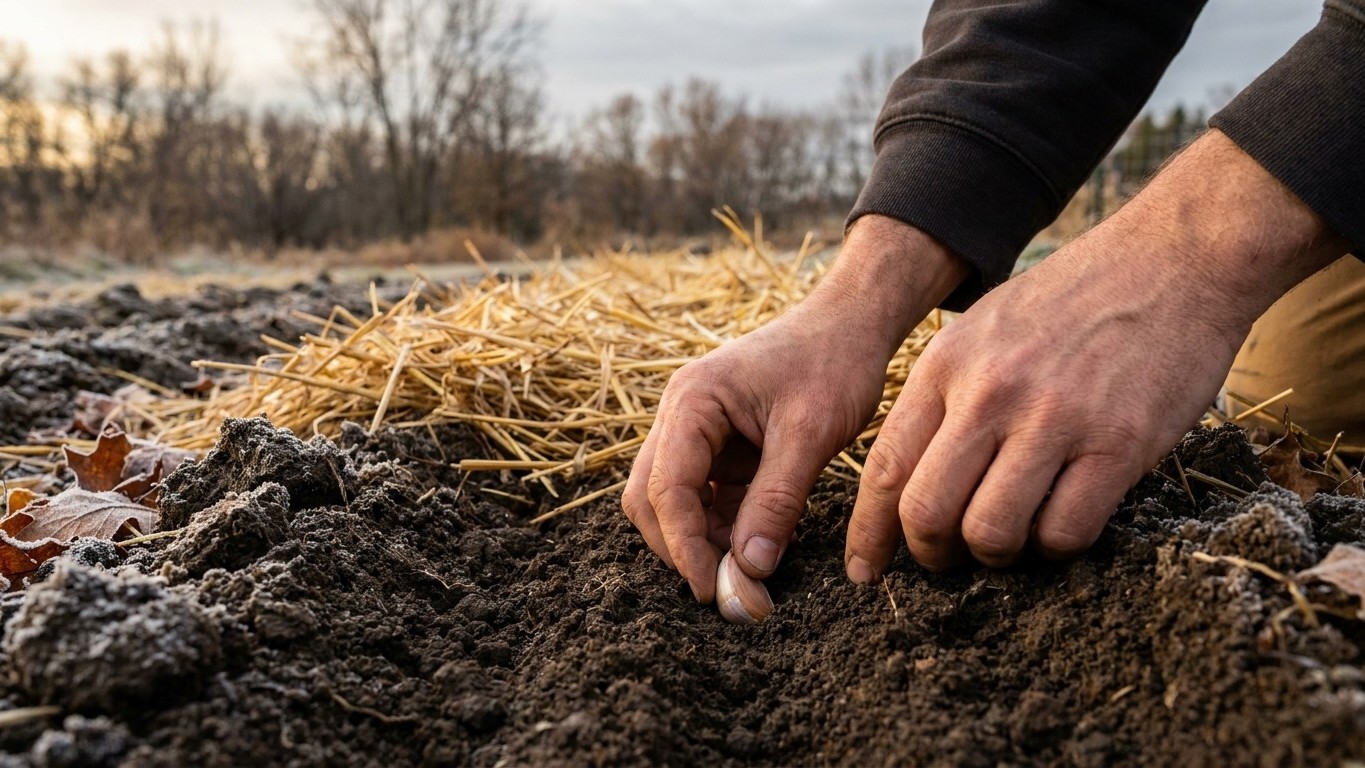
Garlic and shallots are the one crop worth planting outdoors this month, and only where a shovel still goes into the soil without a fight. Push cloves in, cover with four to six inches of straw mulch, and let winter do the vernalizing. This isn’t a gamble the way a tomato transplant would be; garlic is built for exactly this timing across USDA zones 3a-5a.
Bare-root fruit trees, brambles, and dormant perennials can also go in if a nursery has stock available and the hole can still be dug. Heel them in with mulch immediately after planting since there’s no growing season left to establish roots before hard freeze.
Cold frames and low tunnels aren’t for new sowing at this point. They’re for protecting greens that are already established, buying a few more weeks of harvest rather than starting anything from seed. And if there’s rhubarb or chicory in the garden, this is the month to dig roots before the ground freezes hard, then move them into a dark, cool space to force indoors. Nothing else goes into open Minnesota ground this month. That’s the honest answer, and it’s a short list for a reason.
What to start under cover
The instinct to start something indoors in November runs into the math of Minnesota’s last spring frost, which falls between April 17 and April 30 depending on location. Count backward from that window and most transplant crops land somewhere between January and March, not November. Onions and leeks, which need 10 to 12 weeks of indoor growth before transplanting, point to a start date in late January or early February. Peppers, needing 8 to 10 weeks, land in February. Starting either of these now, months ahead of that math, produces exactly the failure the calendar warns against: leggy, rootbound seedlings sitting in pots far too long before there’s anywhere outdoors to put them.
So what actually belongs under cover this month isn’t frost-dependent at all. Microgreens and sprouts don’t care about the last frost date because they never go outside; a tray on a windowsill can be cut in one to two weeks regardless of what month it is. Forcing bulbs, paperwhites, amaryllis, hyacinths prepped for indoor bloom, works the same way, running on its own internal clock rather than the garden’s.
The other failure mode worth naming is the opposite problem: waiting until the frost math says “go” and then discovering the seed order never arrived, or that a favorite variety sold out weeks earlier. November is a fine month to place that order even though nothing in it gets sown for months. That’s not busywork. It’s the only way to make sure the January or February start date is actually available to hit.
What is ready to pick
Outdoors, there is little to nothing left to harvest in most of Minnesota by November. That’s simply where the season sits once the first fall frost has passed statewide. But “little” isn’t “nothing,” and the household kitchen doesn’t have to go empty.
Kale and leeks left in the ground under a layer of snow or heavy mulch often hold through much of the winter, sweetened rather than ruined by the cold, and can be dug or cut as needed if the ground beneath the cover hasn’t fully locked up. Cold-frame greens, spinach, mâche, arugula planted earlier in fall, keep producing light cuttings on milder days even as outdoor beds sit dormant. Indoors, sprouts and microgreens fill the gap entirely on their own schedule, ready in days rather than months.
The other harvest task this month isn’t in the garden at all, it’s in the root cellar or basement. Stored squash, potatoes, and onions need a hands-on check now: squash with soft spots or a sweetish smell should be used first, potatoes showing sprouts or wrinkling separated from the rest, and onions with any give or dark spots pulled before they take neighbors with them. One rotting squash in a bin of a dozen can spread faster than most people expect, so this check is worth doing on a schedule rather than only when something starts to smell.
The jobs that matter this month
A quiet-looking month in the garden is still a full month of real work, and November’s list has hard deadlines attached to it even though nothing is being planted.
Dormant pruning of fruit trees and cane berries can start once leaves have dropped and the wood is fully dormant, and doing it now, before deep snow makes branches harder to reach and read, sets the shape for next year’s growth. Raspberries and blackberries in particular benefit from removing spent canes before winter, since dead wood left standing becomes a hiding spot for pests over the cold months.
Ordering seed now, rather than waiting for the January rush, is the difference between getting the variety that performed well last season and settling for whatever’s left on the shelf. Seed companies do run out of popular varieties, sometimes by midwinter.
Soil testing and amending pay off precisely because there’s time now for amendments to work into the soil before spring planting starts. A soil test run through the University of Minnesota Extension gives a baseline that guides how much lime, compost, or fertilizer actually makes sense, rather than guessing.
Turning the compost pile, cleaning and sharpening tools before they sit unused all winter, and repairing raised beds, trellises, or fencing while the ground is still workable enough to set a post are all jobs that get harder or get skipped once snow cover settles in. And rotation planning, deciding on paper now which beds host which family of crops next season, is far easier to do at a desk in November than rushed in the scramble of spring.
Quick job checklist
- Prune dormant fruit trees and cane berries once leaves have dropped
- Order seed before popular varieties sell out
- Test and amend soil while it’s still workable
- Turn compost, clean tools, repair beds and fencing
What not to do in November
The classic mistake this month is trusting a mild afternoon over the calendar and the ground. A 55°F day in early November can feel like an invitation to get one more planting in, but air temperature isn’t soil temperature, and nothing tender survives the freeze that follows within days. If it’s past the first fall frost window for the area, that window has already made the decision.
Uncovering cold frames or removing mulch after a warm stretch is another common misstep. A few mild days don’t mean winter is over, and stripping protection off garlic beds or cold-frame greens just ahead of the next hard freeze undoes weeks of insulation for nothing. Leave the mulch on until there’s real, sustained warmth, not a single comfortable afternoon.
Feeding nitrogen at this point in the season is also a mistake, since it pushes soft new growth right when the plant should be shutting down for dormancy. That new growth has no time to harden off before the cold, and it’s often the first tissue killed outright. Compost or slow-release amendments are a better call now; save nitrogen-heavy feeding for active growth in spring.
Finally, tender bulbs like dahlias and gladiolus left in the ground through repeated hard freezes usually don’t come back. If they weren’t dug and stored before the ground froze, that’s a loss to note for next season rather than a task still worth attempting now.
Checking this against your own county
Everything above is a statewide starting point, not a county-specific instruction. Minnesota spans USDA hardiness zones 3a to 5a, and elevation, lake effect, and simple north-south distance shift real planting windows by two to three weeks in either direction. A garden near the Twin Cities is working with the mild end of the state’s frost calendar; a garden in the north is working weeks tighter on both spring and fall frost.
For a local read, University of Minnesota Extension publishes county-level guidance and a planting calendar built around regional frost data, worth checking before locking in any date from a statewide article.
Gardeners who plant by the Moon can check the November 2026 moon planting calendar, a tradition rather than a proven method.
Common questions
Can garlic still be planted in Minnesota in November?
Yes, as long as the soil hasn’t frozen solid. Once it’s in, mulch heavily with straw to insulate through winter.
Is it too late to start seeds indoors in November?
For anything meant to transplant outside, yes, since the math from Minnesota’s last spring frost (April 17 to April 30) points to a January or February start for most crops. Microgreens and sprouts are the exception, since they run on their own short timeline.
What can still be harvested in a Minnesota garden in November?
Very little outdoors past the first fall frost, though kale and leeks under mulch or snow cover, and cold-frame greens, often hold on. Indoors, sprouts and microgreens fill the gap.
Should mulch be removed if a warm spell hits in November?
No. A few mild days aren’t a sign that winter is over, and pulling protection off garlic beds or cold frames too early leaves them exposed to the next hard freeze.
Elsewhere? See what to plant in November in every state and province.