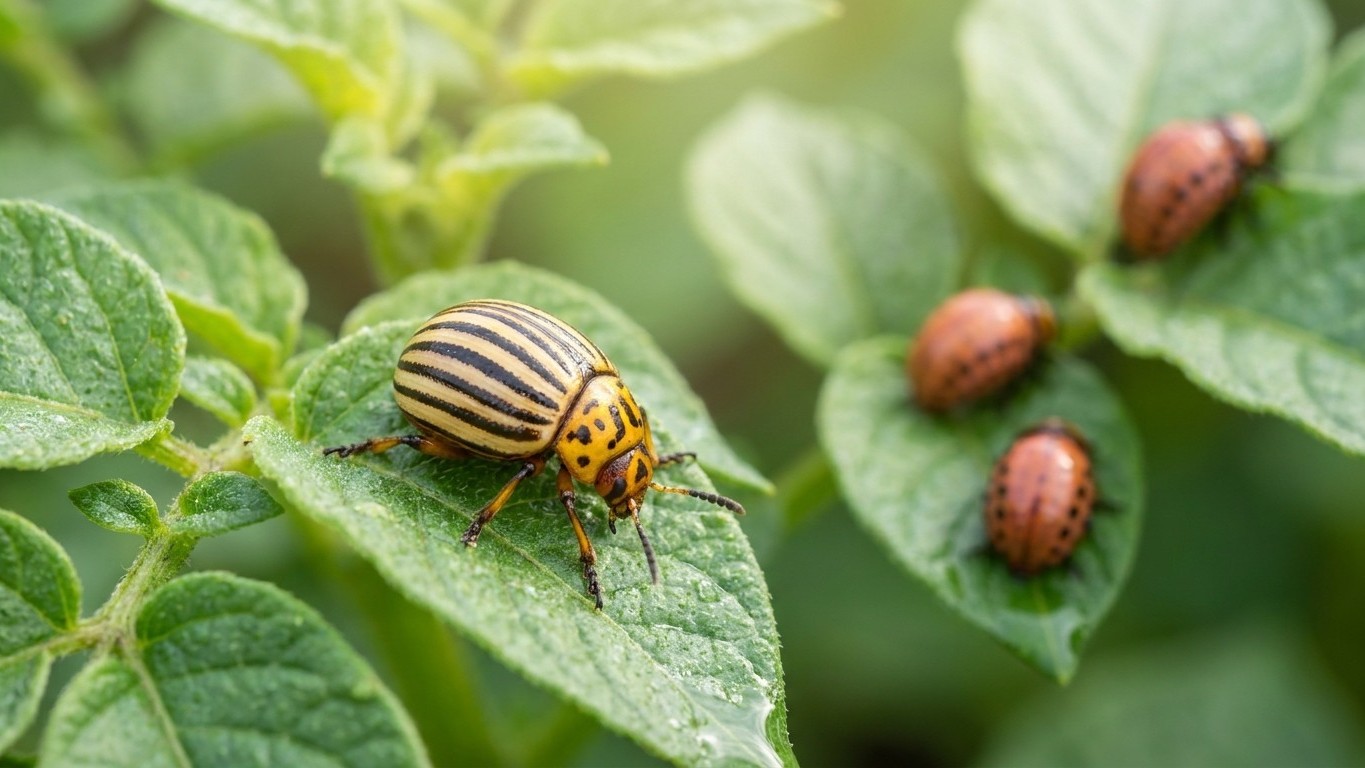

In Minnesota gardens, only two insects on the University of Minnesota Extension’s documented pest list actually feed on potato: the Colorado potato beetle and the three-lined potato beetle. Both show up once plants are up and growing, work through leaves rather than tubers, and can strip a young plant fast if nobody checks under the foliage. The rest of the extension’s garden pest list belongs to cabbage, onions, squash, or fruit, not potato.
Which pests attack potato in Minnesota

University of Minnesota Extension documents ten insect pests for home gardens in this state: cabbage maggot, Colorado potato beetle, Japanese beetle, onion maggot, spotted wing drosophila, squash bug, squash vine borer, striped cucumber beetle, swede midge, and three-lined potato beetle.
Only two of those ten are documented as potato feeders: Colorado potato beetle and three-lined potato beetle. The other eight belong to different crops entirely, and pinning one of them on potato damage just sends a gardener chasing the wrong insect.
Why the other eight don’t fit a potato patch
Cabbage maggot and onion maggot are root feeders tied to their name crops. Cabbage maggot larvae tunnel into brassica roots such as cabbage, broccoli, and radish, and onion maggot larvae do the same to onion and garlic bulbs. Neither touches a potato plant, whose edible part forms underground as a tuber rather than a taproot or bulb.
Squash bug, squash vine borer, and striped cucumber beetle all feed on cucurbits, squash, cucumber, pumpkin, melon, plants with sprawling vines and broad flat leaves built differently from potato foliage. Swede midge attacks the growing point of brassicas, causing twisted, blind growth with no equivalent in a potato bed. Spotted wing drosophila lays eggs in soft-skinned fruit like raspberries and blueberries and has no interest in a potato leaf or tuber. Japanese beetle is the trickiest to rule out, since it feeds on hundreds of plant species, but its documented damage in Minnesota gardens runs to roses, grapes, and linden trees, not potato.
Both remaining insects belong to the same leaf beetle family, but the resemblance stops there. Colorado potato beetle is the more aggressive defoliator of the two, capable of stripping a young plant down to bare stems across a single generation. Three-lined potato beetle causes narrower feeding, ragged holes and skeletonized patches rather than total leaf loss, and it will also work on tomato, eggplant, and other nightshade relatives growing nearby.
When each one shows up, and what it does first
Minnesota’s last spring frost falls between April 17 and April 30 in the Twin Cities, and that window anchors everything that follows in a potato bed. Gardeners farther north should expect that frost-free window to open two to three weeks later, which pushes every insect event on this list later as well.
Colorado potato beetle first
Colorado potato beetle adults spend the cold months buried in soil near where potatoes grew last, often in the same bed if it wasn’t rotated. They dig out once soil warms after the frost-free window opens, and the first sign is small round holes chewed into the earliest leaves of a young plant, sometimes before it has more than a few sets of leaves. Within days of that first feeding, check the undersides of leaves for tight clusters of bright yellow-orange eggs standing on end. Those hatch into humpbacked, reddish larvae that do the heaviest damage, working through a leaf until only veins remain.
Three-lined potato beetle a little later
Three-lined potato beetle adults tend to appear once foliage has filled in more, feeding in ragged, irregular holes rather than the neat rounds Colorado potato beetle leaves behind. Its larvae are the more distinctive stage: pale, soft-bodied, and coated in a dark, wet-looking smear that’s actually the larva’s own waste, carried on its back as a defense against predators. That larval stage causes most of the leaf loss, and it tends to run later in the season than the first wave of Colorado potato beetle activity.
Because both insects can produce more than one generation before the season closes, a garden can see a second, smaller wave of adults and eggs later on, which is why a single early check is never the end of scouting. A weekly walk through the rows, looking under leaves rather than just at the tops, catches both at the egg stage, before the larvae that do the real damage have hatched.
Telling the damage apart from everything else
The single feature that separates real insect feeding from everything that mimics it is torn or missing leaf tissue. Nutrient deficiency, drought stress, and most fungal diseases change a leaf’s color or texture without actually removing bites of it, while Colorado potato beetle and three-lined potato beetle leave unmistakable gaps.
| What you see | Likely cause | What settles it |
|---|---|---|
| Small round holes in young leaves, yellow-orange egg clusters underneath | Colorado potato beetle | Adult has ten black stripes down a yellow-orange wing cover |
| Ragged holes, dark sticky-looking larvae on leaf surfaces | Three-lined potato beetle | Larva carries a visible dark fecal shield on its back; adult has three brown stripes on a yellow wing cover |
| Uniform yellowing across the whole plant, no chewed tissue | Nutrient deficiency or uneven watering | Leaf tissue stays intact; discoloration spreads evenly rather than in bite marks |
| Brown lesions with concentric rings, lower leaves first | Early blight or another foliar disease | Lesions form a target-ring pattern, spreading from older lower leaves upward |
| Wilted or severed young stems near the soil line | Mechanical damage, cutworm, or another cause not documented here | Check the stem base for a clean cut versus chewed tissue, and bring a sample to the local extension office |
The fecal shield on a three-lined potato beetle larva ends most confusion; nothing else on a potato plant looks or feels like it. Past that, a gardener staring at a damaged leaf and unsure which row it belongs in is better served bringing a sample, or a clear photo of both the damage and any insect on it, to a local expert than guessing from a list.
What actually works here, and what is a waste of time
Hand-picking adults and crushing egg clusters, checked weekly from the time plants emerge, does more for a home garden than any spray applied on a fixed calendar date. Both insects are large enough to see and slow enough to catch, and removing egg clusters before they hatch skips the larval stage that causes most of the leaf loss.
Rotating potatoes to a different bed than where they, or any tomato, eggplant, or pepper, grew the previous season matters more on a short Minnesota growing season than it might elsewhere, since it forces overwintering adults to travel farther to find a host plant instead of digging out directly under it. Row covers placed over the bed as soon as plants emerge keep the first wave of adults off entirely, though they need to come off once the plant flowers if pollinators are needed nearby.
What tends to waste effort is spraying on a set schedule regardless of what stage the insect is actually in. A treatment timed to the calendar rather than to an actual sighting of eggs or small larvae often lands after the vulnerable stage has passed, hitting adults that are already leaving to lay more eggs elsewhere. Companion planting schemes built around potato pests are popular online but don’t carry the same documentation as scouting and rotation, so treat them as unproven rather than a substitute for checking leaves. Any decision about an actual pesticide, which one is registered for home garden use in Minnesota and how it should be applied, belongs with University of Minnesota Extension, since registrations change and a state extension service is the authority that tracks that.
Where to check this for your own county
University of Minnesota Extension, through its county office network, is the source that tracks which of these insects are actually active in a given part of the state and when. A pest documented statewide doesn’t mean it’s present at the same level, or on the same schedule, in every county, and a county extension office is where that local detail lives.
This matters more in a state the size of Minnesota than it might elsewhere. The frost-free window itself runs two to three weeks tighter in the northern part of the state than in the Twin Cities reference used earlier, and insect emergence follows that same soil-temperature clock, meaning a garden near the Canadian border can see its first Colorado potato beetle adults weeks after a garden near the Iowa border does.
A home gardener staring at a damaged potato leaf and unsure whether it matches Colorado potato beetle, three-lined potato beetle, or something else entirely has one clear next step: contact the county extension office, describe or photograph the damage and any insect found on it, and ask what’s currently being reported active in that county. Many offices also run a diagnostic clinic or accept mailed samples, which settles a borderline case faster than trading photos back and forth. That local, current answer will always outrank a statewide list for deciding what’s actually eating a particular garden’s potatoes.
Common questions
Does Colorado potato beetle damage the tubers or just the leaves?
It feeds on foliage, not the tuber itself. Heavy defoliation early in the season can still shrink the tubers that form later, because the plant loses the leaf area it needs to bulk them up underground.
Can a Colorado potato beetle problem come back the next year in the same spot?
Yes. Adults overwinter in the soil near where they fed the previous season, which is exactly why moving potatoes to a different bed matters.
Is Japanese beetle ever actually a potato problem in Minnesota?
It’s documented in Minnesota home gardens, but its recorded damage runs to roses, grapes, and shade trees rather than potato foliage, so it isn’t one of the two insects tracked as potato feeders here.
Does a row cover work against three-lined potato beetle too?
Yes, as long as it’s in place before adults find the plants. It needs to come off once the potato flowers if pollinators are working nearby.