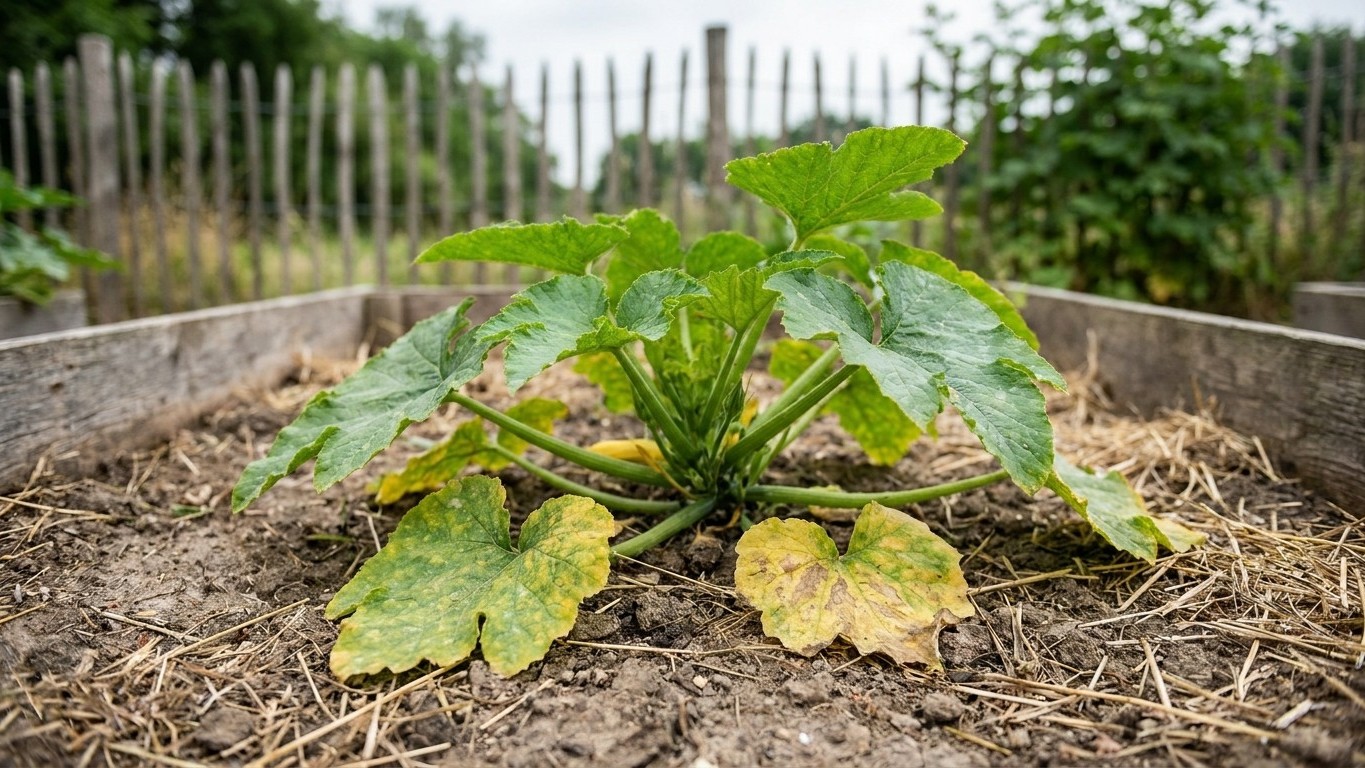

Minnesota gardeners growing summer squash deal mainly with four insects: squash bug, squash vine borer, striped cucumber beetle, and Japanese beetle. Each one hits at a different point in the season and leaves a different kind of damage, which matters more for diagnosis than the bug’s name ever does.
Which pests attack summer squash in Minnesota

University of Minnesota Extension documents ten pests active on vegetable crops in the state: Cabbage maggot, Colorado potato beetle, Japanese beetle, Onion maggot, Spotted wing drosophila, Squash bug, Squash vine borer, Striped cucumber beetle, Swede midge, and Three-lined potato beetle. That’s the full list for this territory, and it’s not padded out here with anything beyond it.
Half of that list has no business on a summer squash plant. Cabbage maggot and Swede midge work the roots and growing points of brassicas, cabbage, broccoli, kale, not cucurbits. Onion maggot is an allium specialist; it never touches a squash leaf. Colorado potato beetle and Three-lined potato beetle both feed on nightshades, potatoes, eggplant, tomatillo, and stay off squash entirely. Spotted wing drosophila targets soft, thin-skinned fruit like raspberries and blueberries, not the tougher fruit of a zucchini or yellow squash.
That leaves four that actually matter for this crop: squash bug, squash vine borer, and striped cucumber beetle are the three that specialize on cucurbits, while Japanese beetle is a generalist that will chew squash foliage alongside dozens of other garden plants. Squash bug feeds on leaves and stems with a piercing mouthpart, draining tissue until it wilts. Squash vine borer larvae tunnel inside the stem near the base, cutting off water to the whole plant from the inside. Striped cucumber beetle chews holes in leaves and blossoms as an adult, and its larvae also feed on roots, but it carries a second risk: it can spread bacterial wilt from plant to plant as it moves. Japanese beetle skeletonizes leaves, eating the tissue between veins and leaving a lacy skeleton behind.
None of these four is exotic to a Minnesota vegetable garden. All four show up most years somewhere in the state, though how heavy an infestation gets varies a lot by yard, by year, and by what was planted there the season before.
When each one shows up, and what it does first
Minnesota’s frost-free window runs from a last spring frost between April 17 and April 30 to a first fall frost between October 11 and October 23, depending where in the state a garden sits. Squash transplants or direct-seeded hills typically go in only after that spring frost risk has passed, and that planting date becomes the reference point for everything that follows on the plant, not a calendar month.
Striped cucumber beetle is usually the first to show, often within days of seedlings or transplants going in. The first sign is small, round or irregular holes chewed in the cotyledons or first true leaves, sometimes enough to skeletonize a very young seedling before it has a chance to establish. Because the adults move from plant to plant, a garden with several squash hills close together tends to see damage spread fast once beetles find the row.
Squash vine borer moths lay eggs at the base of the stem once plants have put on some vine growth, and the first visible sign is usually not a hole at all: it’s a healthy-looking plant that suddenly wilts during the heat of the day, especially the kind of sustained heat that shows up on the roughly 10.6 days a year this region reaches 90°F or hotter. Look closer at the stem base afterward and there’s often a small entry hole with a sawdust-like frass pushed out of it, the tunneling larva’s calling card.
Squash bug tends to build later, often becoming obvious by mid-summer as populations pyramid from a few overwintered adults into clusters of nymphs. The first sign is usually yellow speckling or stippling on leaves where the insects have been feeding, followed by leaves that turn brown, crisp, and collapse, a symptom gardeners sometimes mistake for wilt disease. Egg clusters, small and copper-colored, laid in neat rows on the underside of leaves, are the giveaway that squash bug is the cause rather than a fungal problem.
Japanese beetle arrives later still, usually once summer heat is well established, and announces itself with lacy, skeletonized leaves where only the veins remain, working from the top of the plant down.
Telling the damage apart from everything else
Squash problems get blamed on insects more often than insects actually cause them. Heat stress, uneven watering, powdery mildew, and simple nutrient shortfalls all produce symptoms that look enough like pest damage to send a gardener down the wrong path, especially on a crop already stressed by a summer that averages about 13.0 inches of rain across June, July, and August, with July the driest month at 4.06 inches, meaning water stress on sandy or fast-draining soil is a real competing cause almost every year.
| Symptom | Likely insect cause | What else it could be, and what tells the difference |
|---|---|---|
| Sudden wilting of one vine in hot weather | Squash vine borer | Drought stress wilts the whole plant evenly and recovers with watering; borer wilt is localized to one vine and doesn’t recover. Check the stem base for a frass-filled hole. |
| Small round holes in young leaves | Striped cucumber beetle | Hail or wind-whipped debris tears leaves irregularly rather than punching clean holes; beetle feeding leaves rounded chew marks and the beetles themselves are visible on close inspection. |
| Yellow leaves turning brown and crisp | Squash bug | Powdery mildew leaves a white, powdery coating on the surface before tissue browns; squash bug damage skips that stage and shows copper egg clusters underneath the leaf. |
| Lacy, skeletonized leaves | Japanese beetle | Nutrient deficiency yellows leaves between veins without eating the tissue away; beetle damage removes the leaf material itself, leaving only a net of veins. |
None of this replaces a look at the actual plant. When a symptom doesn’t match cleanly, the county extension office is the place to send a photo or a sample rather than guess.
What actually works here, and what is a waste of time
Timing beats product on a growing season this compressed. Covering plants with a floating row cover right at transplanting, and keeping it in place until flowering starts, blocks both cucumber beetle and vine borer moths during the exact window when they’re doing the most damage. Covers have to come off once blossoms open, though, because squash needs insect pollinators to set fruit, and a cover left on past bloom trades one problem for a worse one: no squash at all.
Checking the base of each vine weekly for the small entry holes vine borers leave gives a gardener a chance to slit the stem and remove the larva before it kills the plant, a fussy but effective habit during the stretch after transplanting when moths are laying eggs. Handpicking squash bug egg clusters off the undersides of leaves before they hatch also works, and it’s the single most effective non-chemical step against that insect, since a crushed egg cluster never becomes a feeding nymph.
Crop rotation matters more here than most gardeners expect: vine borer pupae and squash bug adults overwinter in soil and garden debris near where squash grew, so planting squash in the same spot year after year builds the population instead of starving it out. Clearing and tilling under old vines at season’s end, rather than leaving them to overwinter in place, denies both insects a place to sit out the cold.
What tends to waste a gardener’s time is spraying on a schedule rather than in response to what’s actually on the plant, and spraying anything while flowers are open, which hits pollinators along with the target pest. Any decision about a specific product or timing belongs with University of Minnesota Extension, which knows what’s labeled for use in the state; this is not a call to make from a label bought elsewhere.
Where to check this for your own county
University of Minnesota Extension is the source for everything above, and it’s also the right first stop for anything more specific than what’s written here. Its website is at extension.umn.edu, and every county in the state has a local Extension office that can look at a photo, a stem, or an egg cluster and say what it actually is.
State-level documentation doesn’t mean even distribution. A garden in a warmer southern county reaches its frost-free window a couple of weeks ahead of one up north, and pest pressure follows that same lag: a vine borer moth active in a Twin Cities garden in early summer may not be flying yet two hundred miles north. **What’s documented for Minnesota as a whole is a list of what’s possible here, not a forecast for one particular yard.**
The next useful step for a gardener seeing damage right now isn’t more reading, it’s a call or a sample drop-off to the county office, since that’s the only way to know for certain which of these four is actually on the plant this season.