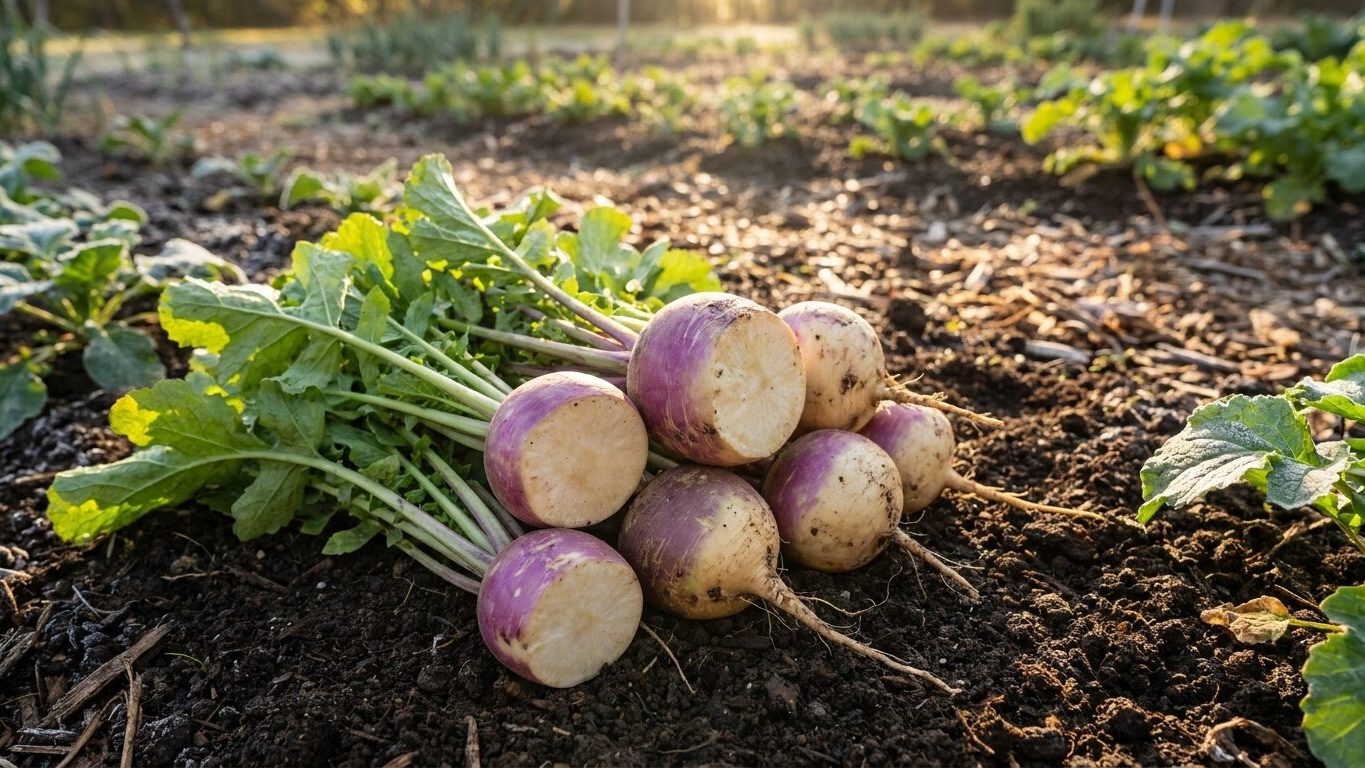

Sow turnips and rutabaga in Minnesota once the soil has warmed after the last spring freeze, then plan for a cool-weather harvest in fall. At the Minneapolis reference station, that last freeze falls between April 17 and April 30. The state’s cold shapes the rest of the story. Frost sweetens the roots, but a hard winter means lifting them, not leaving them in place.
When the soil is warm enough in Minnesota
The frost date is a proxy, not the target
NOAA’s 1991-2020 Climate Normals put the last spring 32°F freeze at Minneapolis between April 17 and April 30. That range is the 30-70% probability band. It is a probability, not a promise, so a late freeze can still show up after the band closes.
The date matters less than it looks. Frost is a measurement of air. Turnip and rutabaga seeds sit in soil, and soil lags behind the air. It warms after the frost risk ends, not alongside it. A cold, wet seedbed in late April can hold seed for weeks, or rot it, even when the thermometer on the porch looks friendly.
Minnesota is long, and the Twin Cities sit in its mild south. Northern Minnesota runs two to three weeks tighter at both ends of the season. A gardener near the Canadian border should push every date in this article later in spring and earlier in fall, and then verify against local conditions.
Checking the soil itself
Buy a soil thermometer. Push it in to seed depth and read it in the morning for several days in a row, since a single warm afternoon proves nothing. The germination and soil-temperature thresholds for each crop are published by University of Minnesota Extension. This page leaves the numbers to them, because the useful reading is the one taken in your own bed, on your own soil.
Heavy clay in a low spot warms slowly and stays wet. A raised bed or a south-facing slope with sandy loam gets there days ahead. Both can sit in the same yard.
The crop type changes the timing too. Quick-maturing salad turnips are the ones worth sowing in spring, because they can beat the summer heat. Rutabaga and larger storage-type turnips are slower, and gardeners generally aim them at the cool end of the year. Sow them with the fall in mind rather than racing a spring that is already turning warm.
For the varieties trialled in your part of the state, ask the extension service instead of trusting a seed-rack label written for the whole country. Turnips and rutabaga are brassicas, like cabbage, kale and mustard, so the bed you choose should not have held any of those recently. Our general guide, Growing Turnips and Rutabaga: An Autumn Crop, Sweetened by Frost, covers the crop itself.
How long the season lasts here
Take the two dates the NOAA normals give for Minneapolis: last spring freeze between April 17 and April 30, first fall freeze between October 11 and October 23. Subtract, and the frost-free window comes out between 164 and 189 days, depending on which ends of the two bands the year lands on.
| Scenario | Last spring freeze | First fall freeze | Window |
|---|---|---|---|
| Shortest | April 30 | October 11 | 164 days |
| Longest | April 17 | October 23 | 189 days |
Those figures describe the Twin Cities. Northern Minnesota is two to three weeks tighter at both ends, so by that arithmetic the window there shrinks by roughly four to six weeks. The calculation uses only the dates above, and no estimate fills in a missing one.
What a window like this allows
A window near six months is long enough to plan two sowings in the south of the state. One goes in early for a fast crop. A second goes in later, timed so the roots size up in the cooler weeks, ahead of the fall freeze. Because turnips tolerate light frost, the fall crop is not strictly ended by the first freeze date, which makes the second sowing the more forgiving of the two. Our succession sowing guide on this site walks through spacing those sowings.
In the north, where the window is tighter, the first sowing is often the only one that will fit. That changes the transplanting question. Turnips and rutabaga form a taproot that resents disturbance, and a transplant with a damaged root tends to fork or stall. In a long season you can afford a setback and replant. In a short one you cannot, so direct sowing is the safer plan and transplants are rarely worth the root check.
The same logic explains why gardeners in Vermont and Nova Scotia read their calendars differently from a Twin Cities gardener, even though all three are cool-weather places for this crop.
Heat and water in Minnesota
What this page can and cannot say about summer
The verified figures behind this page cover frost dates, winter cold and hardiness zone. They do not include a count of days above 90°F or a summer rainfall total, and quoting numbers from memory would be guessing. For those, look up the NOAA normals for the station nearest your garden.
Where summers run cool and damp, the trouble is different from a hot-climate summer. Wet foliage invites mildew, roots ripen slowly, and soil that stays saturated favors rot. A hot spell, when one arrives, tends to toughen roots and sharpen their flavor, which is one more reason the fall crop does better than a summer one.
These crops share their diseases with the rest of the cabbage family. Turnip and rutabaga are brassicas, so the troubles that hit cabbage, kale and mustard hit them too. Rotating a turnip bed into a former cabbage bed rotates nothing. Our rotation page on this site explains how many seasons to leave between brassica plantings.
The two cold facts that decide the harvest
The mean daily minimum of the coldest month at Minneapolis is 8.8°F, from NOAA’s 1991-2020 normals. That is an average night, not a record low. Ground that sees that kind of cold goes hard, and fleshy roots left under a layer of mulch are not a safe bet. In Minnesota, plan to lift the crop and store it. Mulch is worth using to stretch the harvest by a few weeks in late fall, but not to carry roots through winter.
USDA’s 2023 Plant Hardiness Zone Map, which classifies zones by the average annual extreme minimum temperature, puts Minnesota at 3a to 5a. That is a range across the whole state, and the Twin Cities sit at its milder end. A northern county can be a full zone or more colder.
The first fall freeze, October 11 to 23 at Minneapolis, starts the sweetening. Cold nudges the roots to convert starch to sugar, so the flavor improves with frost. The period of sweetening runs from that first freeze until the ground freezes hard. This page has no date for the hard freeze, so watch the soil. Pull the roots while you can still push a fork in easily.
Inspect every root you plan to store. It should be firm all over. A soft patch, a weeping spot or a moldy crown ends the question, and that root goes in the compost or trash, not the cellar. A root that looks sound is not proof that it is safe, and this page promises no keeping time.
Which turnips and rutabaga suit Minnesota
Choose by type first. The state’s facts point in a clear direction. A season of 164 to 189 days in the south, and shorter in the north, favors the earliest types. A summer that can run damp makes disease resistance the first thing to read on a seed packet, and airflow in the bed matters as much as the variety.
| Type | Where it fits | What to watch |
|---|---|---|
| Quick-maturing salad turnips | Early spring sowing, or a late sowing for fall in the south | Bolting and toughness in a hot spell |
| Larger storage-type turnips | Fall harvest, sown with cool weather in mind | Rot in wet soil, and inspection before storing |
| Rutabaga | Needs the longer stretch, so favors the southern half | A tight northern window, and mildew in damp summers |
Spacing helps too. Crowded rows hold moisture on the leaves, and wet leaves are where mildew starts. Give each root room, thin early, and keep weeds down so air can move at soil level. Shade at the root, from mulch or from neighboring plants, keeps soil cooler during a warm spell.
No cultivar names appear here, and that is deliberate. The only recommendation that means anything is a variety trialled where you garden, and this page does not have those trial results. A name pulled from a national catalog may have been tested in a very different climate. A Minnesota variety recommendation that is wrong costs you a season.
The place to ask is University of Minnesota Extension. They can tell you what has done well locally, which diseases are active in your county, and how local soil and weather change the picture. For a second opinion from a similar climate, our pages on growing turnips and rutabaga in Vermont and in Nova Scotia show how the same crop behaves under other cold-weather conditions.
Common questions
When can I sow turnips in Minnesota?
Wait for warm soil, not just a date. At Minneapolis the last spring freeze falls between April 17 and April 30, but soil warms after that. Northern Minnesota runs two to three weeks later.
Can I leave rutabaga in the ground over winter?
Plan not to. The mean daily minimum of the coldest month at Minneapolis is 8.8°F. Lift the roots before the ground freezes hard, and inspect each one before storing it.
Can I plant turnips where cabbage grew last year?
No. Turnip and rutabaga are brassicas, like cabbage, kale and mustard, and they share diseases and pests with them. Moving them into a cabbage bed is not a rotation.
Which variety should I buy?
Ask University of Minnesota Extension for the varieties trialled in your region. Until then, choose by type: earliest types for a short season, and disease resistance where summers run damp.