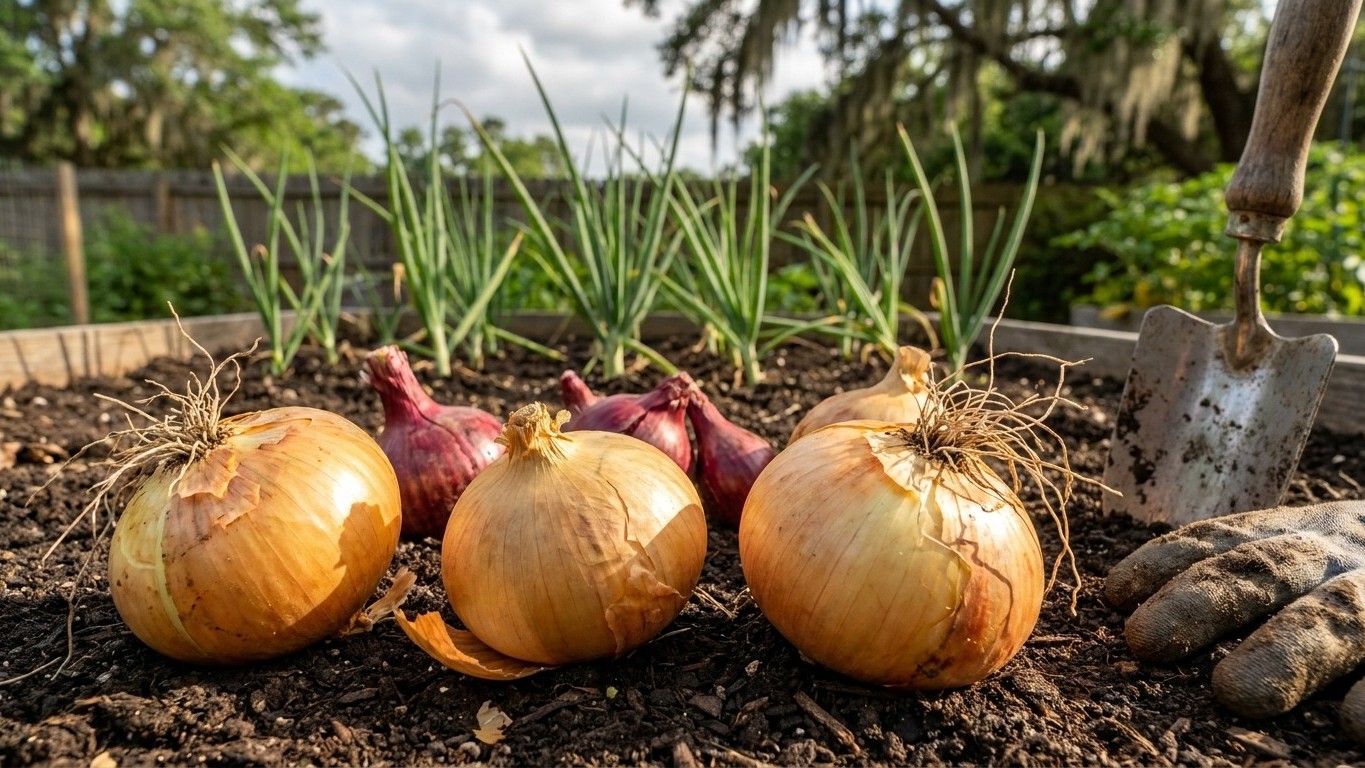

Short-day onions bulb reliably in South Carolina. Long-day onions won’t. The dividing line comes down to one number: how many hours of daylight the state gets on its longest day of the year, measured against what each variety needs to stop growing leaves and start forming a bulb. Near Charleston, that number is 14 hours and 10 minutes, and it rules out most of the onion varieties sold in northern seed catalogs.
How long your longest day is

Charleston sits at 32.90 degrees north latitude, and on the summer solstice, the sun is up there for 14 hours and 10 minutes. That single fact decides which onions will bulb in a South Carolina garden and which ones will just sit there making leaves. Onions don’t respond to heat the way tomatoes or peppers do. They respond to day length. A short-day variety starts forming a bulb once it senses roughly 12 hours of daylight, which happens early in the season practically everywhere, including here. An intermediate-day variety waits for something closer to 13 to 14 hours, which South Carolina’s early summer supplies without trouble. A long-day variety needs 14 to 16 hours, a threshold the Lowcountry and Midlands never cross, no matter how long the growing season runs or how good the soil is.
At 14 hours and 10 minutes, South Carolina lands squarely in short-day and intermediate-day territory. That’s the entire logic of this page in one sentence: buy for day length, not for the pretty picture on the seed packet. Getting the timing right matters just as much as the variety, so see When to Plant Onions in South Carolina for planting dates based on this same day-length logic.
South Carolina is not one latitude
The 32.90N figure belongs to Charleston specifically, and it’s worth remembering that South Carolina stretches well beyond that single point. The coastal Lowcountry sits at the southern edge of the state, while the Upstate, up toward the Blue Ridge foothills, sits several degrees farther north. That difference matters more than most gardeners assume. A gardener growing in Greenville or Spartanburg gets measurably more summer daylight than one in Charleston or Beaufort, which can shift an intermediate-day variety from “reliable” to “borderline” or push a variety near the edge of its range into safer territory. If you garden well north of Charleston, look up your own latitude before trusting any number on this page as gospel for your yard.
Which varieties bulb in South Carolina
Eleven varieties documented on this site have a published latitude range that covers 32.90N, which means they’re built for exactly this kind of day length. For a deeper look at these picks, see The Best Onion Varieties for South Carolina. They include:
- Elsye (intermediate-day, 32-45N)
- Expression (intermediate-day, 32-45N)
- Gabriella (short-day, 20-35N)
- Madalyn (short-day, 20-35N)
- Red Rock (short-day, 30-36N)
- Red Sensation (short-day, 25-35N)
- Scout (intermediate-day, 32-46N)
- Sierra Blanca (intermediate-day, 32-45N)
- Texas Grano 1015Y (short-day, 25-35N)
- Vidora (short-day, 25-35N)
- White Castle (short-day, 30-38N)
Gabriella, Madalyn, Red Rock, and White Castle don’t have their own pages on this site yet, but their published ranges cover this territory just the same. One more variety, Candy (intermediate-day, 33-40N), sits close enough to the boundary that it falls into a blurred zone rather than a clear yes. Candy may bulb reasonably well around Charleston, but a gardener planting it there is working at the edge of its range, not comfortably inside it.
Now the list that actually matters most, because it’s the one that explains a failed garden. Nineteen varieties documented on this site are published for latitudes above 32.90N and will not bulb in South Carolina: Ailsa Craig, Barolo, Blush, Bridger, Cabernet, Calibra, Frontier, Monastrell, New York Early, Patterson, Powell, Red Carpet, Red Long of Florence, Red Long of Tropea, Redwing, Rossa di Milano, Safrane, Talon, and Walla Walla Sweet.
If any of those names look familiar, there’s a reason. They’re common on seed racks nationwide, including in stores that stock the same inventory for every zip code. Plant one of them in a South Carolina garden and the pattern is almost always identical: strong, healthy-looking tops all spring, no bulb swelling at the base by early summer, and then a slow collapse into rot as the plant runs out of season waiting for a day length that never arrives. It isn’t a small onion. It’s no onion at all.
When to plant onions in South Carolina
Because South Carolina’s mild winters put it in short-day and intermediate-day territory, the planting calendar here looks nothing like it does in states where onions go in during late winter. Gardeners in this climate plant in fall, growing a small, hardy set of leaves through the cool months and letting the plant resume growth as days lengthen in late winter, well ahead of the solstice trigger that decides bulbing.
NOAA’s 1991-2020 climate normals for the Charleston-area station put the average first fall freeze between November 20 and December 5, and the average last spring freeze between February 28 and March 17. Those windows work as a planting frame: onion sets or transplants typically go in during October or early November, giving the plants enough of a head start before the coldest stretch, then coasting through winter with minimal fuss before bulking up in spring.
Those frost dates deserve a caveat, though. They’re averages built from three decades of data, not guarantees for any single year. A 30 to 70 percent freeze probability band means exactly what it sounds like: some years bring frost well outside that window, and a gardener who plants strictly by the calendar can still get caught by an early cold snap or a late one. It’s also worth remembering that the Charleston station represents the airport, not the peninsula itself, which tends to run noticeably milder. Gardeners in the Upstate face a tighter, earlier-ending window on both ends, sometimes by several weeks, so the fall planting date should shift earlier and the spring safety margin should shift later the farther inland and upland the garden sits.
Watching local forecasts in the two weeks around planting still beats trusting a 30-year average to predict a specific October or November.
Sweet onions or onions that keep
South Carolina gardens are built to produce sweet onions, not onions that last through winter, and the reason has nothing to do with skill or luck. It’s chemistry. The bite in a pungent onion comes from volatile sulfur compounds, and those same compounds are what make a bulb resistant to rot in storage. Varieties bred to be mild have fewer of these compounds, which makes them better eaten fresh but far less capable of surviving weeks in a pantry. According to University of Missouri Extension’s guide on growing onions, sweet onions do not store as well as more pungent types, as a general rule.
Short-day and intermediate-day varieties, the ones that actually bulb at South Carolina’s latitude, tend to run sweeter for exactly this reason. Long-day onions, the kind that need 14 to 16 hours of summer daylight and thrive in northern gardens, build up more of those sulfur compounds and keep for months as a result. That trade-off tracks day length almost perfectly: shorter days produce sweeter, softer onions; longer days produce sharper onions built for the root cellar.
What that means practically for a South Carolina kitchen is worth being honest about. A harvest of short-day onions from a Charleston or Midlands garden will taste great sliced raw on a sandwich in June, but it won’t still be sitting in good shape on a pantry shelf by March. These onions are for eating within a few weeks to a couple of months of harvest, not for stockpiling through winter. A gardener who wants both a sweet summer onion and a bulb that lasts into next year is asking two varieties to do one variety’s job, and no amount of soil prep or watering changes that. The honest plan is to grow short-day onions for fresh eating through summer and fall, and treat any leftovers as a bonus rather than a stockpile.