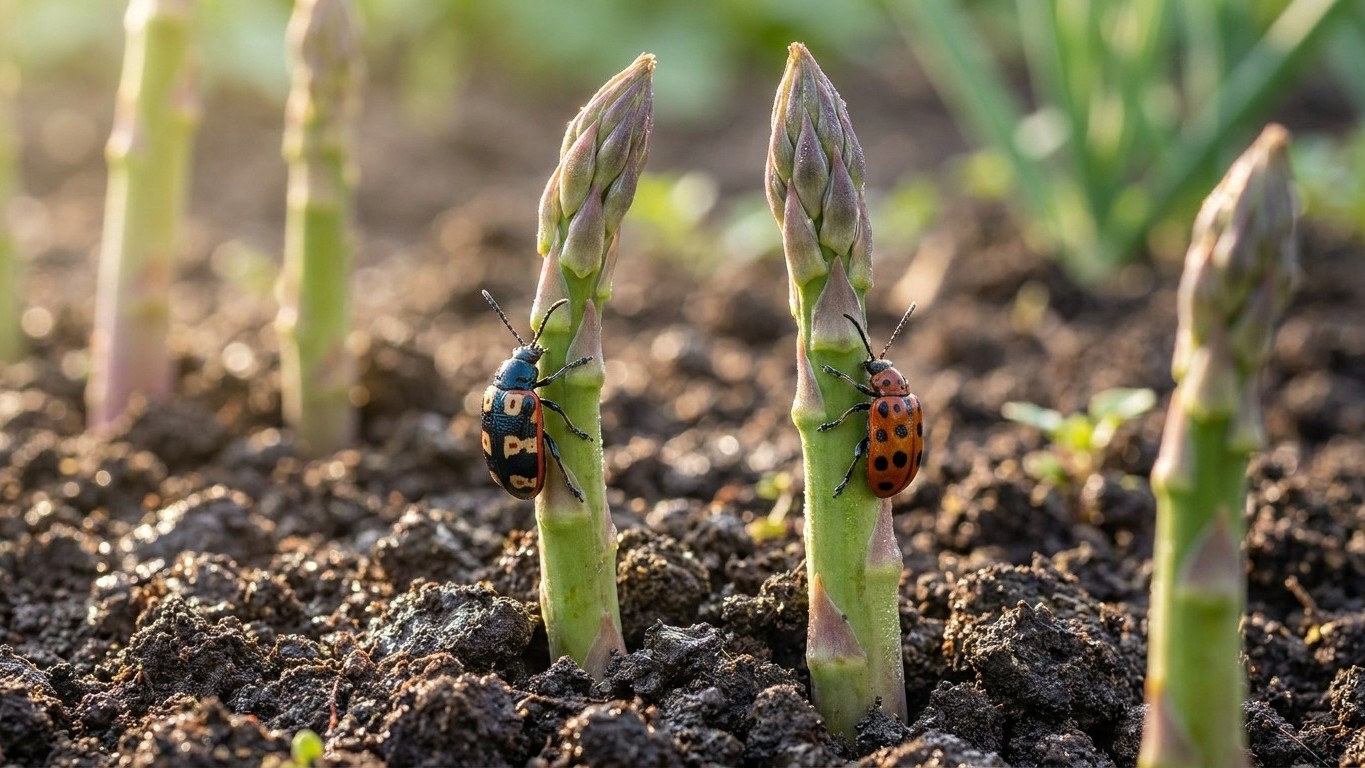

Nothing in the sources behind this page ties a specific insect or disease to a specific month in Mississippi, so there is no honest pest calendar to hand you here. What those sources do pin down is what decides whether anything gets a chance at your plants: a bed that stays put for 10 to 15 years, needs drainage, takes water on a schedule, and goes in around the last spring frost. The sections below cover those three. For pest timing in your county, ask your local Extension office.
The short answer
A planted asparagus bed is a fifteen-year decision. The crowns go into furrows 8 inches deep, nothing is harvested until year 3, and after that the bed produces for 10 to 15 years. Utah State University Extension, the authority behind this page, sets one condition on the soil: it must be well drained. Most soils will do, provided they are. So the question for Mississippi is whether the ground drains, and for the dominant soil the answer is yes, with a caveat that matters.
What the state soil tends to do
Mississippi’s official state soil is the Natchez series, named by state law and tracked by the USDA’s Natural Resources Conservation Service. It is an Inceptisol, a young soil that has not yet developed strong horizons. The surface layer runs loam to silt: 5 percent sand, 13 percent clay and 82 percent silt, with organic matter around 1.8 percent. USDA classes it as well drained. Those are representative values for the surface of the major components of the series (31 mapped components in all), not a measurement of a worked garden bed.
The same record puts the surface pH at about 6.2, slightly acid. Treat that as a description of the series, not of your plot. The source we rely on is silent on pH, so no target number appears here. A soil test gives you your own.
If your ground does not drain
The state soil is a starting point, not a diagnosis. A state has hundreds of soil series, and river bottoms, hill country and any lot a builder has scraped or filled can behave nothing like Natchez. Elsewhere in the garden, a heavy soil is an annual nuisance you amend each season. With asparagus it is a decision you cannot undo, because the crowns stay where you put them.
Check before you dig the furrow. Fill a test hole with water and watch how long it stands. If the water lingers, you have three honest options: pick a higher corner of the yard, build the bed up above grade with loose soil, or give asparagus a pass and grow something you replant each year. Our piece on whether Mississippi soil will hold an asparagus bed for fifteen years walks through the soil question in more detail, and the overview, Growing Asparagus in Mississippi, ties the whole cycle together.
Will the summer here water it for you?
Mostly, yes, on paper. The bed wants 1 to 2 inches of water every other week for the first two years, then every three weeks after that. Mississippi’s summer comes close to covering the first schedule by itself, but averages hide a lot.
What a normal summer delivers
At the reference weather station used for this series of pages, June, July and August together average about 14.1 inches of rain, out of 57.4 inches for the full year. June is the driest of the three at 4.43 inches, followed by August at 4.69 and July at 5.02. Spread evenly, June alone works out to a bit over 2 inches per two-week stretch, which is already at the top of what a young bed asks for.
Evenly is the catch. Summer rain here often arrives as a single thunderstorm, and a hard downpour on hot ground runs off more than it soaks in. Days at or above 90°F also pull moisture out of the soil quickly. These are 30-year normals for one station, not a forecast and not your yard. A slope, a city heat pocket or a patchy storm track can give your plot half of what the airport got.
A watering routine that follows the gauge
- Put a rain gauge on the plot itself. It is the only number that settles the question for your bed.
- In years one and two, check the gauge every other week through the growing season. If it shows less than 1 inch over that stretch, water to make up the difference, aiming for 1 to 2 inches in total.
- After the second year, run the same check on a three-week cycle instead.
- After a heavy storm, read the gauge but also dig down a few inches. If the soil under the surface is still dry, the storm mostly ran off and does not count toward your total.
- In a stretch of 90°F days, shorten the interval rather than waiting out the full two or three weeks.
On a mostly silt soil like Natchez, which sits between quick-draining sand and slow-holding clay, expect the water to stay available a while after a soaking. Whether your own soil does is something the gauge and the test hole will tell you better than any normal.
When to put the crowns in
Early spring, once the worst of the freezes are behind you. For the reference station, the last spring freeze at 32°F falls around March 6 to March 22, which is the 30 to 70 percent probability band in the federal climate normals from NOAA. That is an average, so some years it comes earlier and some years later.
Around the last frost
Those dates come from an airport station. Suburban and rural gardens usually see the last spring frost later than the airport, often by one to two weeks, and more at higher elevation. If your plot sits on a ridge or in a cold hollow, push your expectations back accordingly, and check the frost dates for your own county before you mark the calendar. The full timing discussion lives in When to Plant Asparagus Crowns in Mississippi.
Once the crowns are in the 8-inch furrow, the furrow does not get filled all at once. You backfill gradually through the year, 2 inches every other month, so the growing shoots are never buried under a full load of soil.
The seed route and what the sources leave out
Seed is the alternative to crowns. The source used here gives its schedule for crowns, and it does not publish a seed-sowing date or a seed timeline, so none is invented here. Follow the seed packet and your county frost dates.
On varieties, four are named, with only their sex published. Jersey Giant and Jersey Knight are all-male. UC 157 F1 and Purple Passion are male and female. The source says nothing about flavor or yield, and gives no reason to prefer one over another, so any ranking you read elsewhere is not coming from this page.
Common questions
What eats asparagus in Mississippi, and when?
The sources behind this page do not publish a pest list or a month-by-month calendar for the state, so none is given. Your county Extension office is the right place to ask. What this page can confirm is the timeline of the investment: the bed is not harvested until year 3, so anything that damages the crowns early costs you years, not weeks.
Is Mississippi’s state soil good for asparagus?
The Natchez series is well drained, which is the one condition the source sets. But it represents the state, not your yard. Run a soil test and a drainage check on your own plot before you commit to fifteen years.
When can I start harvesting, and when do I stop?
Not until year 3. Then harvest for 4 weeks, the following year for 6, and after that for 8. Do not soften that into taking a few spears early. The stopping rule is an object, not a date: quit when most of the spears are thinner than a pencil.
How should I store cut spears?
The target is 32 to 35°F with near-saturated air (95 to 100 percent humidity). Above 50°F, spears toughen within hours. Near 31°F or lower they freeze, turn water-soaked and collapse as they thaw. In a home kitchen, the practical version is standing the cut ends in water in the refrigerator, because spears lose moisture through the cut end faster than anywhere else, per the UC Davis Postharvest Technology Center.