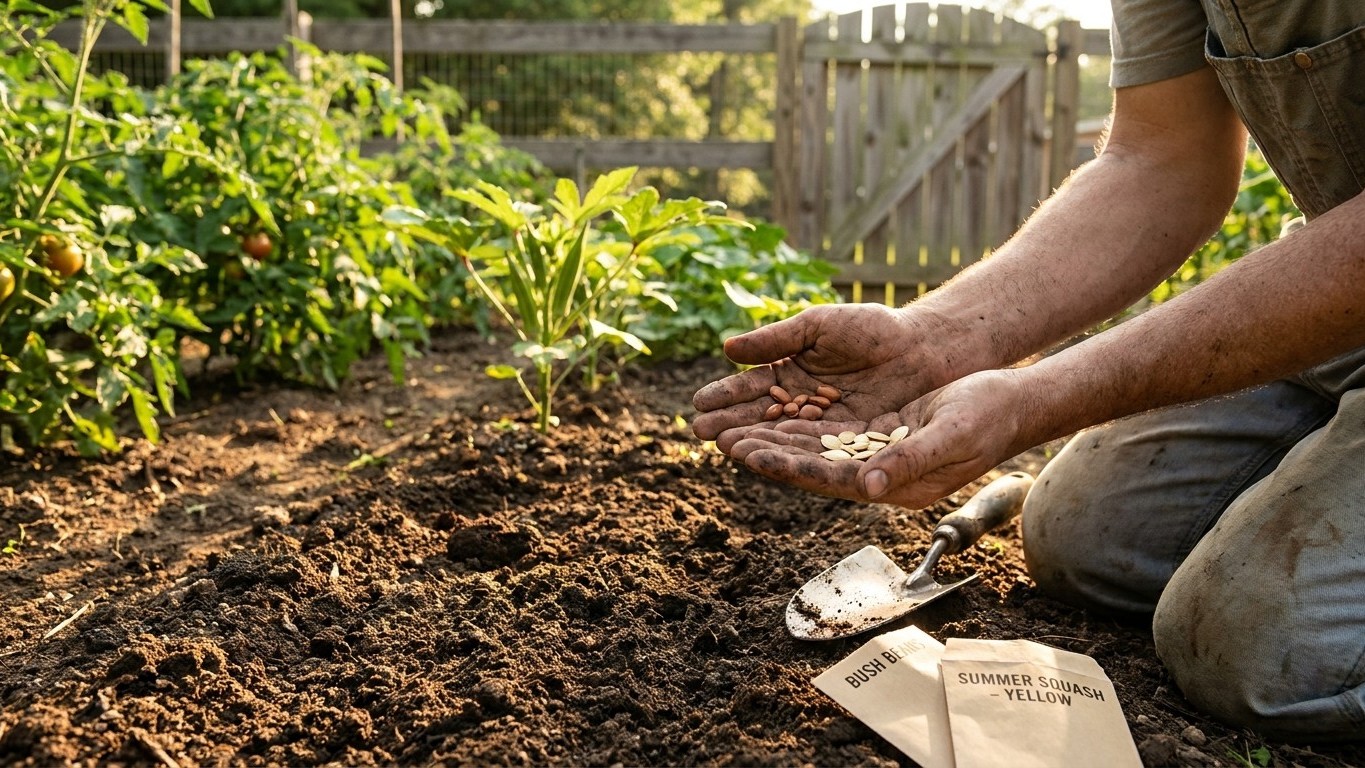

August in Mississippi is fall-garden month. The state sits in USDA hardiness zones 7b to 9a, and the first fall frost lands somewhere between November 7 and November 22 at the reference weather station. That gives roughly ten to twelve weeks of warm soil left, enough to direct-sow beans and squash early in the month and to start the cole-crop transplants that will carry the garden into winter.
What goes in the ground in August

Forget the calendar for a second. What decides whether a seed goes in the ground now is arithmetic: days to maturity, counted backward from that November frost window, not the date on the wall. Mississippi soil in August is hot, often above 85°F at planting depth, which is exactly what warm-season seeds want and exactly what makes brassica seedlings sulk if they’re started in the open without shade.
Bush beans and summer squash still have time if they go in during the first half of the month. Both mature in under 60 days, which leaves a comfortable margin even against the early end of the frost range. Okra can go in early August in the southern half of the state, less reliably farther north where the growing window is tighter. From mid-August on, the ground shifts toward fall greens: turnips, mustard, collards and kale can all be direct-sown straight into the garden bed, since they tolerate the lingering heat better as seedlings than lettuce or spinach do.
Crops that work by planting method
| Crop | Typical days to maturity | Best window this month |
|---|---|---|
| Bush beans | 50-55 days | First half of August |
| Summer squash | 45-55 days | First half of August |
| Okra | 55-60 days | Early August, southern MS |
| Turnips | 40-55 days | Mid to late August |
| Collards | 60-75 days | Mid August |
| Mustard greens | 30-45 days | Late August |
Skip anything that needs more than 70 or 80 days unless it’s already growing as a transplant. Sweet corn, pumpkins for a large fall harvest, and long-season melons are gambles this late; the arithmetic just doesn’t leave enough runway before frost shuts things down.
What to start under cover
The transplants that make a Mississippi fall garden work don’t start in the ground, they start in trays or in a shaded nursery bed, and the timing is worked out backward from the frost window rather than forward from today. Broccoli, cabbage, cauliflower and Brussels sprouts need four to six weeks as transplants before they go into the garden, and they need another 60 to 80 days in the ground after that to reach harvest.
Add it up from the early end of the frost range, November 7, and the math gets tight fast: six weeks of transplant time plus 70 days in the ground is roughly 15 to 16 weeks, which pushes the seed-starting date into July for some varieties. Starting broccoli or cabbage seed in early to mid-August still works for the shorter-season varieties, and it lines up with when the worst of the summer heat starts to ease enough for seedlings to survive outdoors without daily babysitting.
The two ways this goes wrong are mirror images of each other. Start too early in the blazing heat of early summer and the seedlings sit in cell trays too long, become rootbound, and stall out once transplanted, never really recovering their vigor. Start too late and the plants are still small when the first frost range arrives, leaving heads that never fill out. Shade cloth over the seed trays for the first two weeks solves most of the early-start problem; a hard date on the calendar, worked backward from the frost window rather than guessed at, solves the late-start one.
What is ready to pick
August is peak harvest for most of the warm-season garden. Tomatoes, peppers, eggplant, okra, cucumbers, summer squash and southern peas are all coming in steadily, and the trick with several of them is picking often enough to keep the plant producing rather than letting a few oversized fruits shut it down. Okra pods past four inches turn woody fast; check the plants every day or two in peak heat, since growth can outrun a twice-a-week schedule.
Sweet corn planted earlier in the season should be finishing up, and the tell is the silk: brown and dry, with the kernels releasing a milky liquid when pierced with a thumbnail. Melons signal ripeness with a duller rind color and a hollow sound when thumped, along with the tendril nearest the fruit drying out completely.
Garlic and onions harvested and cured earlier in the summer should be checked now for any bulbs going soft in storage. Pull those out before they spread rot to the rest of the batch. Sweet potatoes are still weeks away from digging, but it’s worth checking vines for the telltale cracking soil that signals tubers sizing up underneath.
The jobs that matter this month
Watering rhythm matters more in August than in any other month in Mississippi. Deep, infrequent watering, roughly an inch a week delivered in one or two sessions rather than a light daily sprinkle, encourages roots to grow down instead of staying shallow and vulnerable to the next dry stretch. Container plants and new fall transplants need closer attention, sometimes daily, since their root systems haven’t had time to establish.
Mulch is doing double duty right now, holding soil moisture and keeping root zones several degrees cooler than bare dirt exposed to direct sun. A two- to three-inch layer of straw or shredded leaves around tomatoes, peppers and newly seeded fall crops pays off within days, not weeks.
Pest pressure peaks alongside the heat. Squash vine borers leave a small hole and a pile of frass near the base of the stem; catching it early means slitting the stem and removing the larva before the whole plant collapses. Armyworms and stink bugs show up on everything from corn to peppers, and a quick scouting walk every few days catches an infestation before it spreads across a bed. Succession sowing keeps the harvest coming: another round of beans or squash seed dropped in every two to three weeks through early August extends the picking season well past what a single planting could manage. Staking and caging tomatoes and peppers before they sprawl also saves fruit that would otherwise rot on wet soil.
What not to do in August
The most common mistake this month is trusting the calendar over the soil and the frost window. Gardeners sometimes hold off starting fall brassica transplants because it still feels like the middle of summer, then run out of runway when the first frost range arrives in early to mid-November and the cabbage heads are the size of a fist. Starting on the arithmetic, not on how the weather feels, avoids that.
Direct-sowing tender seedlings like lettuce or spinach into full, unshaded August sun is another version of the same error. The soil surface can run well above what those seeds need to germinate, and they either fail to sprout or come up weak. A shade cloth or a spot with afternoon shade solves it; waiting for October doesn’t, because by then the transplant window for some fall crops has already closed.
Heavy nitrogen fertilizer applied late in the season to tomatoes or peppers pushes leafy growth at the expense of fruit set, right when the plant should be finishing its production cycle rather than starting a new flush of foliage. Switch to a lower-nitrogen, higher-phosphorus and potassium feed once plants are fruiting heavily. And don’t let a few days of lighter heat convince you to skip the deep watering; a dry spell that stresses tomatoes right as fruit is sizing up is a common cause of blossom end rot.
Checking this against your own county
Every date in this article comes from one reference weather station, and Mississippi runs roughly 340 miles from the Tennessee line to the Gulf Coast. That’s enough distance for the first fall frost to arrive noticeably later along the coast than it does in the northern hill country, and for soil temperatures to run warmer in the Delta than at higher elevations near the state’s northeastern corner. Treat the frost window here as a starting point, not a guarantee for a specific backyard.
The Mississippi State University Extension Service publishes county-level planting guidance that accounts for these regional differences. It’s worth checking against the state-wide dates above before locking in a fall garden schedule.
Common questions
Is it too late to plant tomatoes in Mississippi in August?
For a full-size slicing tomato, yes, in most of the state. Standard varieties need 70 to 85 days to fruit, which leaves little margin against the November frost window. Fast-maturing cherry or determinate varieties started as transplants in the first week of August can still produce a crop in the southern half of the state.
Can I still direct-sow squash in August in Mississippi?
Yes, if it goes in during the first half of the month. Summer squash matures in 45 to 55 days, which comfortably beats even the early end of the November frost window. Watch closely for squash vine borer, which is especially active in late summer.
What fall vegetables should I start indoors in August?
Broccoli, cabbage, cauliflower and Brussels sprouts are the main candidates. Start seed in trays with some afternoon shade, and plan on four to six weeks before the seedlings are ready to move into the garden.
Why do my August seedlings keep dying in Mississippi heat?
Soil surface temperature is usually the culprit, not lack of water. Direct sun on bare soil in August can push surface temperatures well past what tender seedlings can handle. Shade cloth for the first one to two weeks after germination, along with consistent moisture, solves most of this.