
Knowing When to Plant Asparagus Crowns in Maryland matters, but the bed you plant now is one you’ll still be harvesting from more than a decade out, since a well-sited planting keeps producing for 10 to 15 years once it’s established. In Maryland, Will Maryland Soil Hold an Asparagus Bed for Fifteen Years? comes down to a single question that has nothing to do with frost dates or hardiness zones: does the ground you’re choosing actually drain.
The short answer
Once crowns go into the ground, they aren’t coming back out. Asparagus roots knit into a dense mat over the years, and as long as the soil under that mat drains, the plant keeps sending up spears season after season without being touched by a shovel. Utah State University Extension names only one hard requirement for the spot you pick: whatever soil is there, it has to drain. Not a particular texture, not a particular pH, not a particular fertility level. Just drainage.
Maryland’s official representative soil, the Sassafras series, happens to answer that requirement well. USDA NRCS data on the surface horizon of the series show it running about 67 percent sand, 10 percent clay and 23 percent silt, with organic matter near 1.6 percent and a surface pH around 5.3, which counts as strongly acid. That much sand, with clay held to a minority share, is exactly the texture that lets water move through rather than sit. NRCS classifies the series as well drained, and a bed dug into ground built like that shouldn’t stay wet for long after a storm.
But Sassafras is the soil USDA picked to represent the whole state, not a survey of what’s under any one garden. Maryland runs from tidal flats on the Eastern Shore to old river floodplains to whatever a builder pushed back over a foundation, and none of that has to resemble the sandy loam described above. A yard sitting on a clay pan a foot down, or on fill dirt, can hold standing water for days no matter what the state’s representative soil does.
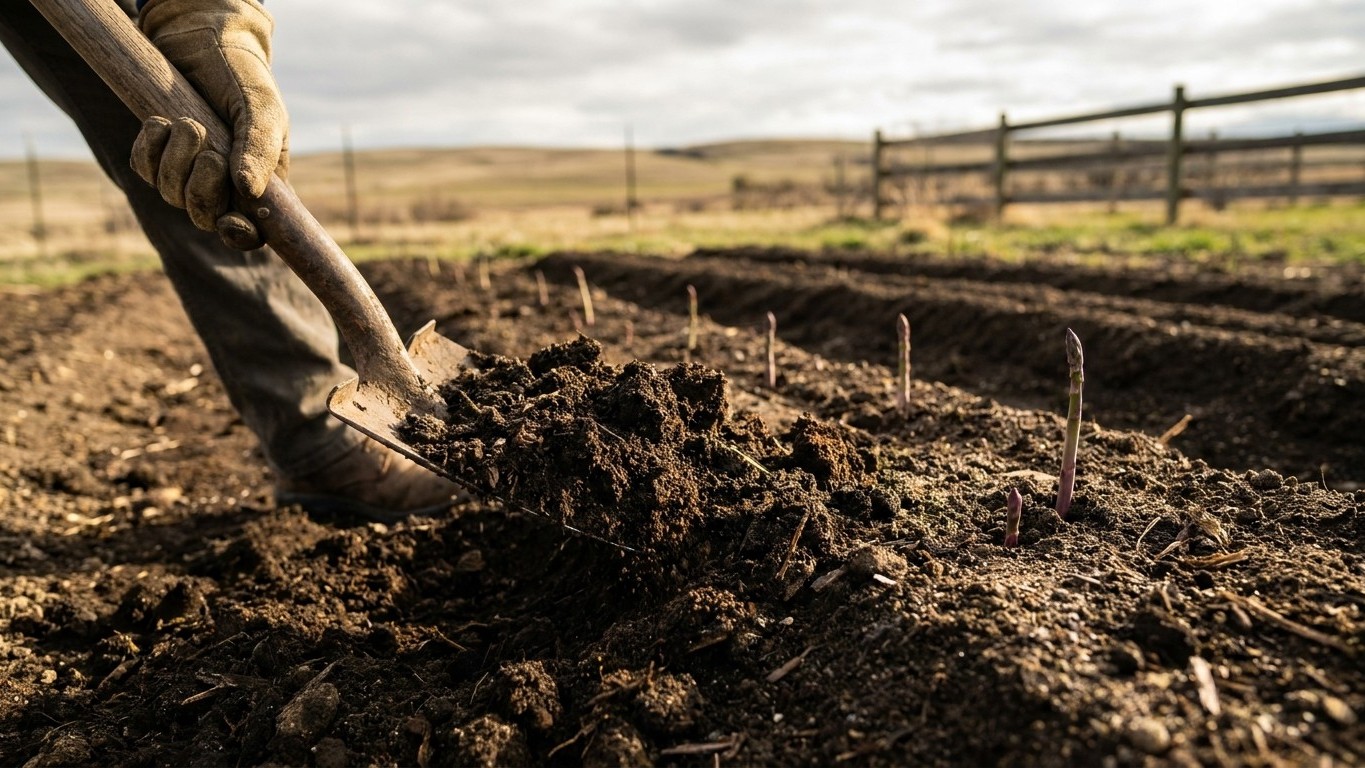
That gap is what a shovel and a bucket of water settle, and a soil map never will. Dig a hole a foot deep, fill it with water, and check back in several hours. If it’s still standing, the ground drains too slowly for a planting meant to outlast most home appliances. The answer isn’t to give up on the spot, it’s to raise it: mounding the planting furrow into a raised bed lets the crowns sit above a stubborn water table even while the native soil underneath stays heavy, the standard workaround wherever asparagus goes into clay ground.
The other number worth sitting with before digging: nothing gets cut the first two years. Harvest starts in year three, and even then it’s brief, about four weeks of spears before the plant needs to grow ferns and rebuild itself for the rest of the season. Year four stretches that window to about six weeks, and from year five on it settles near eight weeks a season. The rule for when to stop cutting in any given year isn’t a date, it’s the spears themselves: once most of what’s coming up runs thinner than a pencil, cutting stops for the season, whatever the calendar says.
Will the summer here water it for you?
Utah State University Extension’s watering guide doesn’t change by region: a newly planted bed wants one to two inches of water every other week through its first two growing seasons, and an established bed can stretch that to about the same one to two inches every three weeks. Maryland’s climate normals give a rough read on whether the sky covers that on its own, and the honest answer is usually, but not evenly.
- What the bed asks for. One to two inches every other week works out to roughly two to four inches a month while a bed is young, and closer to one and a half to two and a half inches a month once it’s established and watering has stretched to every three weeks.
- What Maryland’s summer delivers. NOAA’s 1991-2020 normals for the reference station put June rainfall at 3.98 inches, July at 4.48 inches, and August at 4.09 inches, for a three-month total near 12.6 inches, averaging close to 4.2 inches a month.
- Where that lands. On paper, 4.2 inches a month sits inside the young bed’s two-to-four-inch range and comfortably above the mature bed’s one-and-a-half-to-two-and-a-half-inch range, meaning an established Maryland bed could, in an average year, get by on rainfall alone.
- Why “on paper” isn’t the whole story. Normals average thirty years of weather, not any single July, and June, the driest of the three summer months at 3.98 inches, is also when a newly planted bed most needs steady moisture to survive its first season. Rain that arrives in one heavy thunderstorm mostly runs off a sandy surface rather than soaking into the root zone, and days at or above 90°F pull moisture out of the top few inches faster than a monthly total suggests.
- What that means at ground level. A rain gauge on the actual bed, not a regional average, is what decides whether a given two-week or three-week stretch needs a hose. Take the Maryland normals as a reason not to worry constantly about watering, not as a reason to stop checking.
When to put the crowns in
Crowns go into the ground in early spring, planted into furrows dug about eight inches deep, according to Utah State University Extension. The furrow isn’t filled back in all at once. Soil goes back over the crowns gradually, in roughly two-inch increments added every other month across the growing season, rather than in one pass at planting time.
“Early spring” only means something once it’s checked against when the ground actually stops freezing. NOAA’s 1991-2020 climate normals put the mean last spring frost for the reference station somewhere around April 3 to April 16, a range rather than a single date, since a thirty-year average always carries spread around it. That window shifts hard depending on where in Maryland you’re standing. Garrett and Allegany counties, up in the mountains, run weeks behind that date, while the Eastern Shore tends to warm earlier and milder. Treat the April window as a starting point for your county, not a date to circle.
Seed is the other way in, for gardeners willing to trade cost for patience. Starting from seed adds a full growing season on the front end, since seedlings need time to grow into crowns before they’re large enough to set out the way a purchased crown goes in directly. That means the year-three harvest countdown effectively begins a year later than it would starting from crowns.
On variety, Utah State University Extension names four cultivars, sorted only by which sex of plant they carry, with no flavor or yield ranking attached to any of them:
| Variety | Type |
|---|---|
| Jersey Giant | All-male |
| Jersey Knight | All-male |
| UC 157 F1 | Male and female |
| Purple Passion | Male and female |
All-male varieties are bred to put energy into spears rather than seed production, but the source doesn’t publish a reason to favor one named cultivar over another, and no nursery is named here either. That choice comes down to what’s available where you’re buying crowns, not a documented performance gap.
Checking this against your own county
Every figure above, the frost window, the rainfall normals, the soil description, comes from one reference station and one representative soil series standing in for a state that stretches from Chesapeake tidewater to Appalachian ridge. Neither is a measurement of your particular yard.
University of Maryland Extension is the state’s land-grant extension service, and it exists for exactly this gap between statewide data and one specific garden. Its soil testing program returns an actual pH and nutrient reading for your bed rather than the state soil’s representative number, and its county offices track local frost patterns that one weather station thirty miles off can miss entirely. Before committing a spot to fifteen years of asparagus, a call to University of Maryland Extension at extension.umd.edu is what turns a regional average into a decision about your own ground.
Common questions
How long before an asparagus bed in Maryland starts producing? Nothing is cut the first two years. Harvest begins in year three for about four weeks, extends to about six weeks in year four, and settles near eight weeks a season from year five on. Stop cutting for the year once most spears run thinner than a pencil.
Does Maryland’s soil naturally drain well enough for asparagus? The state’s representative Sassafras soil is sandy and well drained, but that’s a statewide average, not a guarantee for any one lot. A simple hole-and-water drainage test tells you where your own ground stands, and a raised, mounded bed handles the spots that don’t drain fast enough.
What if my county’s frost date is different from the April 3 to April 16 window? It probably is. That range comes from one reference station, and Garrett and Allegany counties in western Maryland run weeks later while the Eastern Shore tends to run milder. Local extension records are the better source for your own planting date.
Which asparagus variety grows best in Maryland? No source ranks one over another. Jersey Giant and Jersey Knight are all-male hybrids; UC 157 F1 and Purple Passion include both male and female plants. The published information covers plant sex, not flavor or yield differences between them.