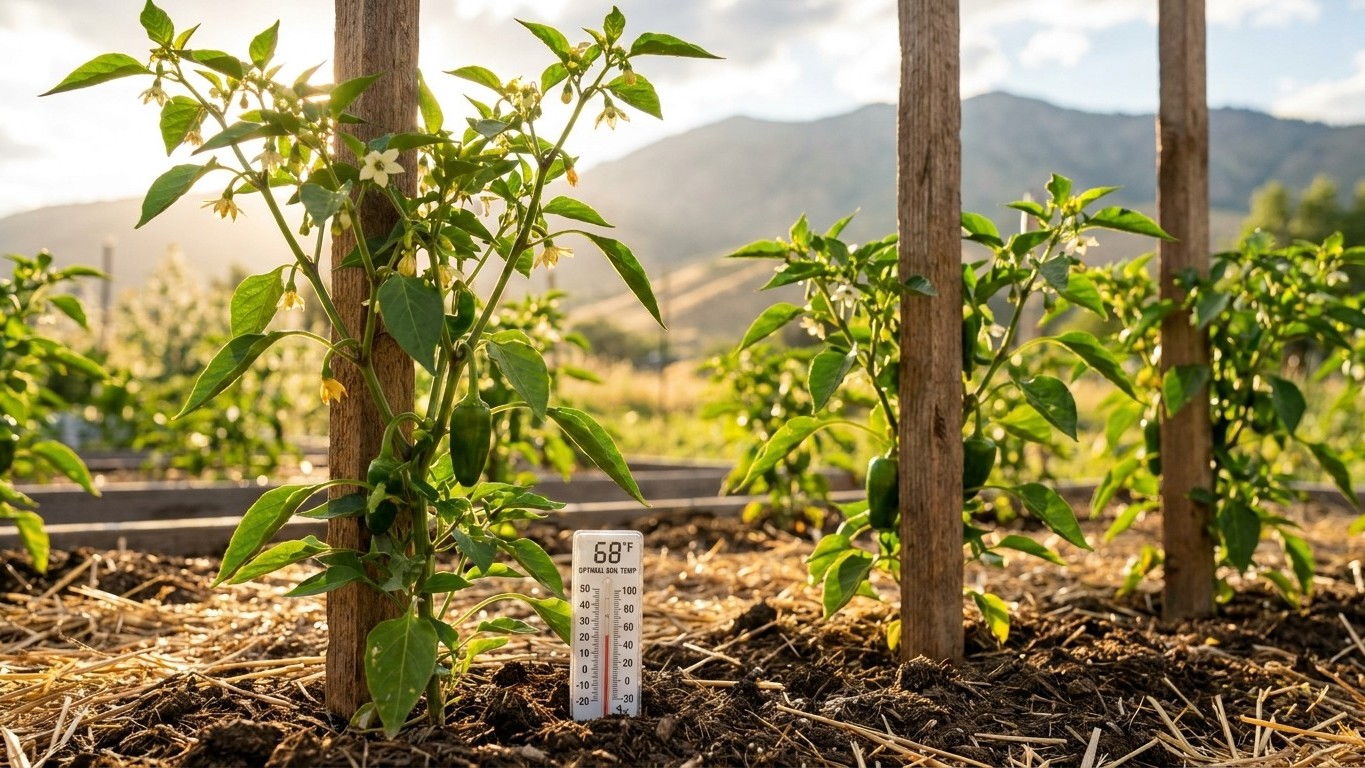

Missouri’s frost-free window runs long enough for most pepper types to ripen, but the calendar isn’t the limiting factor. Fruit set is. A pepper plant can be healthy, green, and loaded with blossoms and still drop every one of them if the weather swings too far in either direction during flowering. Getting a full harvest here means managing that narrow temperature band, not just picking a variety and hoping.
The short answer

Start with the heat side, because that’s the one Missouri gardeners actually measure year after year. The reference station at Kansas City averages 32.7 days a year at or above 90 F, based on NOAA’s 1991-2020 Climate Normals. That’s not an occasional hot afternoon. It’s better than a full month of the growing season spent at temperatures that stress pollen viability. Peppers flowering during those stretches often set poorly or not at all, even on plants that look perfectly healthy. The blossoms open, but the pollen doesn’t function the way it should at that heat, and the flower drops instead of forming fruit.
That 32.7-day figure matters because it tells you the heat load isn’t a rare event to plan around. It’s a recurring feature of a Missouri summer, usually clustered in July and into August, and it will overlap with peak flowering for anything transplanted on a typical spring timeline. Gardeners who see healthy plants stall out in midsummer are usually watching this exact mechanism play out, not a disease or a nutrient problem.
The other end of the window gets far less attention, but it fails fruit set just as reliably. Nights that drop below 55 F stop pollen from developing properly, and the plant responds the same way it does in extreme heat: flowers form, then drop, with no fruit behind them. This shows up most often at the shoulders of the season, in a cool stretch right after transplanting or during an early cold snap in fall.
Here’s the part that matters for planning: this site tracks days at or above 90 F for Missouri, but it does not carry summer night minimum temperatures. There’s no reliable way to state a general nighttime figure for the state, because it varies by county, by elevation, and by how close a garden sits to a river valley or an open field. Don’t estimate it from latitude, and don’t assume the coldest month of the year tells you anything about a summer night. The only dependable method is watching an actual thermometer at your own garden site through the flowering weeks, particularly right after transplant when a late cool snap is still possible.
Put together, the “short answer” is this: pepper varieties ripen in a Missouri season when their flowering period avoids both extremes, which means timing transplant so that flowering falls after the last cool nights pass and, as much as possible, working around the hottest stretch of days rather than through the middle of it.
When to start seed here
The timing question isn’t about a fixed date on a seed packet. It’s arithmetic, and it starts from the back end of the calendar rather than the front.
- Find your last spring frost date. The NOAA NCEI 1991-2020 Climate Normals put Missouri’s last spring frost in the range of April 6 to April 20, based on 32 F freeze probability data. That’s a state-level range, not a single date, because Missouri covers a lot of ground. The reference station near Kansas City sits well north of downtown Kansas City, and the downtown station itself runs about five days earlier in spring. Southern Missouri tends to be milder still, so a garden near the Bootheel or the Ozark border will generally clear frost risk earlier than one near the Iowa line.
- Don’t transplant on the frost date alone. Peppers need soil at 60 F at transplant depth, not just frost-free air. Cold soil stalls root growth even when the plant survives above ground, and a stalled transplant pushes flowering later, closer to the hot stretch described above. Check soil with a simple soil thermometer a few inches down rather than guessing from air temperature.
- Set your actual transplant date once both conditions are met. That’s the later of “past your local last frost” and “soil has reached 60 F.” In much of Missouri those two conditions land close together in mid-to-late spring, but a cool, wet spring can delay the soil threshold well past the frost date.
- Count back 8 to 10 weeks from that transplant date for indoor seed starting. This is the range given by Utah State University Extension for pepper seedlings grown indoors before transplant. If your transplant date lands in the third week of April on the early end of the state range, count back 8 to 10 weeks and you land on a seed-starting window in mid-to-late February. If your local frost date runs closer to the April 20 end of the range, push the whole schedule back accordingly.
- Redo the math for your own county rather than the state range. Because the state figure spans two full weeks, and because MCI runs earlier than downtown and southern Missouri runs earlier still, use your local extension office’s frost data or your own multi-year frost log if you have one, then apply the same 8-to-10-week backward count.
The point of doing it this way, rather than picking a date off a generic chart, is that it keeps flowering timed toward the cooler shoulder of the season instead of drifting into the hottest stretch of days by accident.
What goes wrong here
- Blossom drop from a heat spell. When flowering coincides with a run of days at or above 90 F, pollen viability drops and blossoms fall without setting fruit. The plant often looks fine otherwise. The practical remedy is timing: aim transplant and expected flowering to land before the hottest stretch of midsummer takes hold, and keep soil moisture even during any hot run, since drought stress compounds the heat effect on flowering.
- Blossom drop from a cool night. The same failure shows up at the other end, when nights fall below 55 F, usually right after an early transplant or during an unseasonably cool stretch. Because this site doesn’t track summer night minimums for Missouri, the only remedy is direct observation: hold transplants a little later if a cool spell is forecast, or use row cover overnight to buffer young plants during a cold snap early in the season.
- Sunscald on exposed fruit. Missouri’s summer sun is intense enough, especially paired with those 32.7 annual days at or above 90 F, to scald fruit that loses leaf cover from disease, pruning, or wind damage. Scalded spots turn pale, then papery, and the fruit often rots from that point. The remedy is keeping foliage intact through the hottest months rather than over-pruning, and providing light shade cloth during the worst stretches if leaf loss has already happened.
- Blossom-end rot on developing fruit. This shows up as a dark, sunken patch on the bottom of the fruit and traces back to inconsistent watering rather than a soil calcium shortage in most home gardens. Uneven moisture, wet one week and dry the next during a hot spell, interrupts calcium uptake to the fruit. The remedy is even watering on a consistent schedule, with mulch to buffer soil moisture swings during the hottest weeks of the season.
Common questions
Can I direct-seed peppers instead of starting them indoors?
Peppers grown from seed need a long lead time before they can go in the ground, which is why Utah State University Extension recommends 8 to 10 weeks indoors before transplant. Direct-seeding outdoors in Missouri generally doesn’t leave enough of the season left to ripen fruit before fall frost.
How many days above 90 F does Missouri really get in a typical year?
The NOAA NCEI 1991-2020 Climate Normals put the average at 32.7 days a year at the Kansas City reference station. That’s the figure to weigh against your expected flowering window when planning transplant timing.
What if my county’s frost date is different from the state range?
Use it. The April 6 to April 20 range reflects the state as a whole; MCI’s own station runs about five days earlier than downtown Kansas City, and southern Missouri tends to clear frost earlier than the northern part of the state. Local data always beats a state-level range for planning your actual transplant date.
Do I need to track nighttime temperatures myself?
Yes, if you want to protect fruit set. This site tracks days at or above 90 F by territory but does not carry summer night minimum data, and there’s no reliable way to infer those figures from latitude or from winter temperatures. A simple outdoor thermometer through the flowering weeks is the only dependable way to catch a cool-night risk before it costs you a set of blossoms.