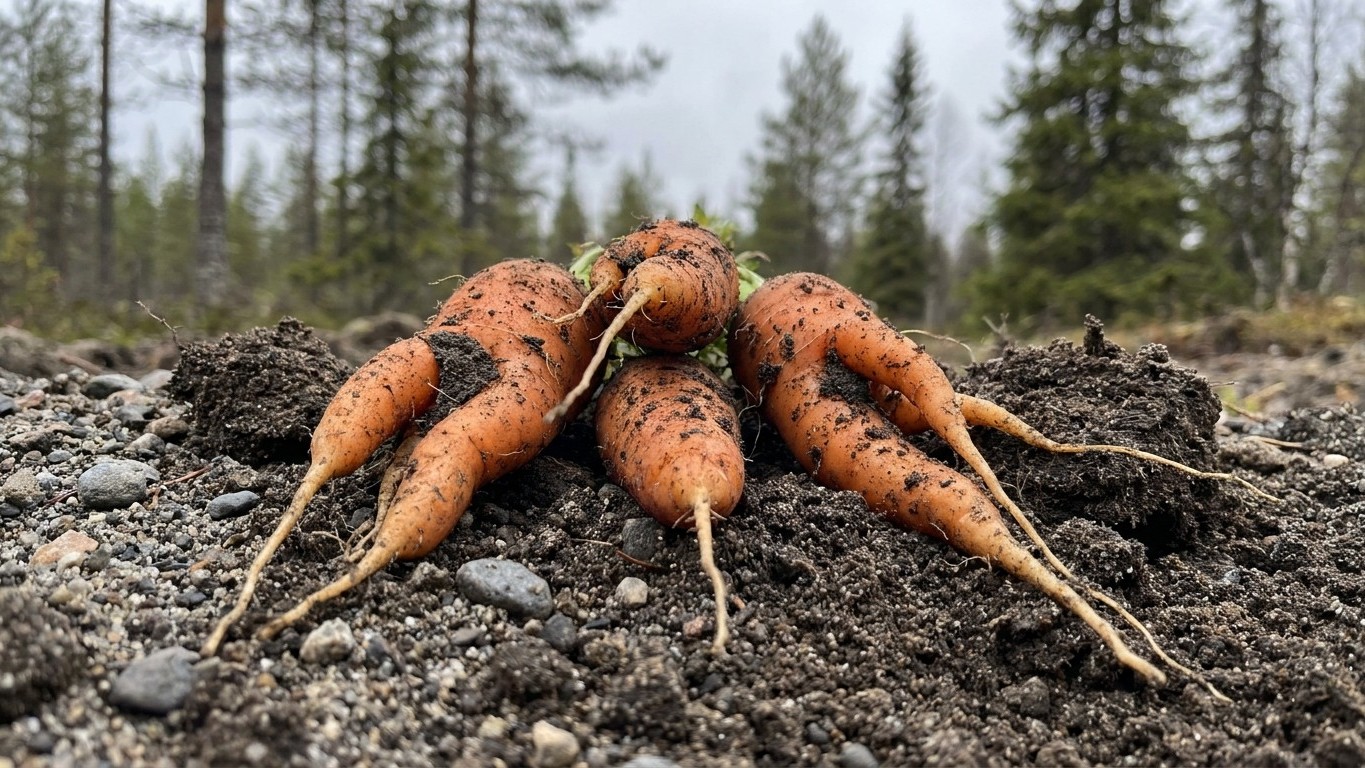

The honest answer is that the verified record behind this page does not hand over a named list of insects documented for carrots in Nebraska. What it does hand over is the state’s own soil profile and the crop’s known growing rules, which decide far more of what a home gardener finds wrong with a carrot root than any single bug does. Start there, then take symptoms to a local office for identification.
Which pests attack carrot in Nebraska
No state-specific insect inventory for carrots shows up in the sourced facts available for this page. That is worth saying plainly rather than padding out a list that was never documented here: a short or absent inventory is a fact in itself, not a gap to fill with names that sound plausible. What the record does contain is something gardeners tend to overlook when a carrot comes out of the ground twisted or stubby: the soil itself.
Nebraska’s official state soil is the Holdrege series, a Mollisol, the deep, dark prairie ground that built the Corn Belt. Its surface runs 11 percent sand, 22 percent clay, and 67 percent silt, with a pH around 6.2 and organic matter near 2.0 percent, and it drains well. That texture matters because carrots are unusually picky about the ground they grow in. Utah State University Extension is blunt about it: carrots want deep, sandy, well-drained soil rich in organic matter, and heavy or rocky soil makes the root fork.
A forked, forked-twice, or stubby carrot is frequently blamed on a grub or a wireworm when the real cause is clay content and compaction. The Holdrege series carries real clay, and any garden running heavier than that state average, or sitting on subsoil a builder has compacted or filled, pushes carrot roots to split around resistance rather than driving straight down. That is not an insect at all, and treating it as one wastes both time and money.
None of this means insects never touch a Nebraska carrot patch. It means this page cannot responsibly name species that were not documented for this territory. A reader who suspects insect feeding, rather than soil resistance, on their own roots or foliage needs a local look, not a guess dressed up as a fact. The next sections cover the timing that actually is documented, the soil-versus-insect distinction in more detail, and exactly where to send a photo or a sample for a real answer.
When each one shows up, and what it does first
Because carrots are sown directly in the ground, there is no transplant date to count from, and no frost-free window published in the facts behind this page to anchor a pest calendar against. Everything reliable here runs off the seed-to-harvest clock instead, which is exactly how the crop itself is measured. Utah State University Extension frames carrots on a 70 to 100 day cycle from seeding to maturity, and Clemson Cooperative Extension narrows harvest specifically to about 65 to 75 days after planting. Those two windows overlap rather than contradict each other, and together they set the only verified timeline available for this crop in this soil.
Early in that window, right after germination, roots are thin and still finding their way down through whatever texture the bed offers. This is when heavy or compacted ground first shows its hand: a seedling that should be pushing straight down instead meets clay resistance and starts to bend or branch. A gardener checking a young stand at this stage and seeing stunted, twisted, or unusually short roots is watching a soil problem develop, not a pest arriving, and that distinction only gets harder to make once the tops fill in and hide the row.
By the middle of the cycle, roots are sizing up, and this is the stretch where forking becomes visible without digging, since a split root often pushes the shoulder of the carrot up and sideways at the soil line. Anything a reader notices chewed on the leaves above ground during this stretch is a separate question entirely from what is happening at the root, and the two should never be assumed to share one cause.
Toward the end of the window, at the 65 to 75 day mark Clemson gives for harvest, roots have reached working size and any forking or stunting from earlier in the season is now permanent and visible at pull. This is also the point where storage handling starts to matter more than anything that happened in the ground, which the next section and the storage facts both bear out.
Telling the damage apart from everything else
A misshapen or disappointing carrot gets blamed on bugs more often than the evidence supports. The single biggest tell is where the damage sits: on the root itself versus on the leaves above it, and whether the shape problem started at the soil line or partway down.
| What you see | Likely cause | What settles it |
|---|---|---|
| Forked, split, or Y-shaped root | Heavy, rocky, or compacted soil | Dig a handful of soil from that spot and check texture; heavy clay confirms it, not a pest |
| Stunted, short, stubby root | Shallow bed, poor drainage, or low organic matter | Depth check of the loosened soil layer; shallow tilth points to soil, not insects |
| Soft, sprouting, or wilted roots after storage | Storage temperature too warm | Check the storage temperature against 33°F; anything warmer explains it without any pest involved |
| Chewed or tunneled foliage or root, with no soil explanation | Possible insect feeding | Photograph it and take it to your county extension office for identification |
Storage failures deserve their own mention because they get mistaken for pest damage constantly. Clemson Cooperative Extension is specific: store carrots at 33°F and high humidity, and bunched carrots with their tops still on keep for only about 10 to 14 days. That last detail is the catch most people miss. The tops keep drawing moisture out of the root even after harvest, which is exactly why bunched carrots go limp so fast while trimmed ones, tops cut off, hold up far longer in the same cold, humid storage. A soft or shriveled carrot pulled from a refrigerator running warmer than 33°F, or one still wearing its leafy top, is a handling problem, not proof that something ate it in the garden.
None of these checks require guessing. A soil texture check, a thermometer in the storage spot, and a photograph of anything that looks chewed will separate soil, storage, and insect causes faster than any description in an article can.
What actually works here, and what is a waste of time
The single most useful move on Nebraska’s typical ground is fixing the soil before worrying about anything that might eat the crop growing in it. Utah State University Extension’s answer to heavy soil is not a different variety, it is amendment: work in plenty of compost, and double dig the bed so the root has loose ground to push through rather than clay to fork around. Doing this once, before seeding, prevents a whole season of misshapen roots that no treatment fixes after the fact. A raised bed filled with looser, sandier mix does the same job for anyone whose native ground runs closer to the state’s Holdrege clay content than to the loose loam carrots actually want.
Timing the sowing window itself matters more than any product applied mid-season, because carrots run a fixed clock, 70 to 100 days by Utah State University Extension’s figure and 65 to 75 days to harvest by Clemson’s, and neither insect pressure nor soil condition changes that math. A bed prepared and seeded correctly at the start rarely needs rescue later.
What wastes time and money is treating an unidentified problem as an insect problem by default. Applying any pesticide, named or generic, to a bed suffering from compaction or poor drainage does nothing for the root and nothing for the wallet. This page does not recommend a product, a rate, or an active ingredient for a reason: pesticide use and what is legally labeled for use on carrots is a state-by-state matter, and only a county extension office can confirm what is currently approved and appropriate for a specific, identified pest. Guessing at treatment before confirming the cause is the single most common waste of effort a home gardener makes with this crop.
Where to check this for your own county
Everything documented on this page, the Holdrege soil figures, the carrot soil requirement, the storage temperature, comes from state-level or national sources, and none of it describes one specific backyard. The state soil figures are a starting point, not a diagnosis: Nebraska spans hundreds of soil series, and a garden on a river bottom, on hill ground, or on soil a builder graded and filled can look nothing like the Holdrege averages quoted here. A basic soil test settles what the state figures only suggest.
For anything alive and chewing, the right next call is Nebraska Extension, through the University of Nebraska-Lincoln, and specifically the county office covering the reader’s own address. Insect presence varies inside a state at least as much as soil does; a species common in one county’s gardens can be rare or absent two counties over, and no state-wide page, this one included, can responsibly claim otherwise.
The concrete next step is straightforward: pull a soil sample if roots are forking or stunted, photograph any chewed leaf or tunneled root if insects are suspected, and bring both to the county extension office before applying anything to the bed. That single visit answers what generic advice cannot.
Common questions
Does Nebraska’s state soil mean my garden has heavy clay?
Not necessarily. The Holdrege series figures, 22 percent clay, 67 percent silt, 11 percent sand, describe the state’s official representative soil, not every yard in it. A soil test is the only way to know what is actually under a specific garden bed.
How long until carrots are ready to harvest?
Utah State University Extension puts the full cycle at 70 to 100 days from seeding, since carrots are sown directly and never transplanted. Clemson Cooperative Extension narrows harvest specifically to about 65 to 75 days after planting.
Why do my stored carrots go soft so fast?
Two likely reasons: storage warmer than the 33°F Clemson specifies, or carrots still wearing their leafy tops. Tops keep drawing moisture from the root, which is why bunched carrots hold only 10 to 14 days while trimmed ones last much longer in the same cold storage.
Can I identify an insect pest from a description alone?
No source behind this page supports a confident identification without a look at the actual damage. A county extension office, working from a sample or a clear photograph, is the only reliable route to a real answer for a specific Nebraska garden.