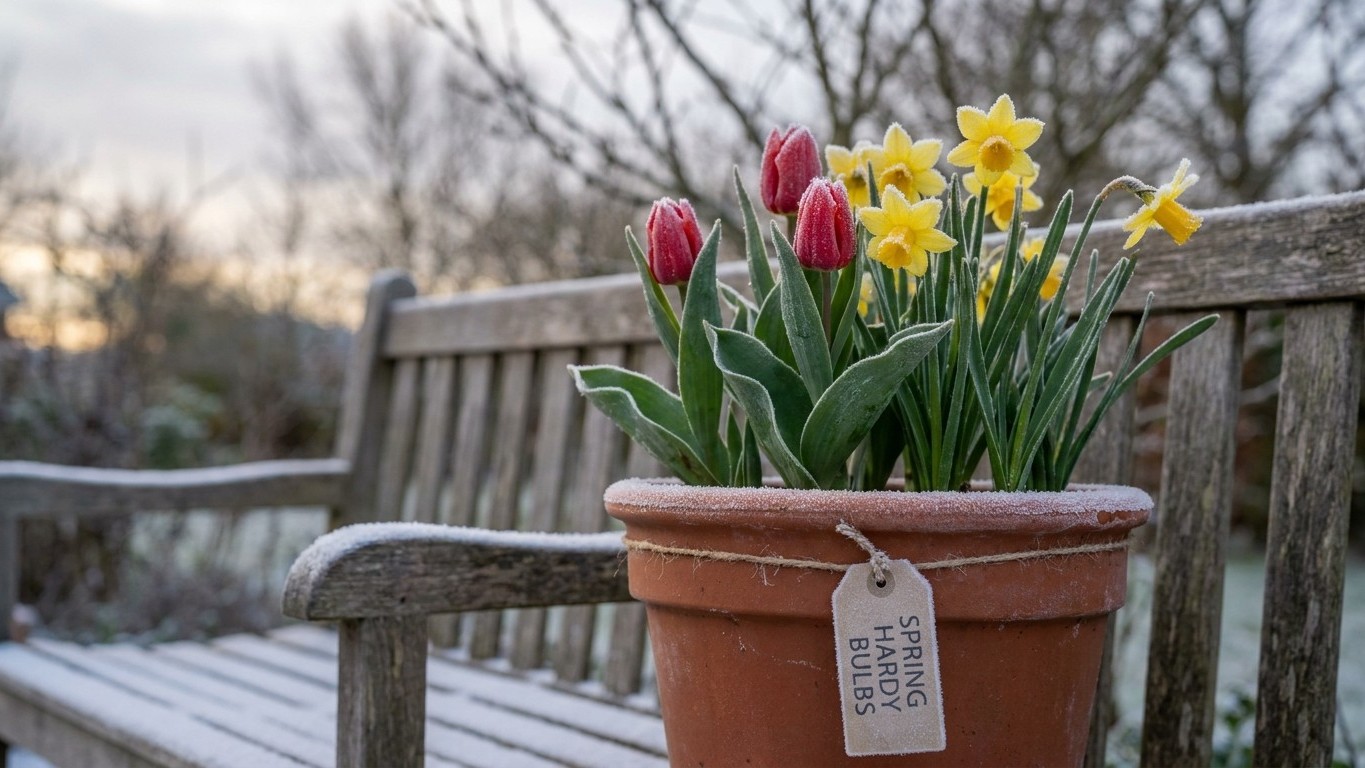

Nebraska’s Spring Bulbs in Containers face a threat that has nothing to do with cold being scarce and everything to do with cold being uncontained. The state’s winters (Omaha’s coldest month averages a minimum of 15.2°F, per NOAA NCEI’s 1991-2020 climate normals) already deliver more chilling than a tulip or daffodil needs. The real risk is a pot freezing solid, roots and all, before the bulb ever gets the chance to bloom.
Why this matters in Nebraska

Start with the number that settles the question: 15.2°F. That’s the average daily minimum for the coldest month at the Omaha reference station, and it’s the figure that decides whether a bulb survives winter here at all, not the record low, not some vague seasonal average. A tulip, daffodil, crocus, or hyacinth needs roughly 12 to 14 weeks below 45°F to satisfy its chilling requirement and produce a flower stalk the following spring. At an average minimum of 15.2°F running through the coldest month, Nebraska delivers that requirement several times over. Forcing, the practice of manufacturing cold artificially because winter won’t provide it, simply isn’t the issue here the way it would be in a state where January stays in the 50s.
The problem is the opposite kind of cold: too much of it, applied directly. USDA lists Nebraska under a 4a-5b range on the Plant Hardiness Zone Map (2023 edition, built on 1991-2020 normals), and that’s a statewide spread, not one number, so a gardener in the Panhandle is working with different lows than one near the Missouri River. Omaha sits toward the milder end of that range, and even there, a bulb rated hardy in the ground can die in a pot at the exact same outdoor reading.
The mechanism is simple physics. In a garden bed, soil a few inches down stays buffered well above the air temperature because there’s mass around it holding heat. A container has no such buffer. Its soil volume is small and exposed on every side, sitting above grade on a patio, porch, or deck rail, so it tracks the ambient air temperature almost as fast as the air itself changes. A tulip that would coast through an in-ground Nebraska winter without complaint can have its root zone frozen through in a pot during the same cold snap. That’s the situation this territory actually presents: not a shortage of chill, but an unshielded delivery of it.
How to do it here
The steps below split into two paths: bulbs chilled naturally outdoors in their pots, and bulbs chilled deliberately for an indoor winter bloom. Both rely on the same 12 to 14 week window below 45°F; only the location of that cold changes.
- Decide the goal first. A pot left outdoors on a porch all winter uses Nebraska’s own cold. A pot destined for a windowsill bloom in January needs its chilling manufactured indoors before it ever sees a warm room.
- For outdoor containers, plant the bulbs, water once, then move the pot into an unheated garage that stays above freezing rather than leaving it exposed on a deck. An unheated garage still swings cold enough to satisfy the chilling requirement without the wide freeze-thaw extremes an exposed pot experiences.
- For indoor forcing, plant the bulbs in the pot and set it in a refrigerator drawer for the full 12 to 14 weeks, kept away from ripening fruit. Fruit gives off ethylene gas, and ethylene kills the flower bud developing inside the bulb before it ever emerges.
- Check the container’s hardiness margin against Omaha’s 4a-5b range. Because a pot has no soil mass to buffer temperature swings, choose a bulb rated at least two USDA zones hardier than what the ground calls for, or plan to move that pot into shelter once outdoor lows approach the mid-teens.
- If moving isn’t practical, bury the pot to its rim in mulch, straw, or leaf litter against a foundation wall. That mimics the insulation an in-ground planting gets for free.
- Once the chilling period ends, bring the pot into gradually warmer, brighter conditions over a week or two rather than straight into full sun and heat. A sudden jump in temperature stresses the emerging shoot.
- Water sparingly through the whole process. A dormant or chilling bulb rots faster from soggy soil than it ever does from cold alone.
Which bulbs are worth it
Not every bulb earns its space in a pot. The ones with a short chilling requirement and a low, compact growth habit handle container life well; tall or slow-to-flower types tend to disappoint or physically tip over once they’re in bloom. It also helps to remember that many large hybrid tulips are effectively a one-season purchase in Nebraska’s heavier clay soils anyway, since they rarely rebloom with the same vigor a second year. Forcing them, or growing them purely for one container season, costs nothing in the long run because they weren’t coming back regardless.
- Crocus, short cold requirement, low stem height suited to shallow pots
- Grape hyacinth (Muscari), reliable, compact, tolerates container life for multiple seasons
- Species tulips (as opposed to large hybrids), shorter stems, better wind and top-heaviness tolerance in a pot
- Daffodils (Narcissus), dependable bloom, sturdy stems that hold up in containers
- Hyacinths, fast to force, strong fragrance, compact enough for small pots
Others fight the container format from the start:
- Tall Darwin hybrid tulips, prone to toppling once the flower head opens on a stem too heavy for a light potting mix
- Fritillaria, temperamental about moisture and cold timing, inconsistent in pots
- Large trumpet daffodils in small containers, root systems outgrow the pot faster than the bulb blooms
- Alliums, top-heavy seed heads that catch wind and tip a lightweight container
What goes wrong, and when you can still fix it
Leaves but no flower
Foliage comes up green and healthy, but no bud ever forms. That means the chilling period ran short, whether the pot spent too little time in the unheated garage or the refrigerator drawer got interrupted by a warm spell. There’s no rescue for the current bulb this season. Note how many weeks it actually got below 45°F, and give it the full 12 to 14 weeks next cycle.
A flower on a stem too short to see
The bud opens, but the stem barely clears the soil line. That’s a sign the pot was warmed too fast after chilling, before the stem had time to elongate. This season’s flower is what it is; cut it and enjoy it in a small vase. Next time, stretch the transition from cold to warm over a longer stretch instead of moving the pot straight into a bright, heated room.
Rot in the pot
Soft, dark bulbs or a sour smell in the soil point to drainage that never worked, whether from a pot without holes, a saucer that held standing water, or soil packed too dense to shed moisture. There’s no saving a rotted bulb. For the next round, use a pot with real drainage holes and a mix that drains fast, and hold off on watering during the chilling weeks unless the soil has gone fully dry.